What Does It Cost to Pay a Creator for Usage Rights?

By
Yong Suk Choi

Ask what it costs to pay a creator for usage rights and the answers come back as a range wide enough to be useless. That is not because the market is secretive. It is because usage rights are not a single product with a single price, and the question quietly contains a second one the contract has to settle first: what are you buying the right to do, where, and for how long?
Once those three are written down, the number stops being a mystery. Before they are written down, no honest answer exists.
Why is there no single price for usage rights?
Because a creator deal contains two payments, and usually only one of them appears on the invoice.
The content fee buys the work and one posting on the creator's own channel. Concept, shoot, edit, publish to their followers, leave it up for an agreed window. That is a finished, self-contained transaction, and it is the number most brands think they are negotiating.
The license buys everything that happens to that content afterwards. Your repost, your paid media, your product detail page, your retail screen, your email. It is a separate purchase with its own scope and its own clock, and it is the one that decides whether the asset you liked in week one is still usable in month six.
Brands routinely pay the first and assume the second. The discovery arrives at the worst possible moment, which is when a video is performing and somebody wants to put budget behind it.
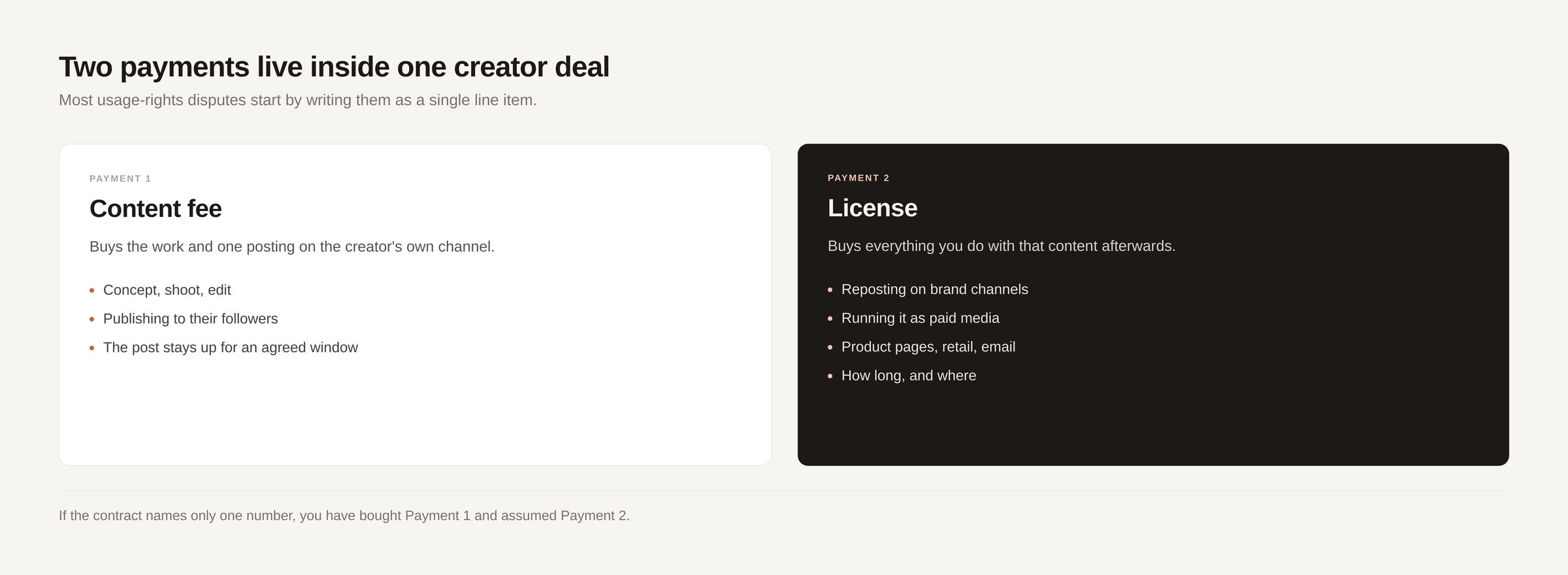
The content fee and the license are separate purchases. Writing them as one line is where most rights disputes begin.
What actually changes the number?
Four variables. Move any one of them and the price moves with it.
The channel list. Creator feed, brand organic, paid placements, product detail pages, retail screens, email and CRM are separate grants, not one bundle called digital. A grant written as "digital use" will be read narrowly on the day it matters, and the day it matters is always the day you need it most.
The term. Thirty days and perpetual are different products, not different sizes of the same one. Set a date range, and say what starts the clock. Tie it to the posting date rather than the signature date, because a shoot that slips three weeks otherwise eats three weeks of the license you already paid for.
Paid use. Three separate permissions hide under this heading. Boosting the creator's own post, running the asset from your brand account, and whitelisting, where the ad runs from the creator's handle, are not interchangeable. Name which one, and on which platform. Whitelisting in particular gives you the creator's identity as well as their content, and it is priced accordingly.
Exclusivity. This one is not usage at all. Asking a creator not to work with competitors removes future income, so it is priced as lost earnings rather than as extra rights. Define the category narrowly, keep the window close to the campaign, and expect it to be the most expensive line in the deal if you do neither.
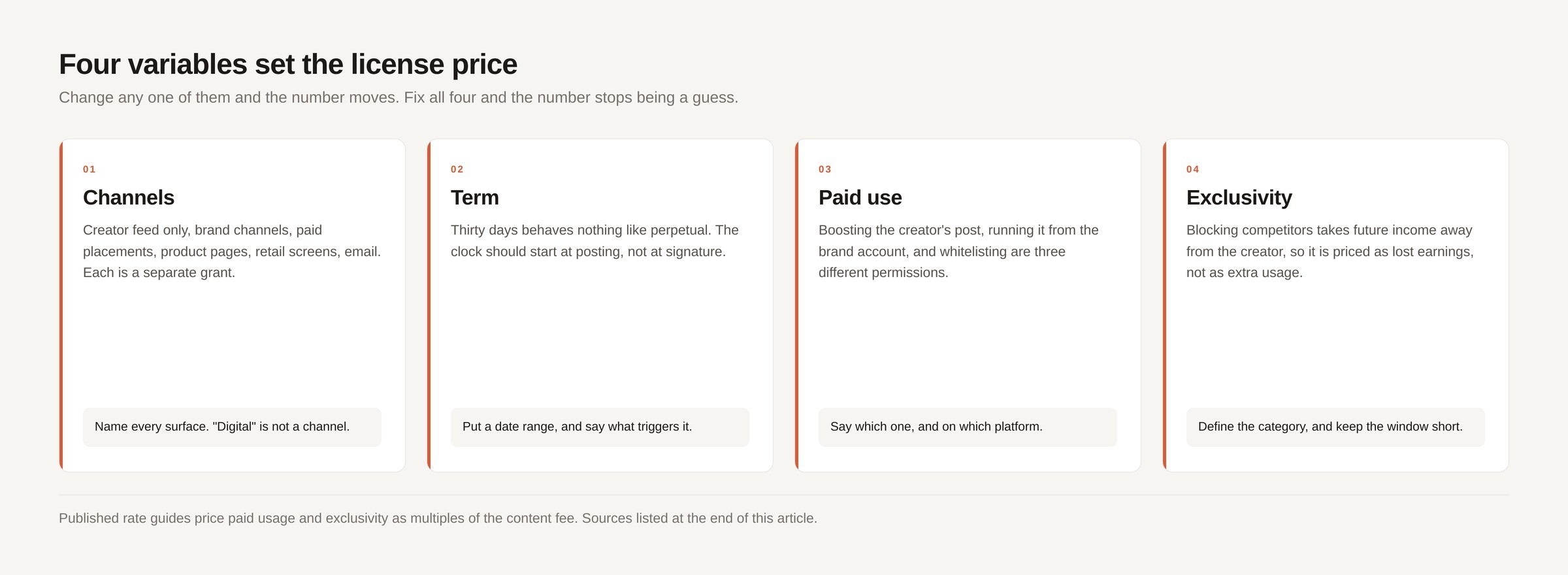
Four variables, priced together. Leave one undefined and either the creator prices the uncertainty, or you find out later you never bought it.
What do published rate guides say?
Published guides converge on multiples of the content fee rather than on flat prices, which tells you something about how the market actually works.
impact.com's guide for creators puts paid usage at roughly an extra 20 to 50 percent of the original content fee, moving with audience size, engagement, term, and where the content will run. UGC marketplace guides land in a similar place for paid social, commonly quoting 20 to 30 percent of base per month, with longer terms adding 50 percent and upward and perpetual buyouts sitting at the top of the range. Influencer Marketing Hub puts category exclusivity in a different bracket entirely, citing 100 to 200 percent of base when a creator agrees to block direct competitors.
Read those as orientation, not as quotes. They describe what independent creators and marketplaces publish. Tier, category, the creator's existing brand relationships, and how badly you want that particular face move the real number more than any published percentage does.
How should the license read in the contract?
Write it as a grid, not as a sentence. One row per surface, one column for the term, one column for whether editing is allowed on it. A sentence invites interpretation, and interpretation is exactly what you are trying to remove.
Three details do most of the work. Say what triggers the term. Grant or withhold re-edit explicitly, because trimming, adding captions, and cutting the footage together with other material are permissions, not conveniences. Price the renewal at signing, while you still have leverage, since negotiating an extension for an asset that is live and performing is a negotiation you have already lost.
One more line worth adding: an obligation to report back where the content ran. It costs nothing, and it is the difference between knowing your license is being honoured and hoping so.
Where does the money actually leak?
Four patterns account for most of it.
Buying perpetual and global when ninety days in one market would have covered the campaign. Paying for usage you cannot execute, because re-edit was never granted and a sixty second vertical you are not allowed to trim is not a paid media asset. Running exclusivity longer than the campaign it was meant to protect. And keeping no record of where the content ran, which turns a straightforward renewal conversation into an archaeology project, and leaves programs that require documented spend with nothing to document.
The clause that is not about price and still costs money
Disclosure. Under the FTC's Endorsement Guides, a brand that directs, finances, or benefits from an endorsement shares liability when disclosure fails. Hiring a creator does not move that exposure onto them. The expectation is that you give written disclosure guidance to every creator, put the requirement in the agreement itself, and check the content after it posts.
The civil penalty under Section 5(l) of the FTC Act currently stands at $53,088 per violation, set by the 2025 inflation adjustment and carried into 2026 without further change. In a campaign with dozens of posts, per violation is the part of that sentence that matters.
So what does it cost to work with us?
We price the content fee and the license separately, on the four variables above, because that is the only way a number stays true a month later. We do not publish a rate card in an article, since a figure without the grid behind it is not a quote. It is a guess that somebody will hold us to.
Tell us the channels you need, the term you need them for, and whether paid media is in scope. We will come back with the number and with the clause that supports it.
Sources: impact.com, How much to charge for usage rights; Influencer Marketing Hub, Organic vs paid usage rights; PitchBrand, UGC usage rights pricing and licensing guide; FTC, The Endorsement Guides: What People Are Asking; eCFR 16 CFR 1.98, Adjustment of civil monetary penalty amounts. Figures in this article are published market references, not BAZZAAL rates.
Related: what a creator contract has to include · what each creator tier actually buys · what seeding actually costs
Written by
Yong Suk Choi
Chief Business Officer
Chief Business Officer at BAZZAAL. 15+ years of zero-to-one go-to-market execution across Korean and US markets, now leading growth for K-beauty brands entering the US from Los Angeles and Seoul.
Connect on LinkedIn
Planning your US launch?
BAZZAAL runs creator seeding, TikTok Shop, and paid campaigns for K-beauty brands entering the US — from Los Angeles, in Korean-company workflows.
Subscribe to STATESIDE
Weekly US K-beauty intelligence, from our team on the ground in LA.


