US K-Beauty at the Half-Year Mark: Where the Numbers Actually Sit

By
Yong Suk Choi

First published August 22 with first-half data. Updated October 3 with the Ministry of Food and Drug Safety's third-quarter figures and the current US tariff rate.
Korea shipped $7.0 billion in cosmetics in the first half of 2026, up 27.3% year over year and the largest first half on record. The United States took $1.45 billion of it, or 20.7%. Through September the total reached $11.1 billion, already 97% of last year's full-year figure of $11.42 billion.
How much did K-beauty exports grow through Q3 2026?
Preliminary figures released October 2 put January to September exports at $11.1 billion, up 31.1%. The third quarter alone came to $4.17 billion, 7.5% above the second quarter's $3.88 billion.
The US took $2.35 billion, up 40.6%. That is more than nine points faster than the total, and the US share is 21.1%, the largest of any market. Skincare shipped to the US alone was $1.8 billion, up 48.8%.
China, by contrast, grew 0.4% to $1.58 billion, and its share fell to 14.2%. The US is not just growing with the category. It is taking share from other markets. Monthly data from the Ministry of Trade points the same way: August exports were $1.31 billion (up 52.1%) and September $1.51 billion (up 31.4%).
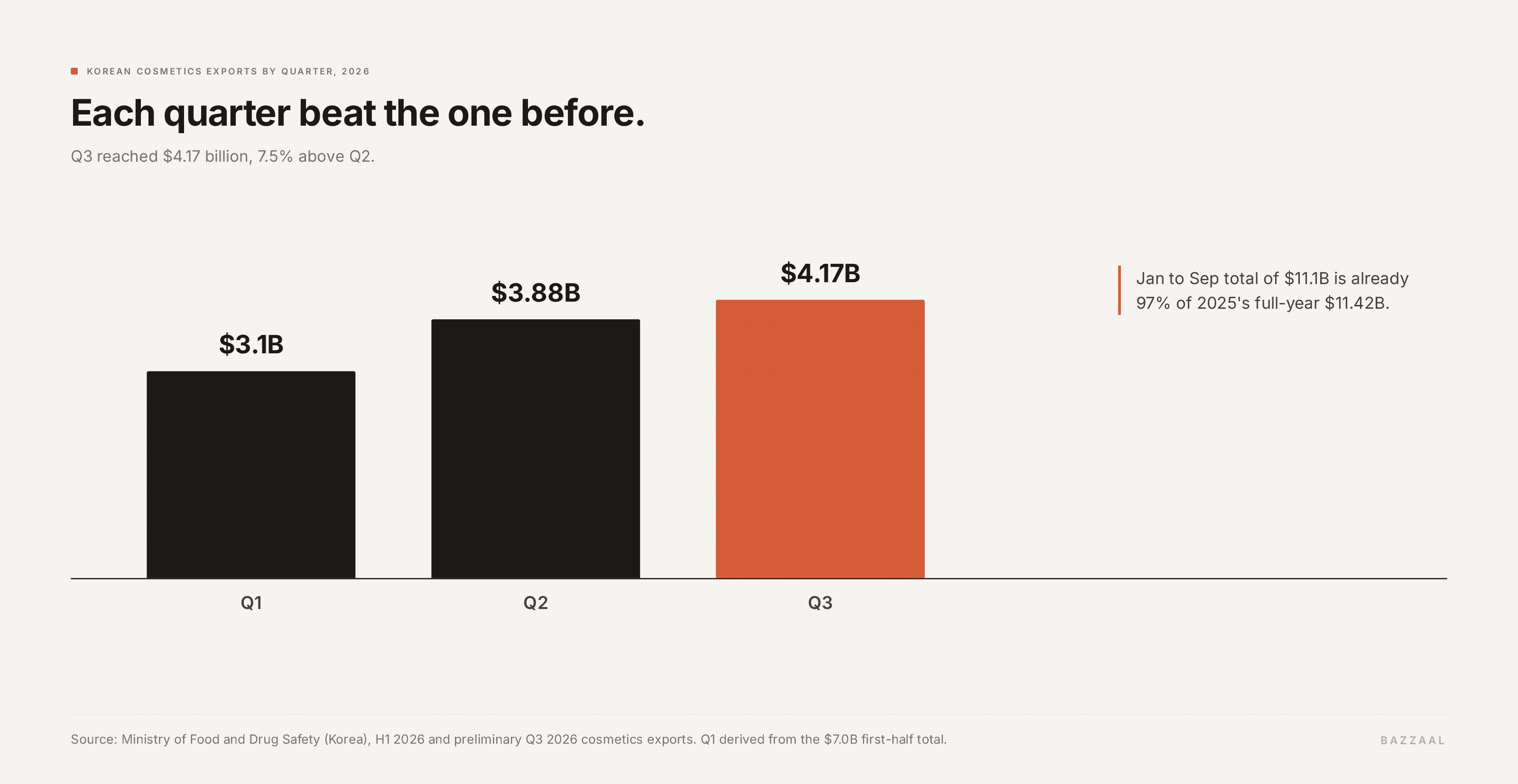
Q3 exports reached $4.17 billion. January to September is already 97% of last year's full-year total.
Is Europe becoming a second growth market?
Through September, exports to the UK reached $443 million (up 179.3%) and to the Netherlands $369 million (up 292.6%). Canada hit $285 million (up 124.4%). In dollars these are still about a fifth of the US, but they are growing much faster. For a brand deciding where to go after the US, the UK numbers are worth a close look.
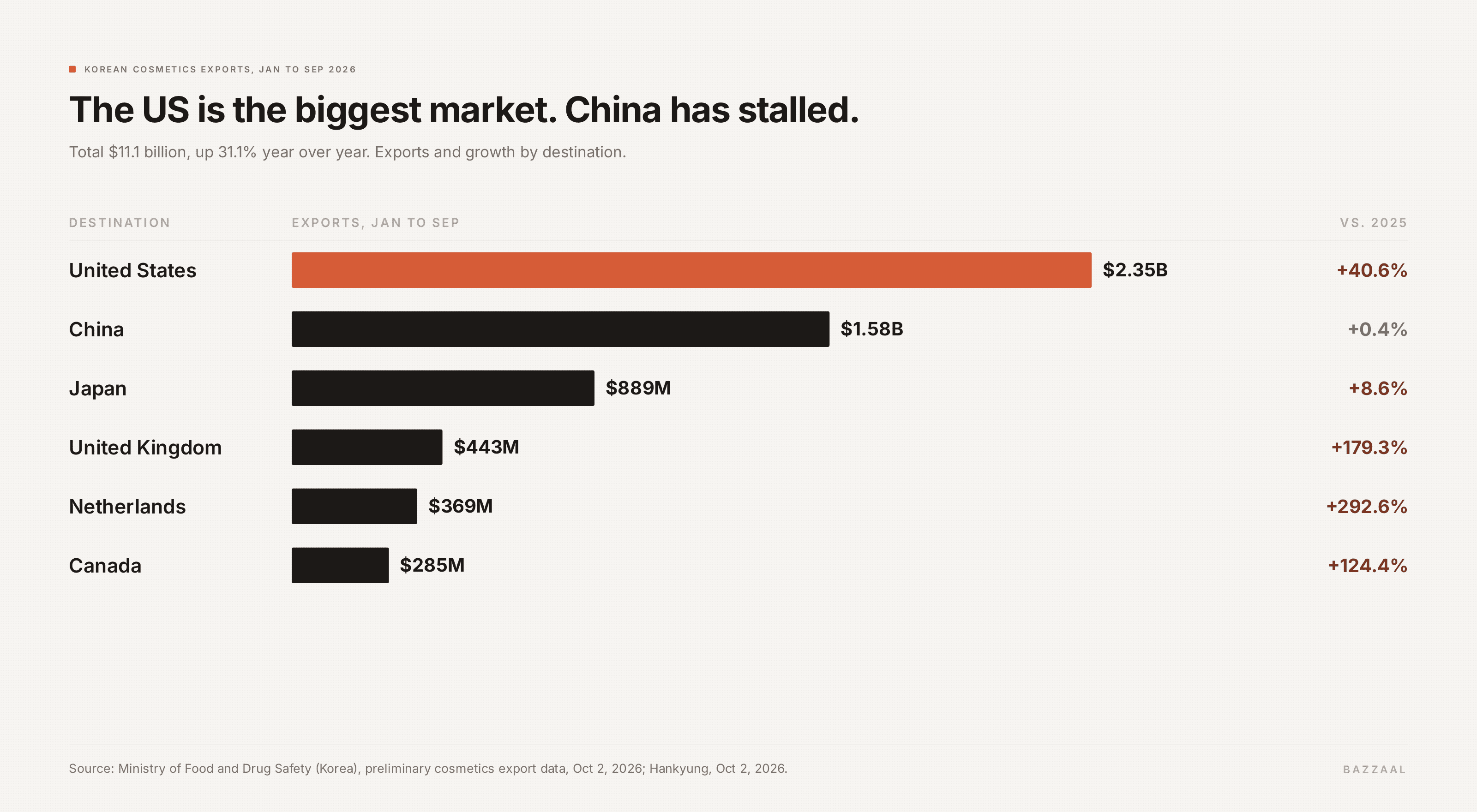
The US is the largest market by value. The UK, Netherlands and Canada are growing fastest.
Who picks the brands on Sephora and Ulta shelves?
On August 20, nineteen K-beauty brands chosen by Olive Young, about 150 products, went into more than 580 US Sephora stores and Sephora.com. Olive Young made the selection, based on sales and consumer response in Korea. As of early October, neither company has published sales results.
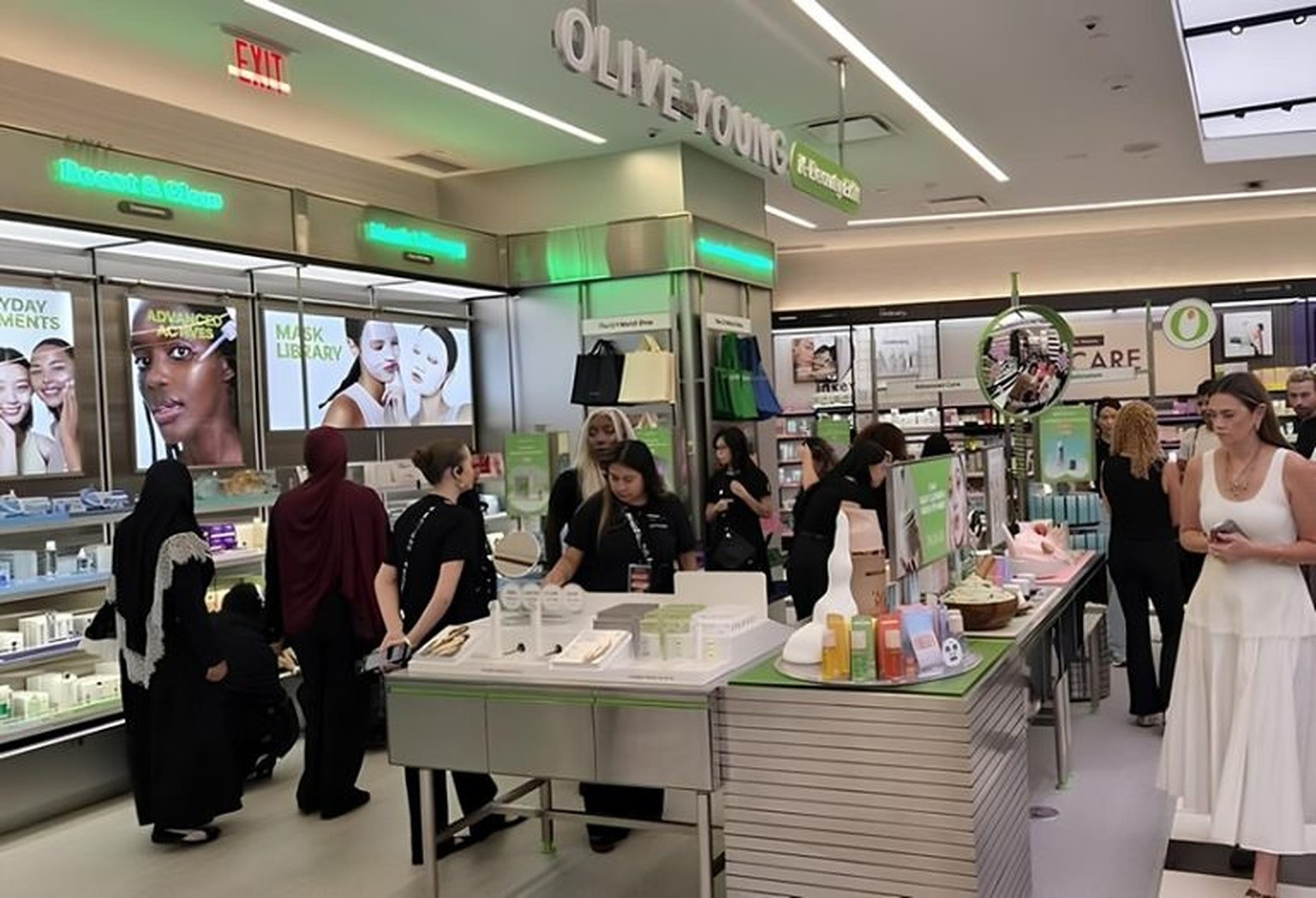
The OLIVE YOUNG K-Beauty Edit inside a US Sephora store.
Photo: CJ Newsroom
Ulta works differently. Its K-Beauty World, announced in March 2026, runs through Landing International on Ulta Beauty Marketplace and grew to seventeen brands by May. An online marketplace listing and a physical shelf need different preparation.
What is the US tariff on Korean cosmetics now?
12.5% in total, including the regular duty. The 15% reciprocal tariff from the 2025 US-Korea deal stopped being collected on February 24, after the Supreme Court ruled on February 20 that IEEPA does not authorize tariffs. A 10% Section 122 surcharge on all countries followed until July 23. Since July 24, a Section 301 action caps Korean goods at 12.5% including the MFN rate.
Most cosmetics under HS 3304 carry a 0% MFN rate, so the full 12.5% applies in practice. Exact classification and exemption lists can change the number, so confirm with a customs broker before you ship. When this article first ran in August it said 15%. The rate was already 12.5% by then, and we have corrected it.
12.5% is lower than 15%, but it is still well above the 0% Korean cosmetics paid before 2025. The tariff is paid before retail margin and before any marketing contribution a retailer asks for, so US pricing has to be rebuilt with all three in it.
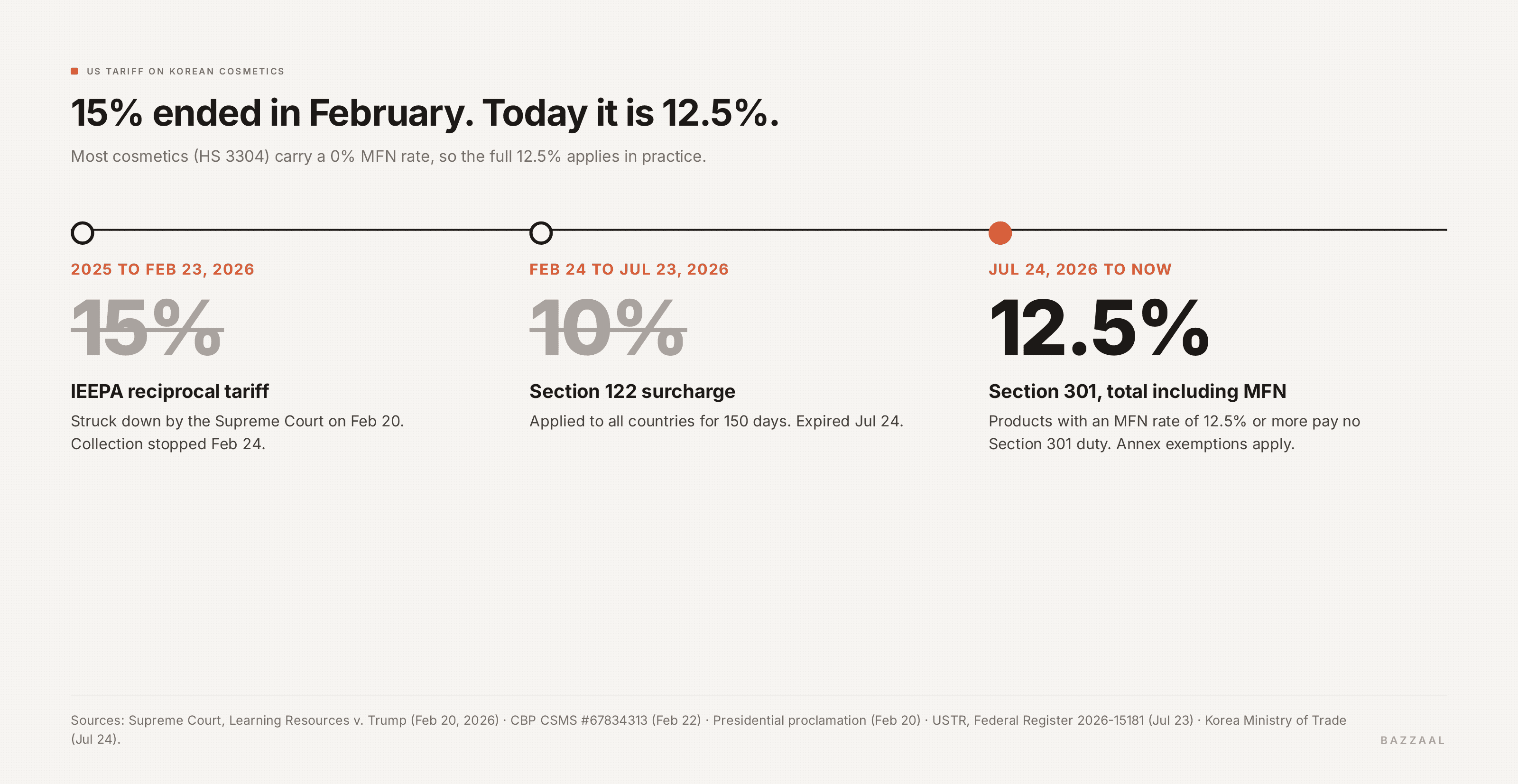
Both the 15% and the 10% have ended. Since July 24 the total is 12.5% including the MFN rate.
What should brands work out for the rest of 2026?
Through September, US demand has not slowed. What is left is execution. Find out who can get you onto Sephora or Ulta, and check that your price still works after 12.5% duty and retailer contributions.
"Who selects you" is not only a buyer question. When US shoppers ask an AI search tool about a product, the sources the engine picks become the answer. BAZZAAL measured 3,814 AI search citations in beauty and wrote up the results in Does AI Search Cite Brand Websites?
Sources: Ministry of Food and Drug Safety (Korea), cosmetics export releases for H1 2026 and preliminary Q3 2026 (October 2, 2026). Ministry of Trade, Industry and Resources (Korea), monthly trade releases (September 1 and October 1, 2026) and Section 301 briefing (July 24, 2026). USTR, Federal Register document 2026-15181 (July 23, 2026). Supreme Court of the United States, Learning Resources, Inc. v. Trump (February 20, 2026). US Customs and Border Protection, CSMS #67834313 (February 22, 2026). Presidential proclamation on a temporary import surcharge (February 20, 2026). Sephora Newsroom (August 4, 2026). CJ Newsroom (October 2, 2026). Hankyung (October 2, 2026).
Related: the system behind US growth · how much K-beauty sells on TikTok Shop · the first six months after you land
Written by
Yong Suk Choi
Chief Business Officer
Chief Business Officer at BAZZAAL. 15+ years of zero-to-one go-to-market execution across Korean and US markets, now leading growth for K-beauty brands entering the US from Los Angeles and Seoul.
Connect on LinkedIn
Planning your US launch?
BAZZAAL runs creator seeding, TikTok Shop, and paid campaigns for K-beauty brands entering the US — from Los Angeles, in Korean-company workflows.
Subscribe to STATESIDE
Weekly US K-beauty intelligence, from our team on the ground in LA.


