Does AI Search Cite Brand Websites? We Measured 3,814 Citations in Beauty.

By
Yong Suk Choi

Every agency in Korea is now selling the same AI search checklist: add schema, publish an llms.txt, rewrite your product pages as text. We spent a week reading the research behind those recommendations and running our own measurements on real K-beauty storefronts. Most of the checklist is either unproven or has already been tested and failed. The part that holds up points somewhere almost nobody is looking.
Four findings. The four-engine framing most teams use is out of date. Every AI crawler we tested already reads our site in full, so access was never the bottleneck. The tactics being sold have been reproduced under controlled conditions and mostly do not work. And in beauty specifically, brand-owned websites account for 2.4% of what AI engines actually read.
Which AI engines actually matter in 2026?
Ask most marketing teams which AI engines matter and you get ChatGPT, Gemini, Claude, and Perplexity. Pew Research surveyed 5,119 US adults in February 2026 and the ranking does not look like that.
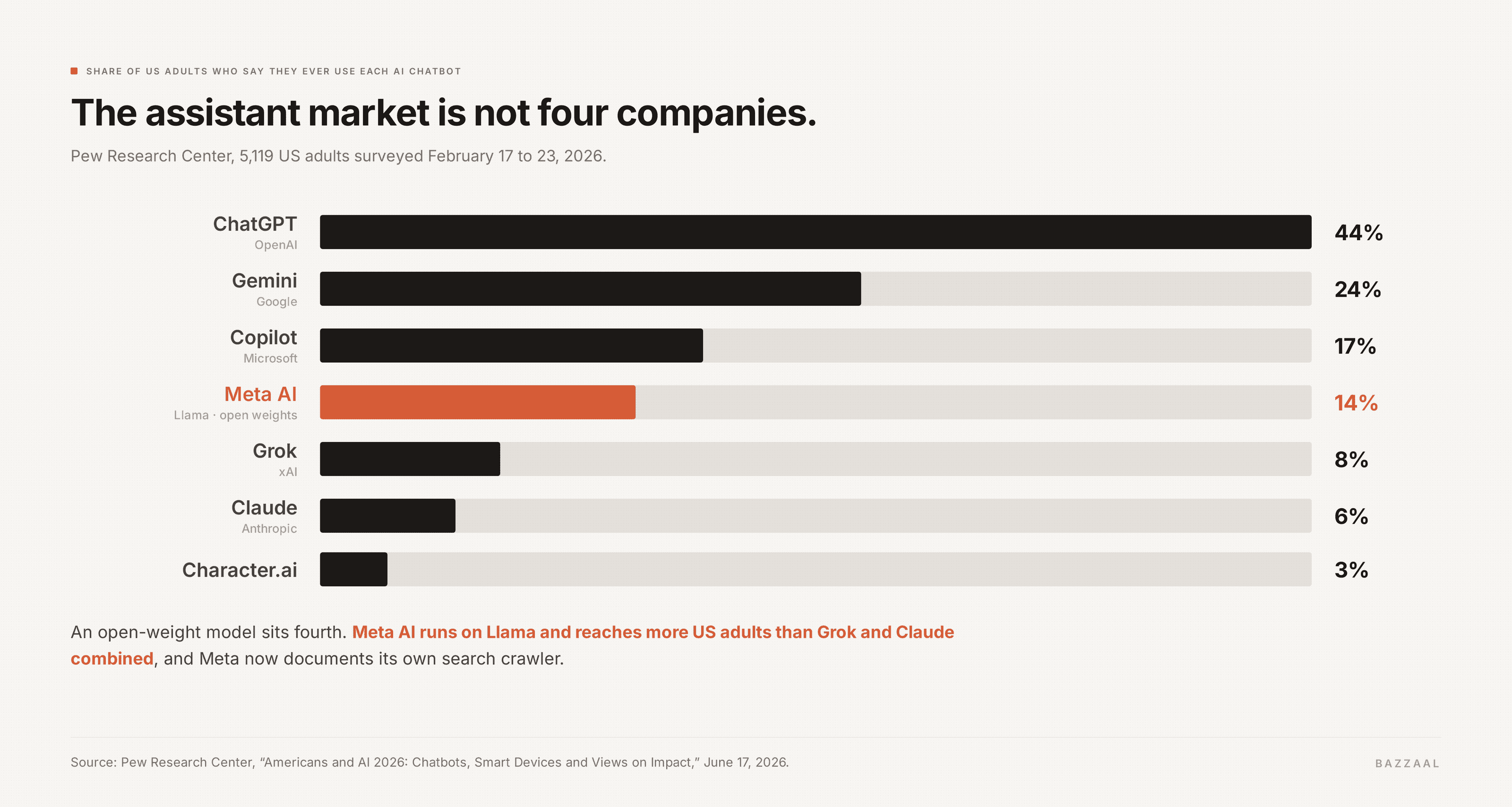
Meta AI runs on Llama, an open-weight model, and reaches more US adults than Grok and Claude put together.
This matters more than a ranking, because the open-weight side of the market is building its own retrieval. Mistral documents two crawlers, one for live answers and one for its own search index. Meta's crawler documentation now lists Meta-WebIndexer, described as crawling the web to cite and link content in Meta AI's responses. Alibaba runs TongyiBot for Qwen. Anthropic added Claude-SearchBot. OpenAI added a bot that validates ad landing pages.
So we asked them directly, fetching our own homepage with each operator's documented user-agent string.
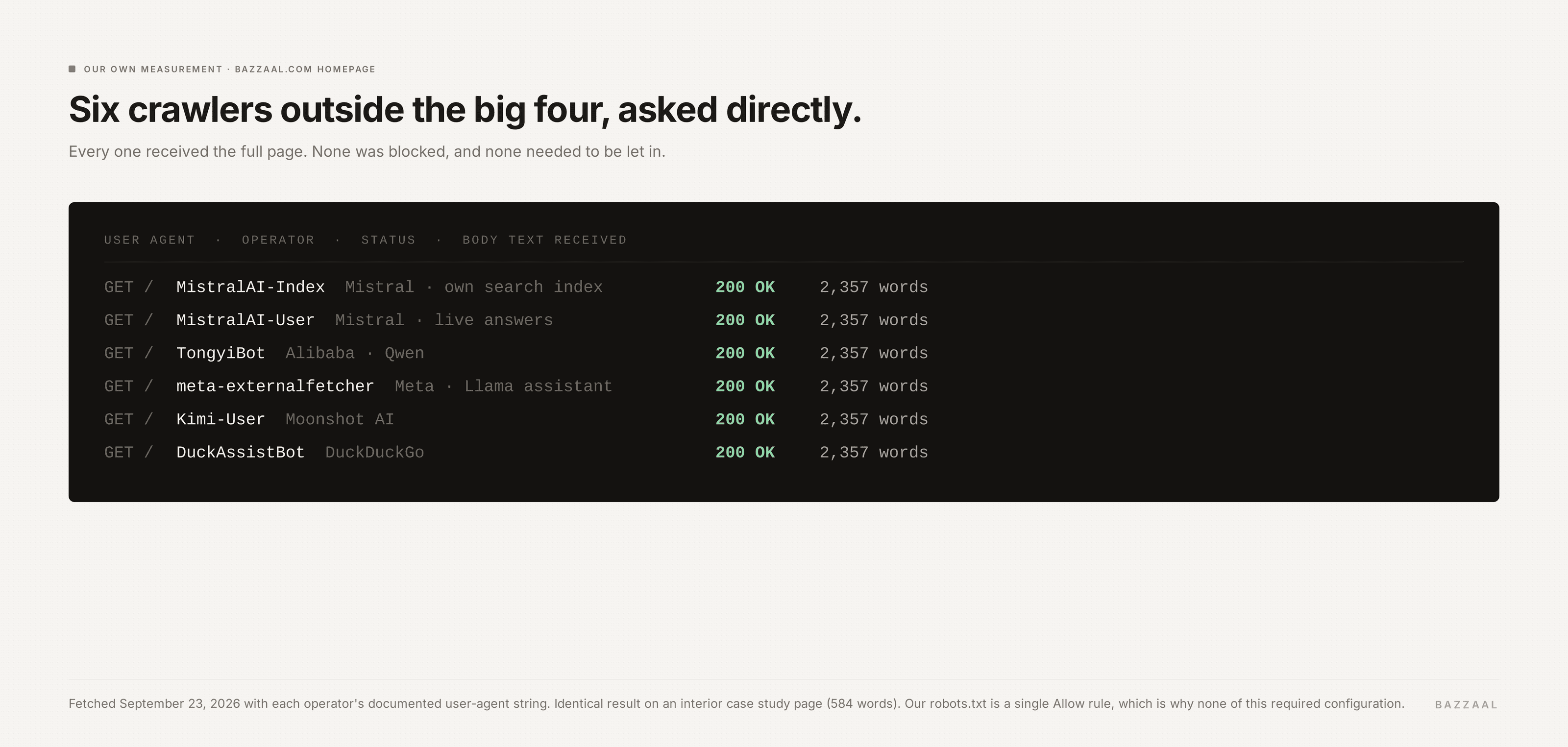
Same result on an interior case study page. Our robots.txt is a single Allow rule, which is why none of this needed configuring.
One caveat worth stating plainly. If a company self-hosts Llama, Qwen, or DeepSeek weights, that model does not see the web at all. Whatever search layer gets attached, usually Brave, Exa, Tavily, Serper, or Bing, decides what it can cite. There is no such thing as optimizing for Llama. Brave is the awkward case: its own documentation says its crawler deliberately does not advertise a distinct user agent, so you cannot confirm from your server logs whether you are in that index.
Do AI engines cite the same sources?
Access was never the hard part. Getting chosen is, and the engines barely agree on who to choose.
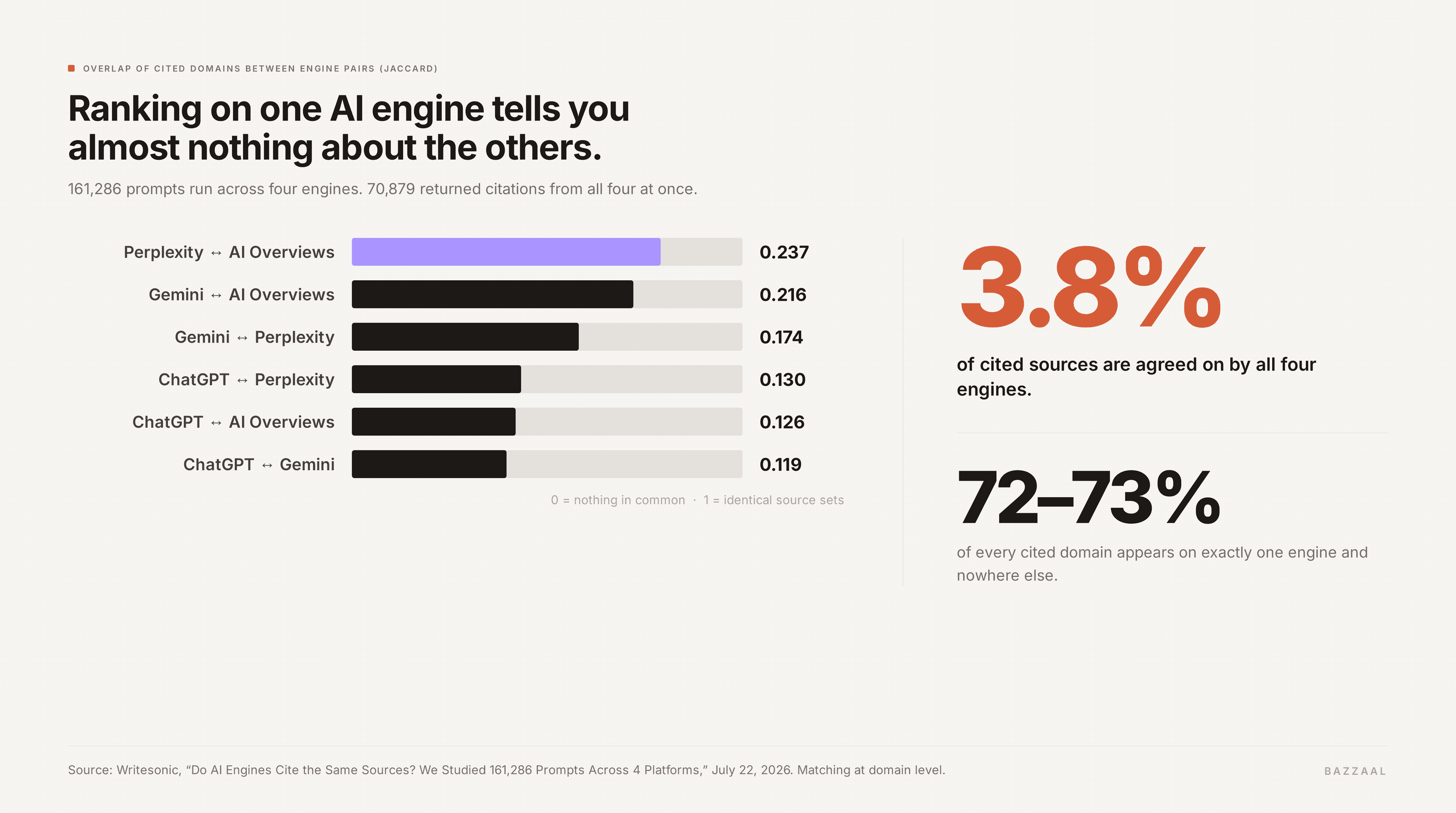
Writesonic ran 161,286 prompts across four engines. 70,879 of them returned citations from all four at once, which is the comparison set.
Read both sides together. The closest pair, Perplexity and Google AI Overviews, shares less than a quarter of its cited domains. ChatGPT and Gemini share 12%. Roughly three quarters of every domain cited anywhere appears on exactly one engine and nowhere else. A single blended AI visibility score is close to meaningless, and so is optimizing for one engine and assuming it carries. The ceiling on that assumption is 3.8%.
Does llms.txt work? Does schema improve AI citations?
This is the uncomfortable part, because we were about to implement some of it ourselves.
The original GEO paper says something different from what it is quoted as saying. Aggarwal and co-authors (KDD 2024) reported up to a 40% improvement, and that number now appears in every agency deck in Korea. It is not traffic. It is share of visibility redistributed among sources that were already retrieved into the top five. In the same paper, keyword stuffing moved the metric from 19.3 to 17.7, which is negative, and the authors explicitly dismissed an authoritative tone as showing no significant improvement. The widely quoted 115% belongs to the site sitting fifth in traditional search results. For the site sitting first, the same table shows a 30.3% decline.
When the tactics were reproduced under controlled conditions, they mostly vanished. C-SEO Bench (NeurIPS 2025 Datasets and Benchmarks) evaluated the published methods across domains and found only 3 of 54 cases statistically significant, and zero on question-answering tasks. Several methods significantly reduced rankings. The paper's own conclusion is that this behaves as a congested, zero-sum game, and that it complements rather than replaces traditional SEO.
Optimizing the body copy alone made things worse. SAGEO Arena (KDD 2026) built a corpus of 2,700 queries over 171,003 documents and measured each stage separately. Body-text-only optimization dropped retrieval by an average of 9%. Structural information helped retrieval a lot, 22% higher hit rate, but the reranking stage remained the bottleneck and structure did not convert into citations.
llms.txt is not read. Google's own guidance on generative AI features says, in a mythbusting section, that machine-readable files like llms.txt are not needed and that Google Search does not use them. Ahrefs then checked 137,210 domains: of the 28% that publish an llms.txt, 97% received zero requests for it in May 2026. Of the requests that did arrive, 96% were bots and 77% of those bots were not AI tools. We had already written ours. We deleted it.
FAQ rich results are gone. Google deprecated them on May 8, 2026 and removed the documentation on June 15, 2026. Bing separately said that clear headings, tables, and FAQ sections help it cite pages accurately, but that is about visible question-and-answer text on the page, not markup.
Are Korean product pages unreadable to AI crawlers?
Partly, and not where people assume. The widely shared version is about Korean detail pages being a single tall image that machines cannot read. One Korean industry study, published by Openads, says the team crawled 370 Korean direct-to-consumer sites and found that 65.5% had no sentence answering any of 50 common customer questions, with beauty the worst category at 86.2%. That is their claim and their methodology, not ours.
What we could verify ourselves is the US side, which is the side that matters for American shoppers. We pulled three product pages each from five K-beauty US storefronts and fetched them the way an AI crawler does, over plain HTTP with no JavaScript execution.
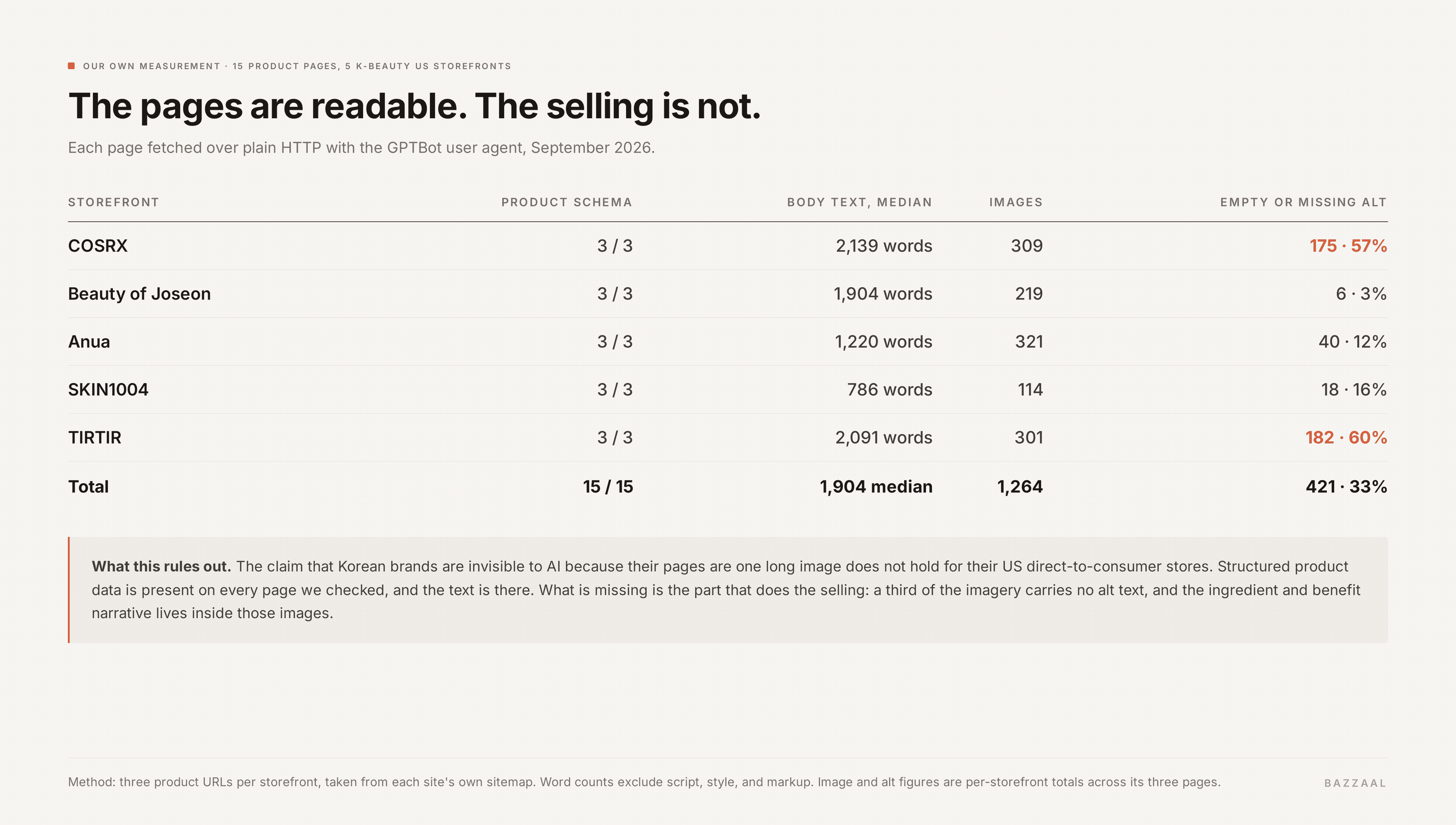
COSRX and TIRTIR leave well over half their imagery without alt text. Beauty of Joseon leaves 3%.
Structured product data was present on every single page. The text was there. What is missing is the part that does the selling, and on the pages we work on every day it is easy to show exactly what that costs.
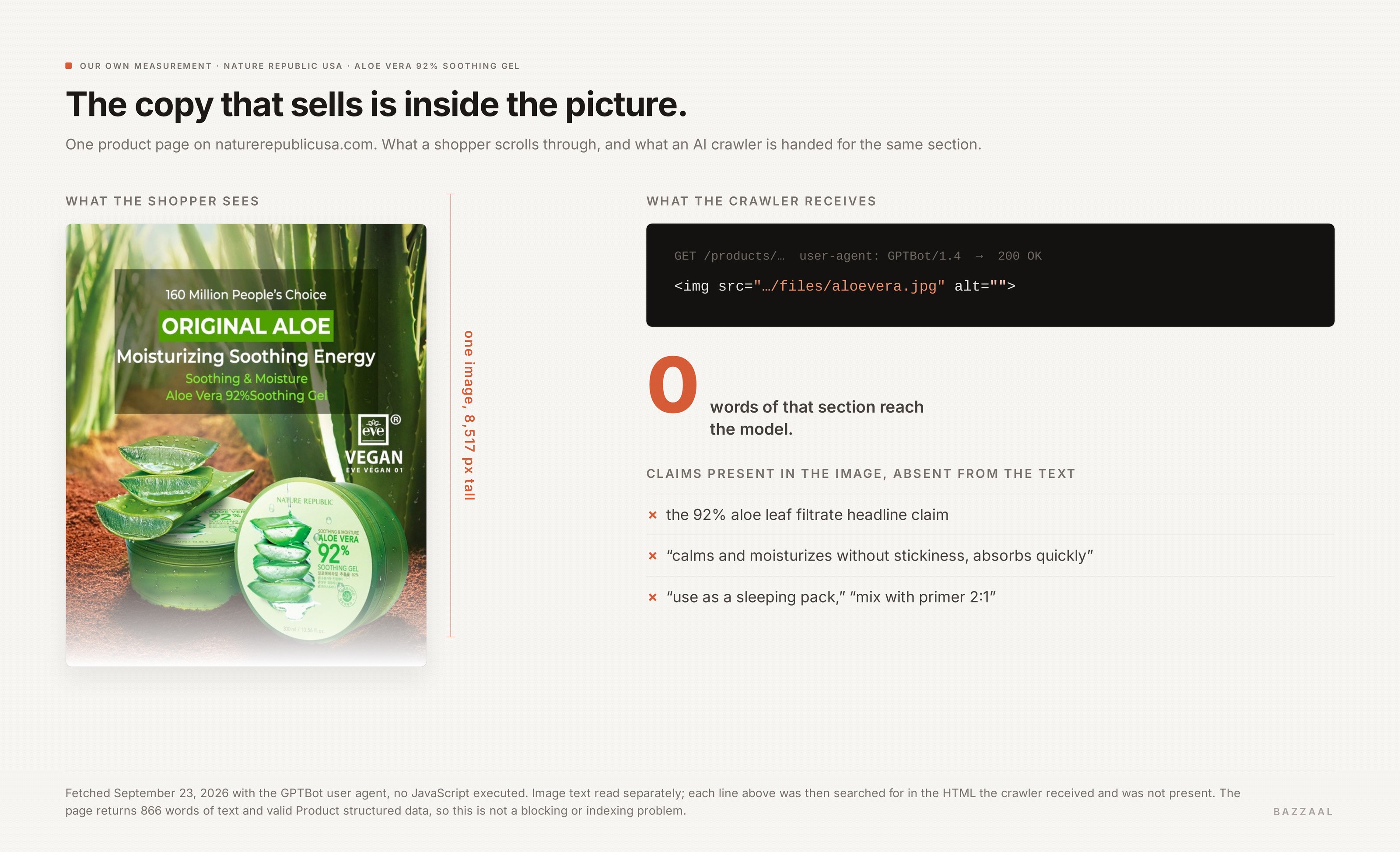
Nature Republic USA, Aloe Vera 92% Soothing Gel. The entire detail section is a single JPEG, 8,517 pixels tall, with no alt text. We read the text inside the image, then searched the HTML the crawler received for each line. The usage instructions and the headline concentration claim were not there.
On the Axis-Y Dark Spot Correcting Glow Serum page, the three panels that carry the argument are three separate images, each with an empty alt attribute. The phrase "Niacinamide 5%" appears in the artwork a shopper sees and nowhere in the 1,477 words the crawler receives. So does the clinical results panel. So does the how-to-use routine, which is the exact shape of question people bring to an assistant.
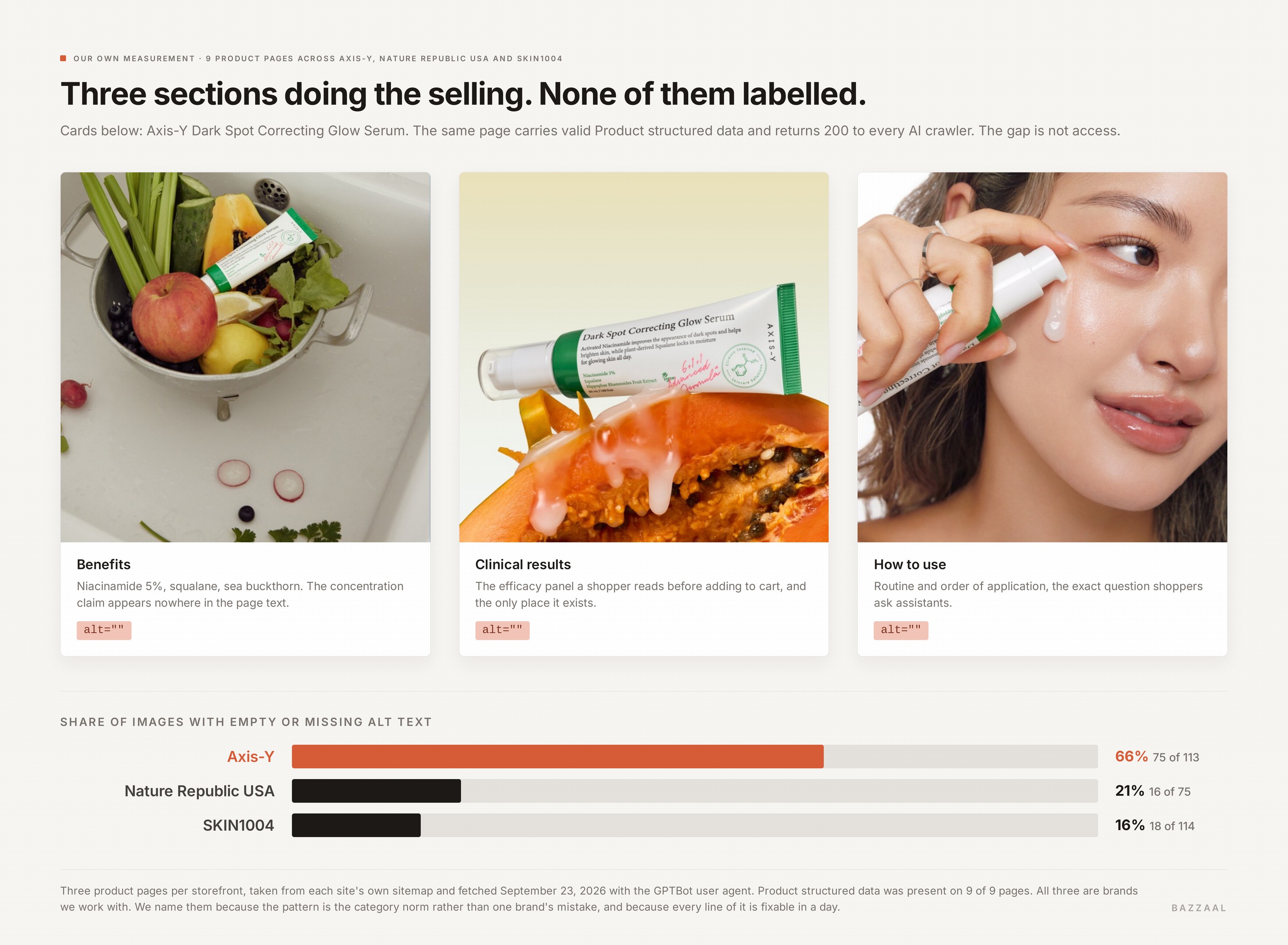
Axis-Y, Nature Republic USA and SKIN1004 are all brands we work with, and we name them because the pattern is the category norm rather than one brand's mistake. All nine pages carry valid Product structured data and return 200 to every AI crawler we tested.
That distinction is the whole technical story, and it has a hard mechanical basis. Vercel and MERJ measured their own network traffic and found that no major AI crawler executes JavaScript. GPTBot, OAI-SearchBot, ClaudeBot, PerplexityBot, and CCBot fetch HTML and parse it. Only Gemini and AppleBot render, because both ride on existing search infrastructure. Anything commercially important that only appears after a script runs is invisible, and any claim that lives only inside a JPEG is invisible too.
There is at least one Korean case with published numbers on the other side of this. Pulmuone said in September 2026 that it restructured its official mall for generative engines, including a separate AI-only product catalog, and that comparing the four months before and after April 1, site visitors rose 2.3 times and purchases 7.4 times. Those are the company's own figures, reported in the trade press, not an independent audit.
What share of AI citations comes from brand-owned websites?
Here is the number that changed our own plan.
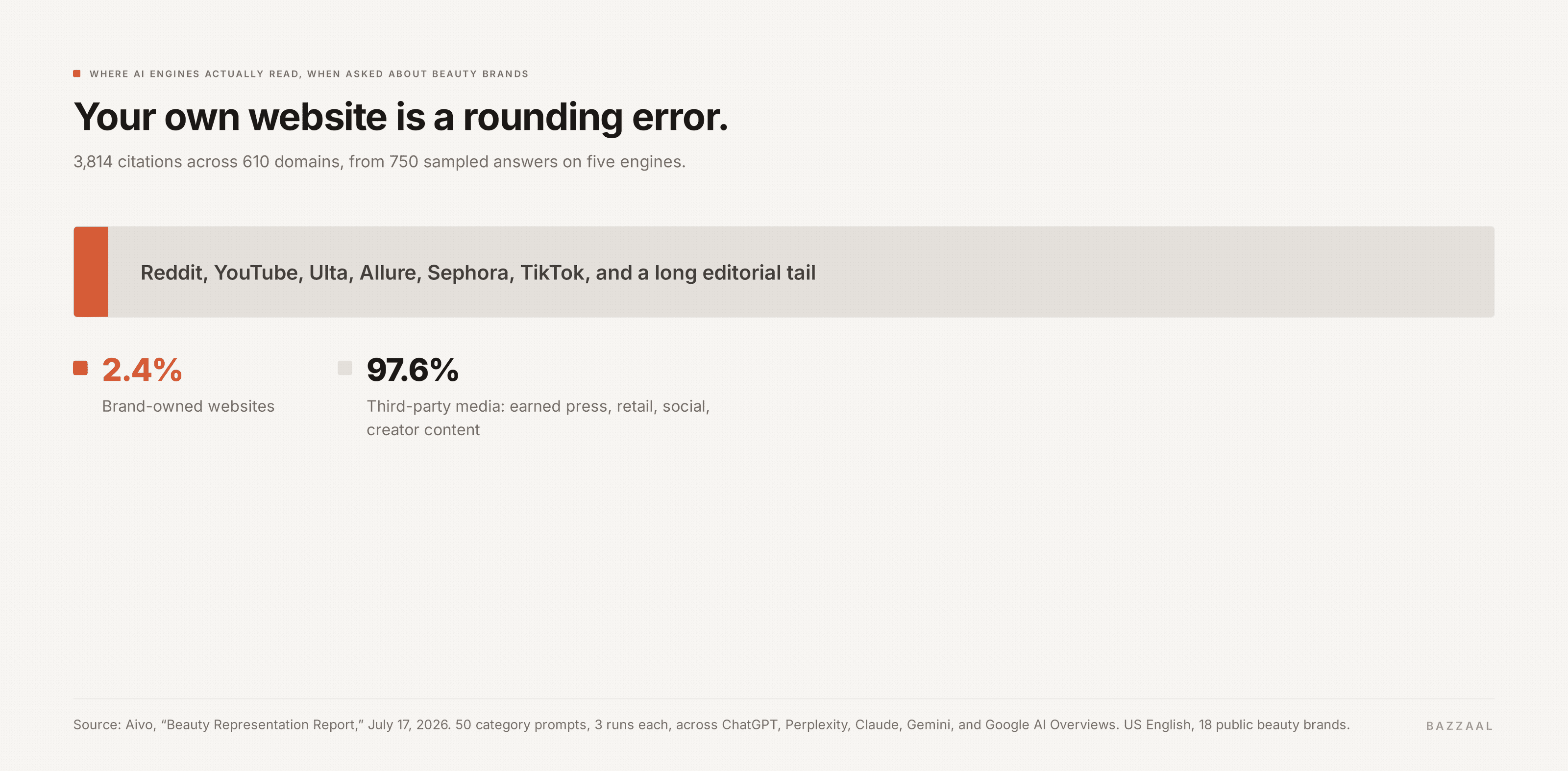
Aivo sampled 750 answers across five engines, 50 category prompts run three times each, on 18 public beauty brands.
Across 3,814 citations from 610 domains, brand-owned sites were 2.4% of what the engines actually read. The rest was Reddit, YouTube, Ulta, Allure, Sephora, TikTok, and a long editorial tail.
The same study found the per-engine spread is not noise. La Roche-Posay appears in 9.3% of Claude answers and 22.0% of ChatGPT answers, with confidence intervals that do not overlap. Revlon pools to around 4% across engines while sitting at 0.7% on Google AI Overviews. It also caught an engine confidently naming Dr. Bronner's as B Corp certified in all three runs, more than a year after the brand gave that certification up.
We want to be careful about what this does and does not prove. Nobody has published a controlled experiment showing that creator seeding causes AI citations. What is measured is where the engines read, and they overwhelmingly read third-party surfaces. If your entire AI search budget is going into your own domain, you are optimizing 2.4% of the input.
Does traditional SEO still matter for AI search?
Traditional search position still matters, and the research says so directly. In C-SEO Bench, being in the first two positions remained significant across domains. Google's own guidance for AI experiences is mostly the old guidance: make sure the page returns a 200, is crawlable, and has indexable content.
Do not rebuild your business around AI referral traffic yet. SparkToro and Similarweb put US zero-click Google searches at 68.01% in the first four months of 2026, up from 60.45% in 2024, so the clicks really are disappearing. But the same analysis puts AI tools at under 1% of all referral traffic. Attention is moving faster than traffic.
And do not trust a single measurement. One arXiv paper from April 2026 argues visibility has to be treated as a distribution rather than a single-point outcome, because answers vary across runs, prompts, and time. Another from May 2026 audited 2,000 runs and found that simply prefixing a persona to the prompt dropped recommendation-set similarity by 0.12 to 0.20. Category leaders held steady at around 80% consistency. Mid-market brands saw up to 75% of the recommendation set swap out depending on who the model thought was asking. Most K-beauty brands entering the US are mid-market.
How should a beauty brand optimize for AI search?
Check the switch before optimizing anything. As of August 31, 2026, every Search Console property has a Search generative AI control under Settings. It defaults to include, but if it is set to exclude, your AI Overviews and AI Mode impressions are zero regardless of what else you do.
Put commercially critical content in the initial HTML response. Price, ingredients, claims, availability. If it only exists after JavaScript runs, assume no AI crawler outside Gemini and AppleBot will ever see it.
Write the alt text, and put the claim in text as well as in the artwork. For K-beauty this is the single highest-yield fix, because the benefit narrative is sitting inside image files that currently describe themselves as nothing.
Measure per engine, and do not buy a tracker yet. Bing Webmaster Tools opened AI Performance in February 2026, showing citation counts and the queries that grounded an AI answer in your page. Google rolled its generative AI performance reports out to all sites by August 31, 2026. Both are free and both are first-party.
Spend the rest on surfaces you do not own. Creator video, review threads, retailer pages, and editorial coverage are 97.6% of what the engines read in this category. That is not an AI tactic. It is the same earned-media work, aimed at a reader that now happens to be a machine.
Skip the llms.txt. Skip expanding FAQ schema.
Talk to us about US creator seeding →
Sources, in order of appearance: Pew Research Center, "Americans and AI 2026," June 17, 2026. Mistral, Meta, Alibaba, Anthropic and OpenAI crawler documentation, retrieved September 23, 2026. Brave Search API documentation. Writesonic citation overlap study, July 22, 2026. Aggarwal et al., "GEO: Generative Engine Optimization," KDD 2024. "C-SEO Bench," NeurIPS 2025 Datasets and Benchmarks. SAGEO Arena, KDD 2026. Google Search Central guidance on AI features and crawler documentation updated July 14, 2026. Ahrefs llms.txt study, June 15, 2026. Openads report, August 2026. Vercel and MERJ, "The rise of the AI crawler." The PR, report on Pulmuone, September 22, 2026. Aivo, "Beauty Representation Report," July 17, 2026. SparkToro and Similarweb zero-click study, June 2026. arXiv 2604.07585 and arXiv 2605.30207. Product page measurements, crawler fetch tests, and the detail-section audits are our own, run September 2026. Product imagery is from the brands' own storefronts.
Related: why category beats origin · creator seeding at scale · selling K-beauty on TikTok Shop in the US
Written by
Yong Suk Choi
Chief Business Officer
Chief Business Officer at BAZZAAL. 15+ years of zero-to-one go-to-market execution across Korean and US markets, now leading growth for K-beauty brands entering the US from Los Angeles and Seoul.
Connect on LinkedIn
Planning your US launch?
BAZZAAL runs creator seeding, TikTok Shop, and paid campaigns for K-beauty brands entering the US — from Los Angeles, in Korean-company workflows.
Subscribe to STATESIDE
Weekly US K-beauty intelligence, from our team on the ground in LA.


