How Many Creators Does a US Seeding Campaign Need?

By
Yong Suk Choi

How many creators does a US seeding campaign need? Before you pick a number, decide which product to highlight and how, then check whether US shoppers already show interest in it. Headcount comes last.
BAZZAAL runs seeding for K-beauty brands from Los Angeles. This guide starts from the result you want and how many pieces of content it takes, before any headcount. Below is what we check first, and how we then match 100, 300 or 1,000 creators to that goal.
In short
Before you pick a headcount, check the product, the angle you will highlight, and your US signals.
Work backward from the result you want. Divide the content you need by the recovery rate, which is about 70% in BAZZAAL's tally and is not a guarantee.
Experience with the creators matters more than the size of the pool.
What does seeding tell you?
Seeding means sending product to creators with no fee. They try it and post if they want to. You get content, and you also see how US shoppers react to the product.
At BAZZAAL, creators apply, we screen them, the brand approves, and then we ship. Product goes only to creators who have said they want it, so we never mass-mail.
Seeding works as a test as well as sampling. You find which product, content and creators get a response, then extend what works into paid collaborations and affiliate.
How do you check for US demand?
Product-market fit (PMF) has several well-known tests. We sorted them into three stages for beauty seeding. The grouping is ours, built from public sources, and is not an industry standard.
Stage 1, search. Check US Google Trends for the product name and key ingredient. Trends only shows relative popularity within a region and time range, so you get direction and no absolute volume. US shoppers also search the category more than any one brand. In ListeningMind's July 2026 analysis, the topic "Korean" drew 1,387,025 searches a month, 3.3 times Medicube (419,978), the largest Korean brand. Read product-name searches next to category searches.
Stage 2, purchase. Track how fast Amazon US reviews pile up, the rating, TikTok Shop sales, and US orders on your own site. Amazon's best-seller score comes from rank, so it does not measure revenue.
Stage 3, repeat and word of mouth. Look at repeat purchases and at unpaid mentions from US creators and on Reddit. The Sean Ellis test asks users how they would feel if they could no longer use the product, and 40% or more answering "very disappointed" counts as PMF. It was built for software, so treat it as a rough reference for beauty.
Marc Andreessen puts it plainly. If customers buy as fast as you can make the product, you have PMF. If word of mouth stalls and sales cycles drag, you don't yet.
With Stage 1 only, run a small first round and read the response. From Stage 2 on, you have a reason to scale.
Which product should you highlight, and how?
Pick one product and decide the angle. The best source for the angle is the wording in US buyers' own reviews, since what they praise is what works there.
What sells in Korea and what US shoppers worry about can differ. In the ListeningMind data, US searches ranked wrinkles first, then blackheads, then dark circles. One study found that posts announcing a new launch weaken the effect (Leung and colleagues, Journal of Marketing, 2022), though it covers influencer posts in general and not seeding.
So write the brief as "this product for this concern" instead of "a new product is out." SKIN1004 showed its toner, ampoule and cream as one routine.
How many products should you send?
Work backward from the result: sales, then conversion, then content, then creators, then seeding. Sending to the same 500 creators calls for a different scale depending on whether the goal is UGC, finding top-performing creators, or affiliate sales.
The recovery rate below covers the step from content back to seeding. Conversion varies by brand, so measure it yourself.
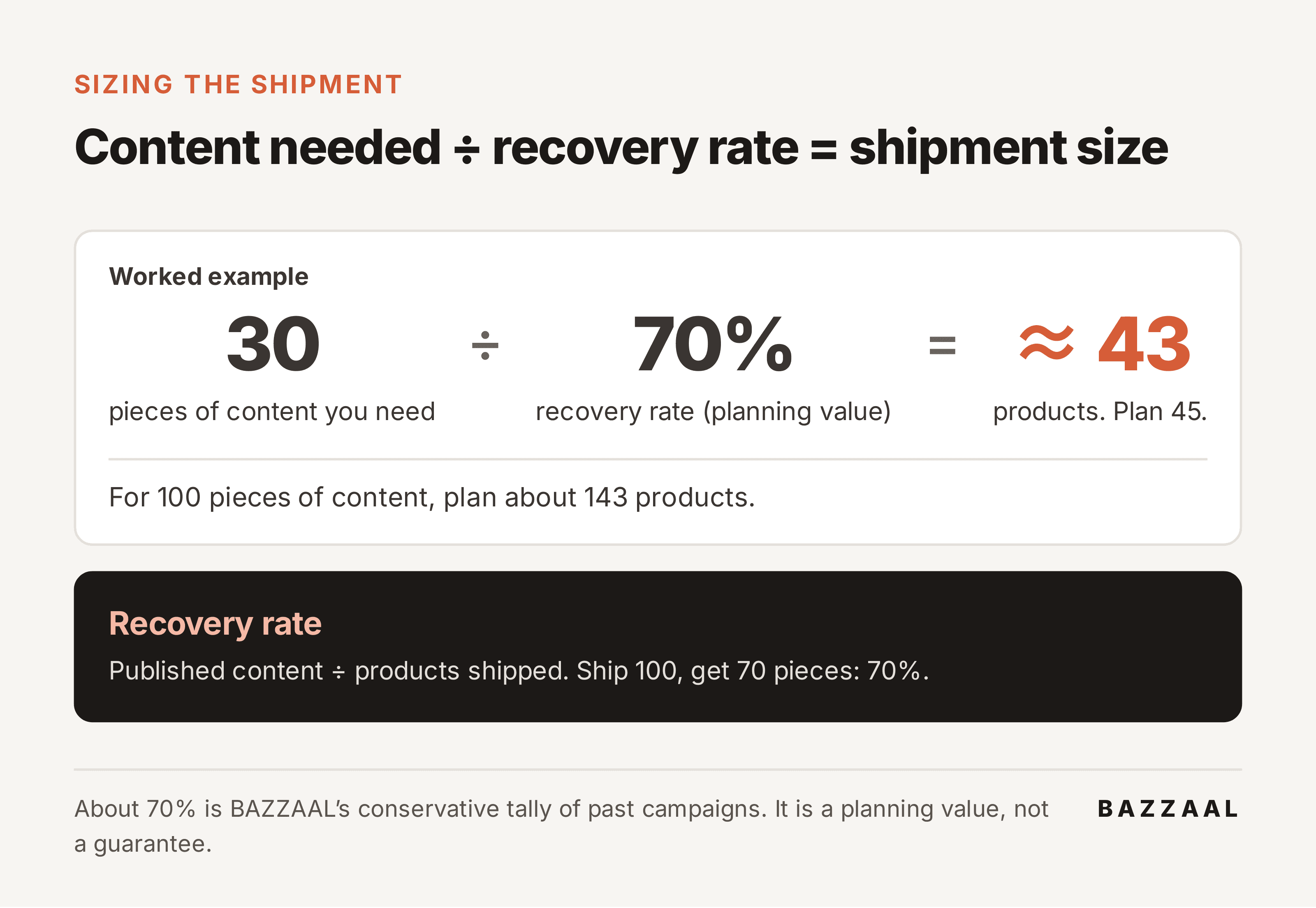
Divide the content you need by the recovery rate. The recovery rate is the share of shipped products that come back as published content: ship 100, get 70 pieces, and it is 70%. Across past BAZZAAL campaigns, a conservative figure is about 70%.
For 30 pieces of content, 30 ÷ 0.7 is about 43 products, so plan 45. For 100 pieces, plan about 143. Use 70% for planning only. It is not a guarantee.
Does the recovery rate change by category?
Yes. We expect K-beauty to land at 70% or higher, and other B2C categories may come in lower.
A recent innerwear campaign also passed 70%. We will publish it as a separate case study.
What do 100, 300 and 1,000 creators get you?
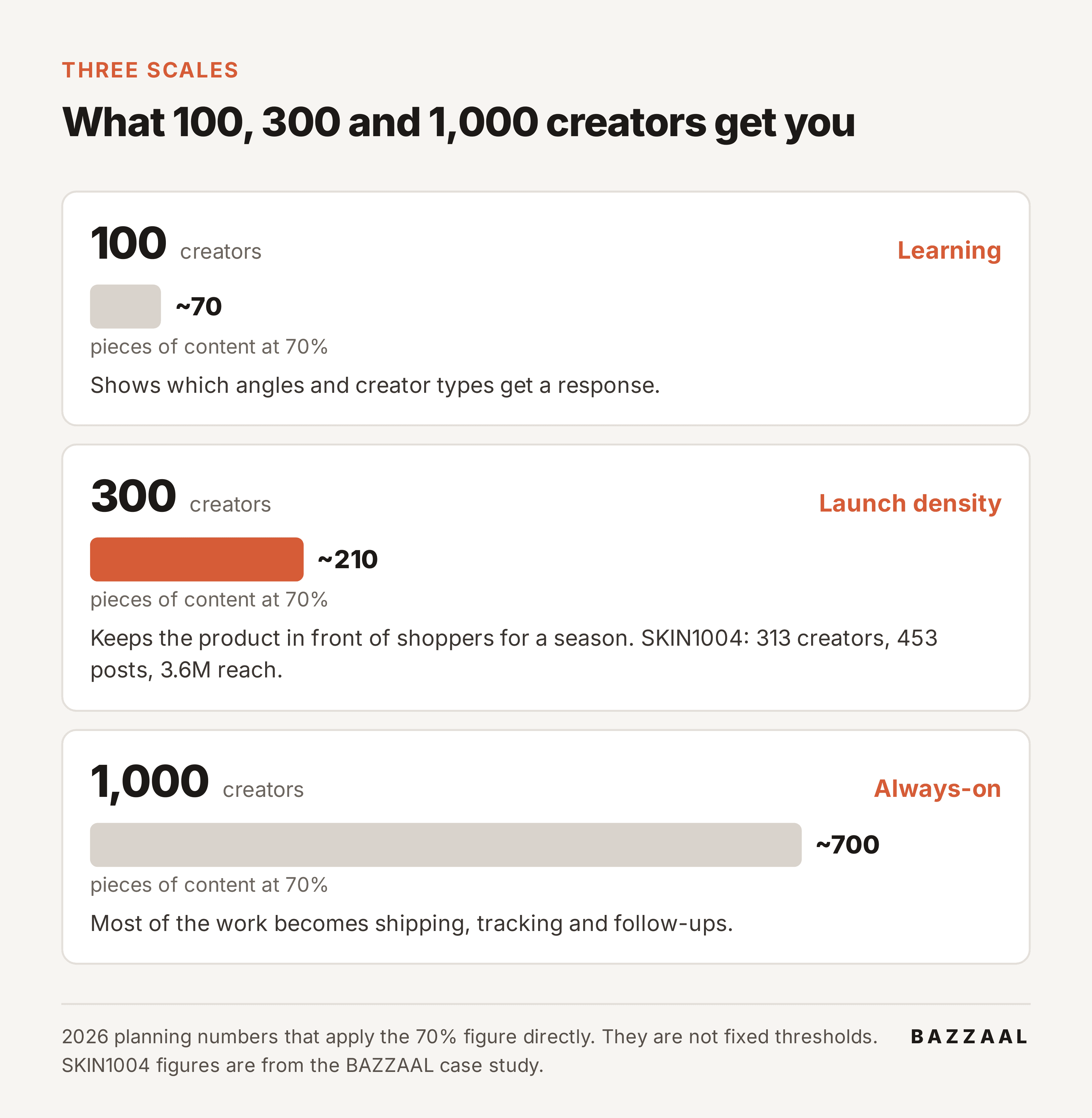
Treat these as examples tied to a goal, not fixed thresholds. They are 2026 planning numbers that apply the 70% figure directly. The same headcount means something different when the goal changes.
100 creators is for learning. About 70 pieces of content show which angles and creator types get a response. Start here if you are still at Stage 1.
300 creators gives you launch density. About 210 pieces of content keep the same product in front of shoppers for a season. In spring 2026, 313 SKIN1004 creators posted 453 posts over about two and a half months, reaching 3.6 million people.
1,000 creators means always-on seeding. It targets about 700 pieces of content, and most of the work becomes shipping, tracking and follow-ups. SKIN1004 grew from 50 to 60 creators a month to monthly lists of about 400 in 2025 and 2026.
In MEDIHEAL's Prime Day seeding, eight featured posts passed 1.25 million views with no paid media. One of them had 493,000 on its own. You can't predict which post will take off, so send more than the target. Pew Research found that the top 10% of videos on popular YouTube channels took 79% of all views. That is 2019 YouTube data, so use it only as a general pattern.
Does a bigger creator pool get better results?
Many agencies and platforms have bigger pools than ours. What matters is whether they have worked with these creators and know them. BAZZAAL's 100,000+ creators counts only people we have contacted and run campaigns with.
A 70% from a list of strangers and a 70% from creators an agency knows are not the same number. Before you ask any agency about pool size, ask whether it has worked with these creators.
What about timing and content usage rights?
Start onboarding six weeks before the campaign. Creator applications, brand approval and shipping take that long.
Seeding posts cannot be reused in ads by default. If you need ad creative, hire paid creators or sign a separate usage-rights agreement.
In unpaid seeding, freshness and continuity matter more than volume. Send to new creators at a steady interval instead of one large batch.
Will this calculation hold in 2027 or 2028?
The 70% may change as platform policy and shopper behavior change. The order of the steps will not.
Check the product and the signals, set a content target, then divide by your own recovery rate. Measure that rate over your first two campaigns and use it in place of our default.
Questions to answer before you decide how many to send
Which product will you show, and from what angle?
In the US, have you confirmed that people look, buy, or buy again?
What result do you want from this campaign, and how many pieces of content does it take?
What recovery rate did you assume, and where does it come from?
Who has actually worked with these creators before?
FAQ
Is a 70% recovery rate guaranteed?
No. It is a conservative figure from BAZZAAL's past campaigns, and it varies by category and product signal.
Is 50 creators enough for a first US test?
It can answer one narrow question. Shipping 50 products at 70% gives about 35 pieces of content, which is too few to compare several hooks or creator types.
Is seeding free or paid?
Usually product only, with no fee. Paid usage rights and affiliate commission come later, once you see which creators and posts work.
Want help designing the product angle and the headcount together? Talk to BAZZAAL →
Sources: MEDIHEAL and SKIN1004 figures are from BAZZAAL case study pages. The roughly 70% recovery rate is BAZZAAL's internal tally of past campaigns and is not a guarantee. Leung, Gu, Li, Zhang, Palmatier, Journal of Marketing 86(6), 2022. Sean Ellis test: First Round Review, How Superhuman Built an Engine to Find Product-Market Fit. Andreessen, The Pmarca Guide to Startups, Part 4. Google Trends data FAQ (Google Help). ListeningMind US K-beauty intent data report (July 27, 2026). Pew Research Center, A Week in the Life of Popular YouTube Channels (2019).
Related: Creator Seeding at Scale: Why 100 Creators Isn't Enough Anymore · Creator seeding hub
Written by
Yong Suk Choi
Chief Business Officer
Chief Business Officer at BAZZAAL. 15+ years of zero-to-one go-to-market execution across Korean and US markets, now leading growth for K-beauty brands entering the US from Los Angeles and Seoul.
Connect on LinkedIn
Planning your US launch?
BAZZAAL runs creator seeding, TikTok Shop, and paid campaigns for K-beauty brands entering the US — from Los Angeles, in Korean-company workflows.
Subscribe to STATESIDE
Weekly US K-beauty intelligence, from our team on the ground in LA.


