How Do You Choose Creators for a US Seeding Campaign?

By
Yong Suk Choi

How do you choose creators for a US seeding campaign? Picking by follower count alone sends product to creators whose audiences barely react. Look at whether they can show the product in use, and whether their viewers care about it.
BAZZAAL runs seeding for K-beauty brands from Los Angeles. This guide covers the criteria we use to choose creators, and the steps a candidate goes through before we ship. It also covers the follower thresholds TikTok and Instagram actually use, and what recent research says about them.
In short
Use follower count as a floor only. Above that floor, compare creators on engagement and recent content.
Use nano and micro for review volume and sales, mid-tier for the signature video, and macro and mega for launch moments.
Creators apply, we screen them, the brand approves, and we ship only to those who confirm they want the product.
Are creators with more followers a better choice?
Not always. A 2026 study in Management Science analyzed sponsored videos on Facebook. Two measures lifted viewership: whether the creator's content matched the brand's theme, and how close the creator's audience was to the brand's audience (Doosti and colleagues).
The effect of theme match depended less on the size of a creator's following. The authors note these matching measures help most when pairing smaller creators with smaller brands. That describes a K-beauty brand still unknown in the US.
How do TikTok and Instagram sort creators by followers?
The platforms US brands use also sort creators by follower count. The clearest example is the collaboration marketplace, where brands and creators meet. A creator has to clear a follower threshold to get in.
To join TikTok One, TikTok's brand collaboration platform, a creator needs at least 10,000 followers. They also need at least 1,000 post views and 3 posts in the last 30 days. TikTok notes that the follower requirement may differ by region.
Instagram's Meta Creator Marketplace sets the bar at 1,000 followers. Creators also need a public professional account, must be 18 or older, and must agree to the partner monetization policies. Brands use the marketplace to find creators for branded content and partnership ads.
On both platforms, follower count opens the door to brand deals.
Does a higher follower tier bring a higher response?
An April 2026 study in the Journal of Interactive Marketing tested this directly. A large Chinese social media platform gives a mid-tier status to creators with 50,000 to 500,000 followers. The researchers compared creators who had just crossed that line with those just below it (Zhong and colleagues). The paper's abstract does not name the platform, and the data comes from the Chinese market.
Creators who gained the status posted more sponsored content, while their organic post count stayed the same. Quality, measured by engagement, did not change for either sponsored or organic posts. The tier brought more deals and left the response where it was.
The extra sponsorships came through multichannel networks (MCNs), companies that manage groups of creators and hand out deals by follower tier. That is the same structure as TikTok One and Meta Creator Marketplace, where a follower threshold opens access to deals.
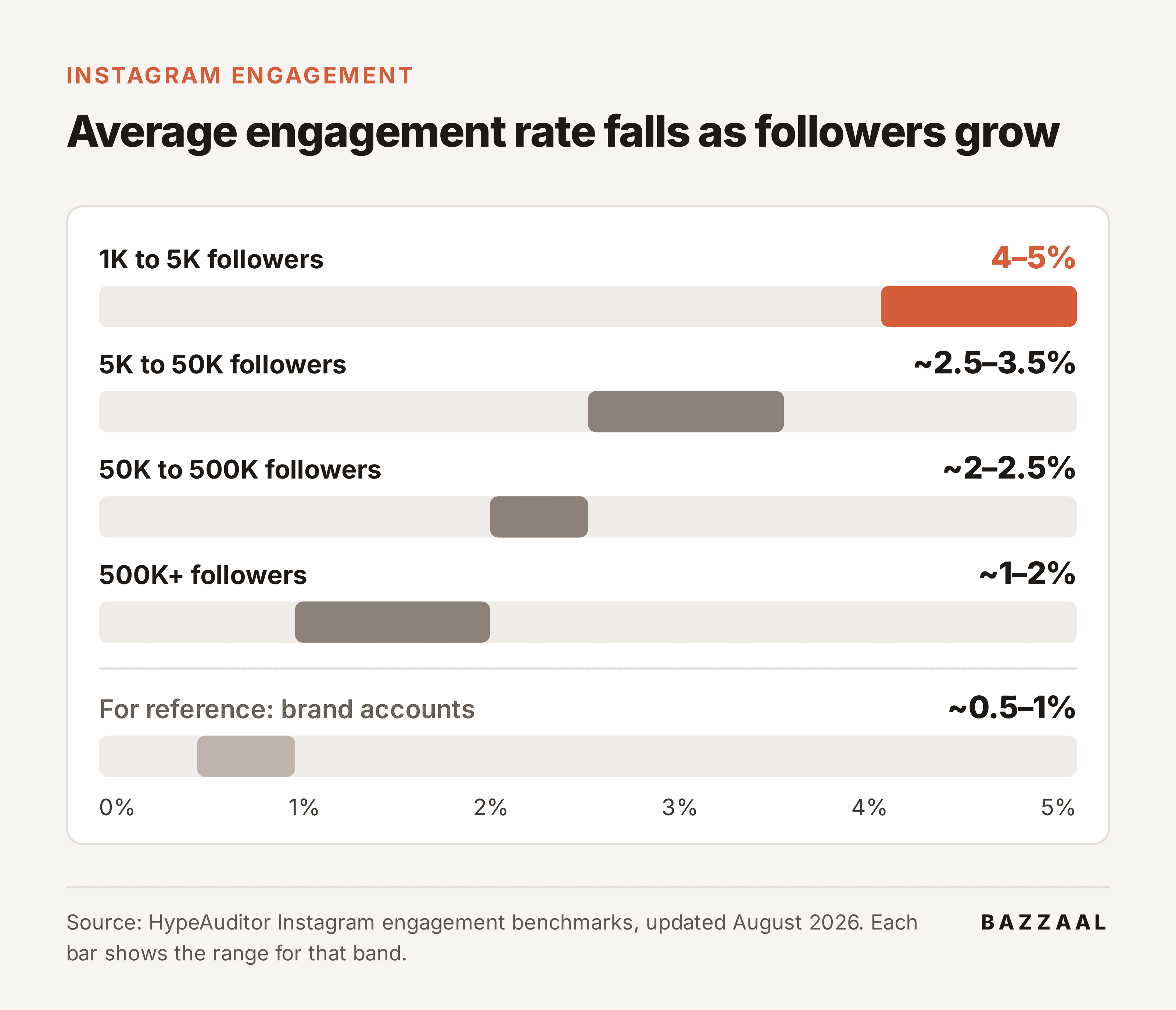
Instagram data shows the same pattern. In HypeAuditor's benchmarks, updated in August 2026, average creator engagement rate falls as follower count rises.
1,000 to 5,000 followers: 4 to 5%
5,000 to 50,000 followers: about 2.5 to 3.5%
50,000 to 500,000 followers: about 2 to 2.5%
500,000+ followers: about 1 to 2%
The 50,000 to 500,000 band, the same range as the mid-tier in the Chinese platform study, engages less than smaller accounts. In the same data, brand accounts often sit around 0.5 to 1%, even with large audiences.
On TikTok beauty content, follower rank and engagement rank also diverged. A June 2026 study compared 120 videos from 12 beauty accounts on Indonesian TikTok. Macro creators had the highest average engagement rate, at 11.634% (Renata and Amelia).
Mega creators were not consistently ahead, and nano creators were not the lowest. Mega creators did deliver the most consistent results, with a coefficient of variation of 48.3%. The authors conclude that follower count and engagement do not move in step on TikTok, and suggest choosing a tier by campaign goal.
Sometimes the follower number itself is inflated. Influencer Marketing Hub surveyed 600+ marketers in 2026. Fake or bot followers made up 56.5% of the fraud and quality issues respondents reported. Templated comments and purchased engagement added another 20.8%.
That is why BAZZAAL uses follower count as a floor only. Above it, we compare creators on the five items below.
From nano to mega: what role does each tier play?
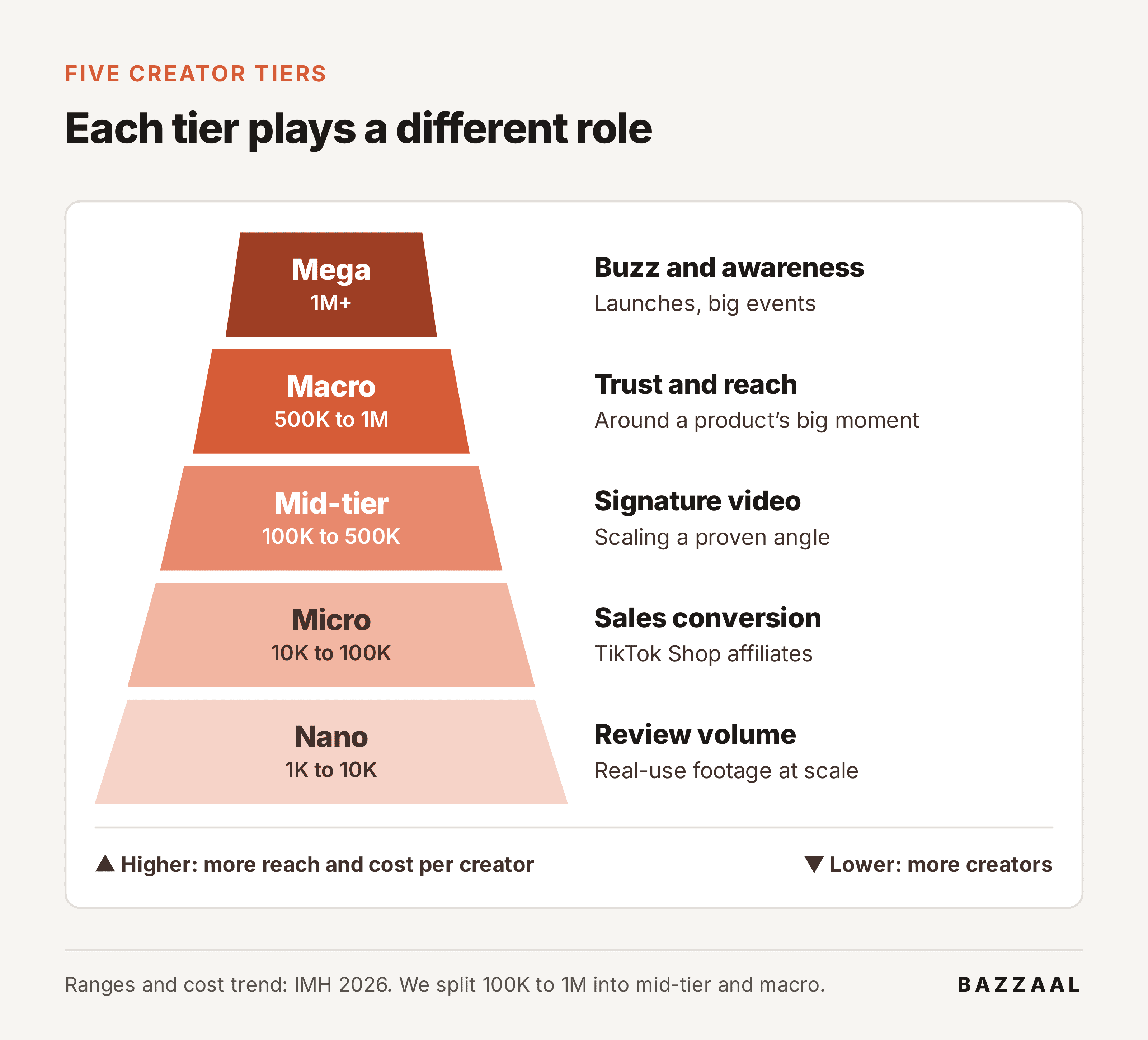
Creators fall into five tiers by follower count: nano, micro, mid-tier, macro and mega. This guide follows the 2026 split from Influencer Marketing Hub (IMH). IMH puts nano under 10,000, micro at 10,000 to 100,000, and mega at 1 million or more, and its 2026 survey asks about mid-tier and macro separately. So we split the 100,000 to 1 million range into mid-tier (100,000 to 500,000) and macro (500,000 to 1 million).
Draw it as a pyramid. Creator count grows toward the base, and each creator's reach grows toward the top. Cost moves the same way: micro lets you work with several creators on one budget, while a macro placement costs far more (IMH). The 10,000 follower entry line for TikTok One is where micro starts, and the 1,000 line for Meta Creator Marketplace is where nano starts.
Sources draw the lines differently. WeArisma calls 250,000 to 500,000 followers macro, and 5W groups 10,000 to 250,000 as micro. Follower counts in the cases below follow each source's own labels.
Nano (1,000 to 10,000): review volume and real-use footage
Use nano when you need many real-use scenes, fast. In IMH's 2026 survey of 600+ marketers, 51.43% planned to expand nano work and 10.00% planned to cut it. About 55% of the nano cost answers were under $500.
An October 2025 study in Telematics and Informatics analyzed nano and micro influencers, including beauty. Follower count did little to explain intent to consume, recommend and follow advice. Opinion leadership, built from authenticity, inspiration and content expertise, explained it better (Korzynski and colleagues).
CollabFeed's 60-day tracking list, updated in August 2026, shows L'Oréal, Olay, La Roche-Posay and NARS paying creators under 5,000 followers. The CEO of influencer agency BrandMe advises opening nano and micro creators in volume first at a TikTok Shop launch. Affiliates and seeding build the content, and the strongest videos are then scaled through paid partnerships and Spark Ads (NetInfluencer, June 2026).
We select on recent-video response, category fit and face visibility. The five items above apply as written.
Micro (10,000 to 100,000): reviews that lead to sales
Micro carries channels where content leads to a purchase, such as TikTok Shop. The CEO of Picky, a US TikTok Shop partner, said in a September 2026 interview that micro influencers can now sell product too. Most TikTok Shop revenue comes from affiliates, he said, and what works changes every 3 to 6 months. Picky has 700,000 creators signed up and about 50,000 active each month.
MISSHA works through what it calls "bottom-up diffusion," starting with micro and mid-tier creators and affiliates (Beauty Independent, February 2026). Its TikTok Shop sales grew 9,528% over last year's Black Friday and Cyber Monday period, the outlet reports.
Dr.Melaxin shared the technical background of its products with more than 16,000 UK creators and reached No. 1 in UK TikTok Shop skincare (Hankyung, January 2026). It also ranked first in US TikTok Shop beauty in Q1 2026, with $46.3 million in sales.
By IMH's 2026 figures, a post costs $25 to $125 on TikTok and $100 to $500 on Instagram. 52.83% planned to expand micro and 7.55% planned to cut it. This is also the range the Andriuzzi and Arrivé study covered (under 100,000 followers), so the brief gives information instead of a pitch.
Mid-tier (100,000 to 500,000): the signature video, with reach
Use mid-tier to show an angle that nano and micro creators already proved to a wider audience. In IMH's 2026 survey, 42.42% planned to expand mid-tier and 21.21% planned to cut it. The most common cost answers fell in the $2,000 to $5,000 and $5,000 to $10,000 bands, about 22.2% each.
WeArisma's January 2026 analysis uses Rhode's Peptide Lip challenge (January 2025) as its case. Hailey Bieber sparked the first wave of awareness. Creators with 80,000 to 500,000 followers then sustained the response and participation. WeArisma says this middle band costs less than mega and celebrity talent, reads as category specialists, and keeps producing UGC-based content that others can copy.
In the Chinese platform study (Zhong and colleagues, 2026) above, the 50,000 to 500,000 mid status raised sponsored volume while engagement quality stayed flat. So for mid-tier we check recent post response and audience fit before follower count.
In BAZZAAL's MEDIHEAL seeding, one post published on June 26, 2026 came from a creator with 134,000 followers. It received 2,099 likes and 299 comments.
Macro (500,000 to 1 million): trust at launches and big moments
Macro works as a selective tier. In IMH's 2026 survey, macro expansion (20.59%) and contraction (20.58%) were almost equal. IMH reads this as many teams keeping macro as a selective layer for credibility moments, launches and reach spikes, while daily output moves to smaller creators.
The CGO of BAT, a K-brand scale-up company, told Hankyung in February 2026: pick the product to focus on, then place mega, macro, micro and nano influencers to fit the momentum. For macro, that means the days around a product's big event.
By WeArisma's count, US beauty macro creators (250,000 to 500,000 followers) generated 8.3 billion views in 2025, up 19% on 2024. Active profiles rose 10% to 3,700 (January 2026). That band overlaps the upper end of this guide's mid-tier.
IMH puts the cost of a macro post (100,000 to 1 million followers) at $1,000 to $25,000: $1,250 to $2,500 on TikTok and $5,000 to $10,000 on Instagram. Because each placement is expensive, we fix the brief, posting date and disclosure wording before we book.
Mega (1 million and up): buzz and awareness
Mega introduces a product to a lot of people at once. In IMH's 2026 survey, 33.33% planned to expand celebrity work and 0% planned to cut it.
Medicube leans on celebrities and large creators. After Kylie Jenner visited its LA pop-up in April 2025, her TikTok drew more than 1.6 million likes and the pop-up had 5,000 visitors in a week (Vogue Business, February 2026). Jenner has 59.7 million followers. Hailey Bieber and Alix Earle also posted before-and-after results, and the #Medicube hashtag holds 670,000 TikTok posts. Beauty Independent adds ready-with-me videos from Mikayla Nogueira and Jeffree Star.
@kyliejenner · Watch on TikTok
The test for mega is whether the product shows a change within a short video. Beauty Independent reports that TikTok Shop's top beauty brands build their ranges around products that are visually transformative and quick to explain.
US TikTok Shop beauty sales hit $980 million in Q2 2026, up 82% year on year (Charm.io). That quarter, one video by creator Mikayla Nogueira drew 12 million views in 5 days and took COSRX's Peptide Collagen Hydrogel Eye Patch to No. 1 in TikTok Shop eye treatment (ETNews, July 2026). She has 17.5 million TikTok followers (checked October 9, 2026).
How to combine the tiers
Medicube was No. 1 in US TikTok Shop beauty in Q2 2026, at $62.8 million (ETNews). Medicube says it fills the platform with content from a network of tens of thousands of creators and works more deeply with the top performers (Beauty Independent, February 2026). LANEIGE has about 200,000 affiliates and runs monthly webinars to update them on new products. MISSHA builds on small creators and adds figures such as K-pop singer Sana.
Experts also disagree on the order. In NetInfluencer's June 2026 roundup of 20 marketing experts, the starting tier varied. BrandMe said to open nano and micro in volume and scale the best videos with paid spend. Tobias Hoss of TopFan said to pay 15 to 25 mid-tier creators flat fees in the first 30 days, then open affiliates once the results show what works.
Upfluence said to recruit micro and mid-tier affiliates broadly, then give paid work to the few with sales history. Brandon Perlman of Social Studies said to pay 5 to 10 mid or micro creators who actually sell to make the first content. All four begin by building the content and conversion signals the algorithm learns from.
5W's July 2026 report proposes a 1,000-creator quarterly mix: 750 or more micro (10,000 to 250,000), 200 or more mid-tier (250,000 to 1 million), 30 or more dermatology and skincare experts, and 10 or more celebrity or mega. 5W's tier lines differ from this guide's.
Paid support shows up in the numbers too. WWD reported in April 2026, using Spate data, that 8 of the top 10 beauty brands by Q1 TikTok view growth got more than 90% of their views from paid content. Dr.Melaxin was among them. That is why seeding volume and paid amplification get planned together.
Matching tier to goal:
For review content volume, use nano and micro.
For sales conversion signals, open affiliates with micro and mid-tier.
For the product's signature video, pick a mid-tier or macro creator whose angle fits.
For a big moment such as a launch or a sale, add macro and mega.
What do you compare when choosing seeding creators?
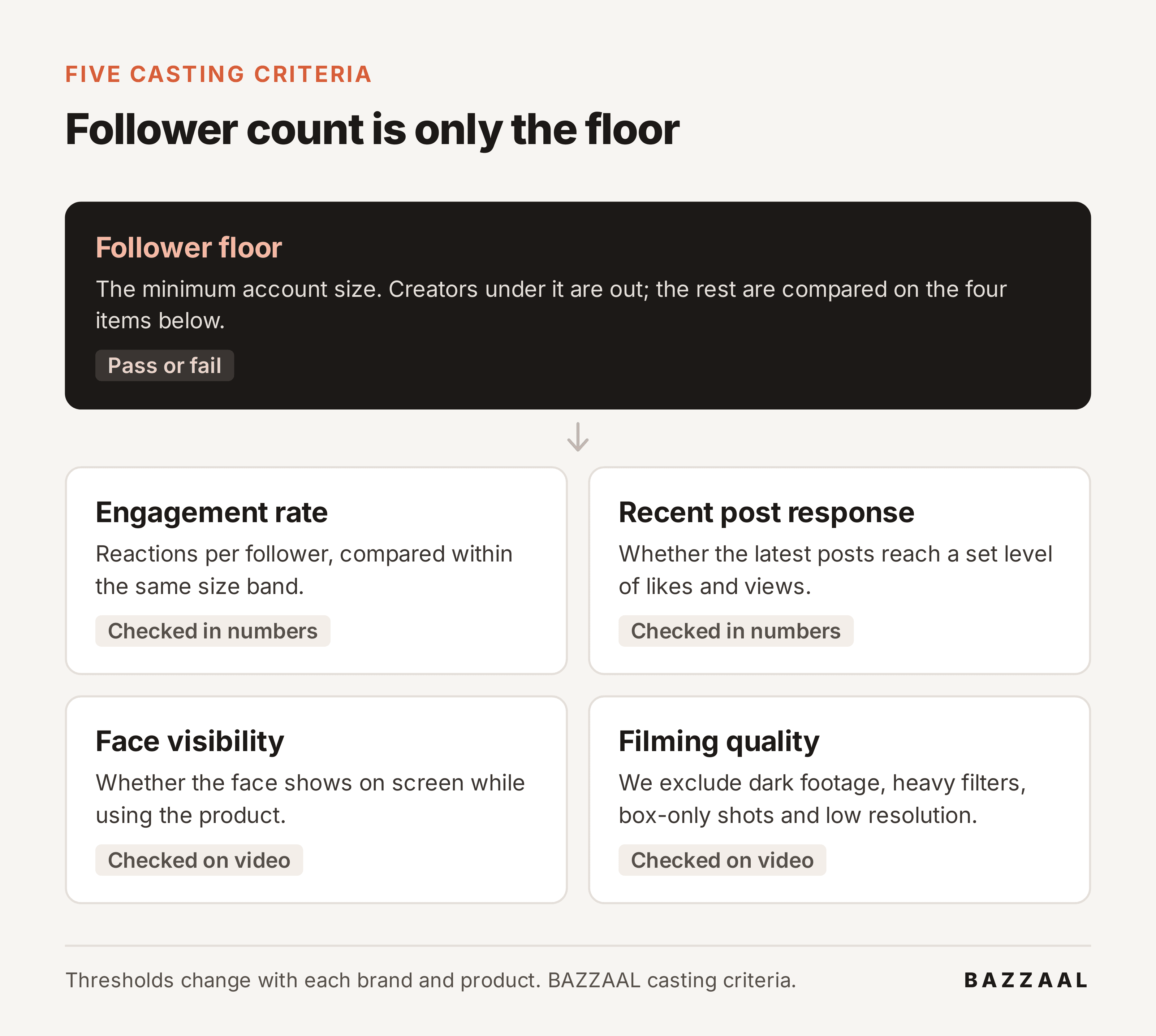
BAZZAAL applies five items as casting criteria on brand campaigns. The thresholds change with each brand and product.
Follower floor. The minimum account size. Creators above it move on to the other items.
Engagement rate. The ratio of reactions to followers. Averages drop as accounts grow, so compare creators within the same size band.
Response to recent posts. Whether the latest posts reach a set level of likes and views.
Face visibility. Whether the person's face shows on screen while using the product.
Filming quality. We exclude dark footage, heavy filters, shots where only the outer box appears, and low resolution.
Only the first item looks at audience size itself.
How do you find creators who fit the product angle?
Decide the angle you will highlight first. Then look for creators who can show that angle naturally. The first test is whether they can show the product's color and texture on screen.
This is the theme match from the Management Science study. In BAZZAAL's MEDIHEAL seeding, creators who showed the masks inside their real skincare routines drove the strongest engagement. The 8 posts drew more than 1.25 million combined views with no paid media.
A November 2025 study in the Journal of Marketing Management ran two experiments with creators under 100,000 followers. When those creators posted persuasive content instead of informative content, consumers were less likely to engage and buy (Andriuzzi and Arrivé). So we write the brief as "here is how to use this product for this concern" instead of a sales pitch.
What steps does a candidate go through?
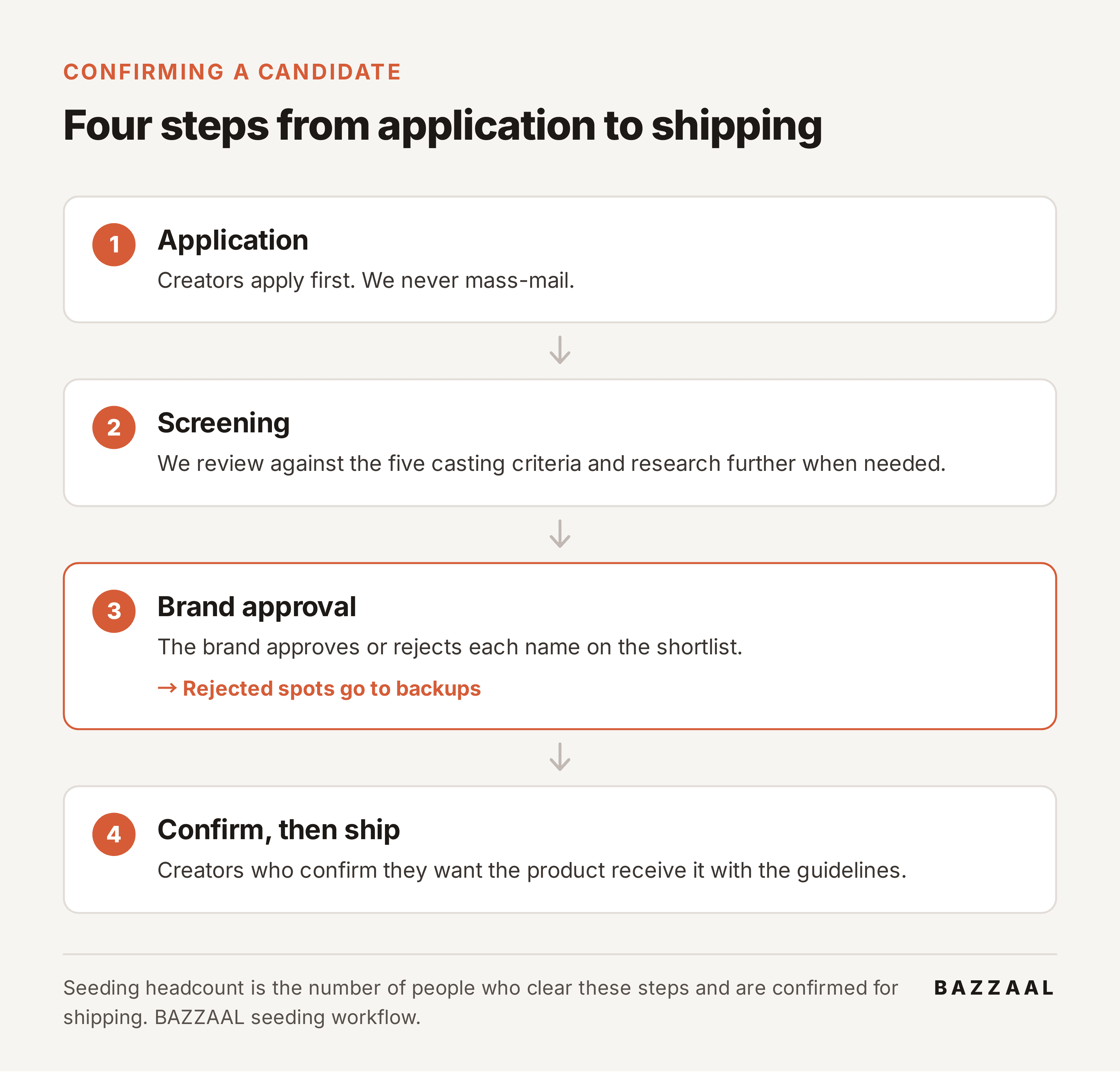
BAZZAAL seeding runs on applications. We never mass-mail, and we follow this order.
Application. Creators apply first.
Screening. We review against the five items above and research further when needed.
Brand approval. We send the shortlist to the brand, which approves or rejects each name. Rejected spots go to backup candidates.
Confirmation, then shipping. We ship to the final creators along with the guidelines.
The brand chooses at the approval step, which lowers the chance of off-criteria creators slipping in. Your seeding headcount is the number of people who made it through these steps and are confirmed for shipping.
Questions to answer before you set your criteria
Which angle do you highlight, and what scene shows it?
What follower floor will you set, and will you consider creators below the TikTok One and Meta Creator Marketplace thresholds?
Are you comparing engagement rate against the average for the same size band?
How many recent posts will you check, and what response counts as enough?
What conditions on face visibility and filming quality rule a creator out?
Who on the brand side approves the shortlist, and by when?
FAQ
Should we exclude creators with fewer followers?
Exclude those below your floor. Above it, compare creators regardless of size. On Instagram, accounts with 1,000 to 5,000 followers had the highest average engagement rate, at 4 to 5% (HypeAuditor, updated August 2026). The floor depends on the brand and the goal.
Can the brand choose the creators directly?
Yes. The brand approves or rejects the shortlist BAZZAAL has screened. Rejected spots go to backup candidates.
Want to design your US seeding creator criteria with us? Contact BAZZAAL →
Sources: Doosti, Lee, Tan, Management Science 72(7), 2026. Zhong, Wu, Sun, Chen, Journal of Interactive Marketing, 2026. Renata, Amelia, E-BISMA, 2026. Andriuzzi, Arrivé, Journal of Marketing Management, 2025. Korzynski and colleagues, Telematics and Informatics, 2025.
TikTok Support, Who is eligible to join TikTok One. Instagram Help Center, Eligibility requirements for creators on Meta Creator Marketplace. HypeAuditor, Instagram Engagement Rate in 2026 (updated August 2026). Influencer Marketing Hub, Influencer Marketing Benchmark Report 2026.
IMH, Macro Influencers Explained (April 2026). ETNews, US TikTok Shop beauty sales (2026-07-28, Charm.io data). EKN, Dr.Melaxin Seller of the Year (2026-05-08). Hankyung, Dr.Melaxin UK No. 1 (2026-01-30) and BAT CGO interview (2026-02-12). Byline Network, Picky interview (2026-09-07). WeArisma, 2026 Beauty Influencer Marketing Trends (2026-01-21). Beauty Independent, strategies of top TikTok Shop beauty brands (2026-02-18). Vogue Business, Medicube (2026-02-13). NetInfluencer, TikTok Shop cold start, 20 experts (2026-06-12). WWD, beauty brands reliant on paid TikTok content (2026-04-14, Spate data). 5W, The 1,000-Creator Playbook for Beauty (2026-07-23). CollabFeed, brands hiring creators under 5K (updated 2026-08).
MEDIHEAL figures are from the BAZZAAL case study page. The casting items and process are BAZZAAL's internal operating standards.
Related: How Many Creators Does a US Seeding Campaign Need? · Creator seeding hub
Written by
Yong Suk Choi
Chief Business Officer
Chief Business Officer at BAZZAAL. 15+ years of zero-to-one go-to-market execution across Korean and US markets, now leading growth for K-beauty brands entering the US from Los Angeles and Seoul.
Connect on LinkedIn
Planning your US launch?
BAZZAAL runs creator seeding, TikTok Shop, and paid campaigns for K-beauty brands entering the US — from Los Angeles, in Korean-company workflows.
Subscribe to STATESIDE
Weekly US K-beauty intelligence, from our team on the ground in LA.


