Where K-Beauty Actually Operates in the US: A City-by-City Map
By
Chloe Joung

Korean beauty brands planning a US entry usually treat the country as one market with one launch date. In practice the decisions that matter cluster in a small number of places, and those places do different jobs.
Los Angeles — where the creators and the retail signal are
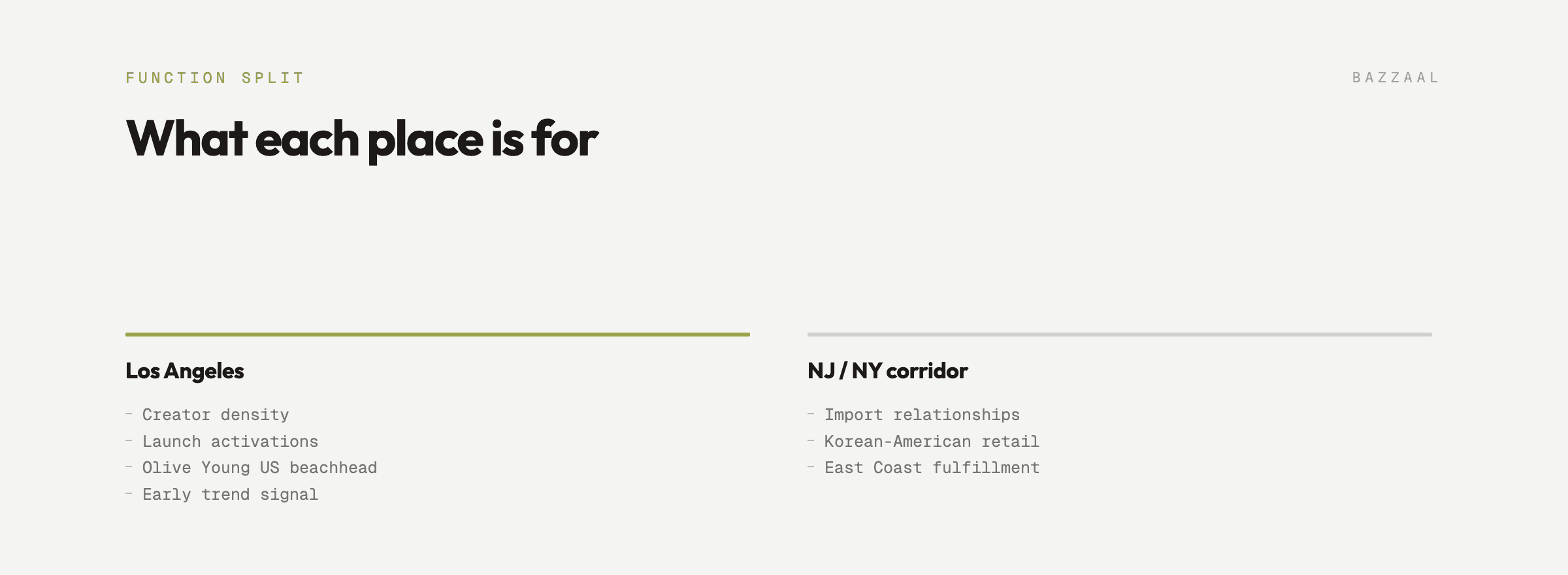
LA is the density center for beauty creators in the US, which makes it the practical base for any creator-led entry. Seeding, IRL activations, content shoots, and creator events all get materially cheaper and faster when the creators are a drive away rather than a flight away.
It is also where K-beauty retail has placed its US bet. Olive Young is building its beachhead here, with stores, a California logistics hub, and a multi-brand festival. When the category's largest Korean retailer picks a city for its first physical US presence, that city becomes where trend signal appears first and where buyers look for proof of demand.
Use LA for: creator programs, launch activations, retail proximity, and reading demand early.
The New Jersey and New York corridor — where the goods move
The Korean-American commercial corridor across northern New Jersey and into New York has been the distribution backbone for Korean consumer goods in the US for decades. Importers, distributors, Korean grocery and beauty retail chains, and the trade relationships that come with them all concentrate here.
If your question is how product physically enters the country and reaches shelves, including Korean-American retail that often becomes a brand's first real US shelf, this is the corridor to work. It runs on a different set of partners than creator marketing does.
Use the corridor for: import and distribution relationships, Korean-American retail, East Coast fulfillment.
Everywhere else — where demand shows up
Sales data will show you strength in metros with no K-beauty infrastructure at all. That is the point of a creator-led, e-commerce-first entry: demand goes national long before operations do. Texas, the Southeast, and the Midwest routinely over-index for a brand whose entire US presence is a TikTok Shop and a 3PL.
The mistake is reading that geographic spread as a reason to distribute your operations. Put operations where your creators, buyers, and inventory partners already are, and let demand land wherever it lands.
Seoul — still on the map
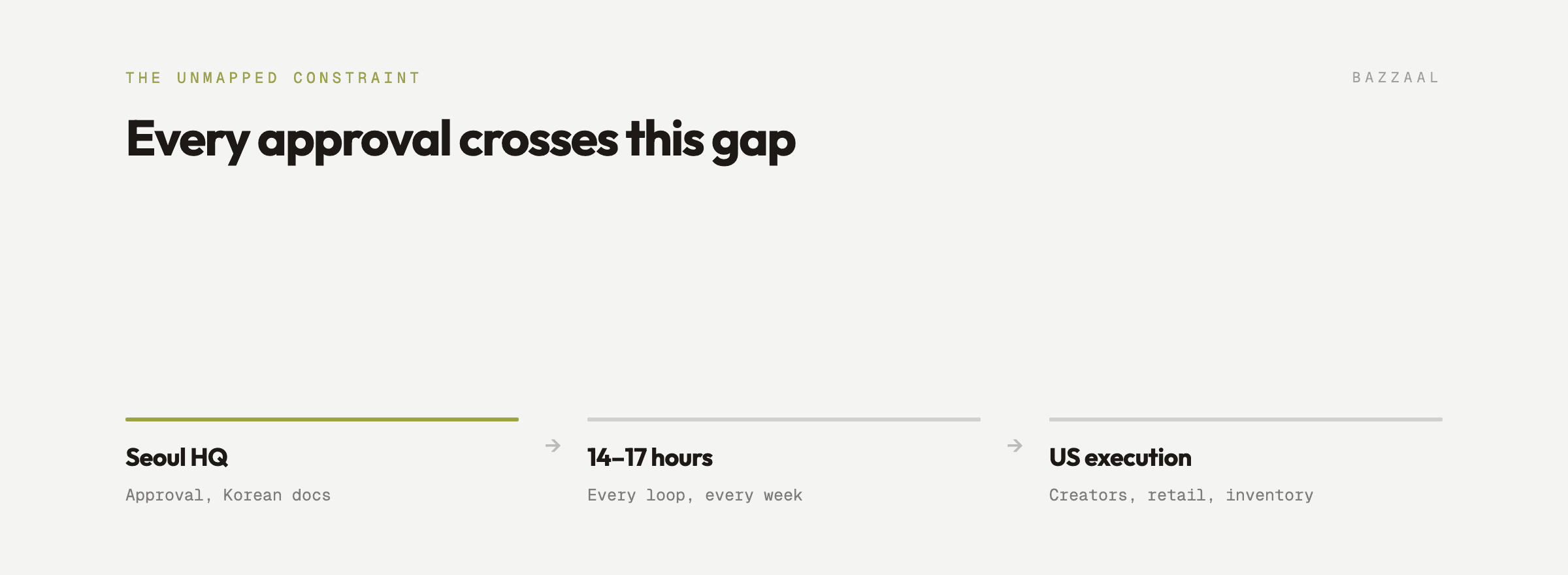
The location most brands forget to plan for is their own. US campaigns run on approvals from a Korean HQ operating fourteen to seventeen hours away, in Korean, on Korean documentation standards. Whatever US structure you build has to survive that time difference every single week.
Which is why the practical answer for most brands runs to three places at once: a US operating base where the creators and retail signal are, a distribution relationship where the goods move, and someone working Korean hours so the loop actually closes.
The short version
Creators and retail signal concentrate in Los Angeles. Distribution concentrates in the New Jersey and New York corridor. Demand goes national and tells you nothing about where to base operations. And the constraint nobody maps is the distance back to Seoul.
BAZZAAL operates from Los Angeles and Seoul, which is a deliberate answer to exactly this map.
Related: how to pick a US agency · setting up TikTok Shop in the US · how the Sephora 19 were chosen
Written by
Chloe Joung
CEO
Founder and CEO of BAZZAAL, with a career dedicated to bringing global beauty brands into the US market — from beauty retail to influencer marketing, social strategy, and community-driven growth.
Connect on LinkedIn
Planning your US launch?
BAZZAAL runs creator seeding, TikTok Shop, and paid campaigns for K-beauty brands entering the US — from Los Angeles, in Korean-company workflows.
Subscribe to STATESIDE
Weekly US K-beauty intelligence, from our team on the ground in LA.


