How Does the Instagram Algorithm Work in 2026? What Adam Mosseri's Four Ranking Videos Mean for Brand Accounts

By
Yong Suk Choi

In September, Head of Instagram Adam Mosseri posted four short videos on how ranking works. I transcribed all four. If you run a brand account, the part worth your attention first is a short stretch near the start of Part 2, where he says Instagram gives more distribution to the account that made a piece of content than to the accounts that repost it.
That one sentence explains why BAZZAAL has built its US seeding around creator accounts. In MEDIHEAL's Prime Day seeding this year, creators posted on their own accounts, and four of those Instagram posts passed 1.2 million views combined with no ad spend behind them. Below, I walk through what Mosseri said and what it means for where a brand's originals should live and how results should be measured.
Why does Instagram rank content instead of showing brand posts as they come?
Part 1 (September 3) starts with why ranking exists. Mosseri gave two goals: helping people who watch make the most of their time by finding what interests them most, and growing the overall pie for creators so there is more reach to go around (0:12).
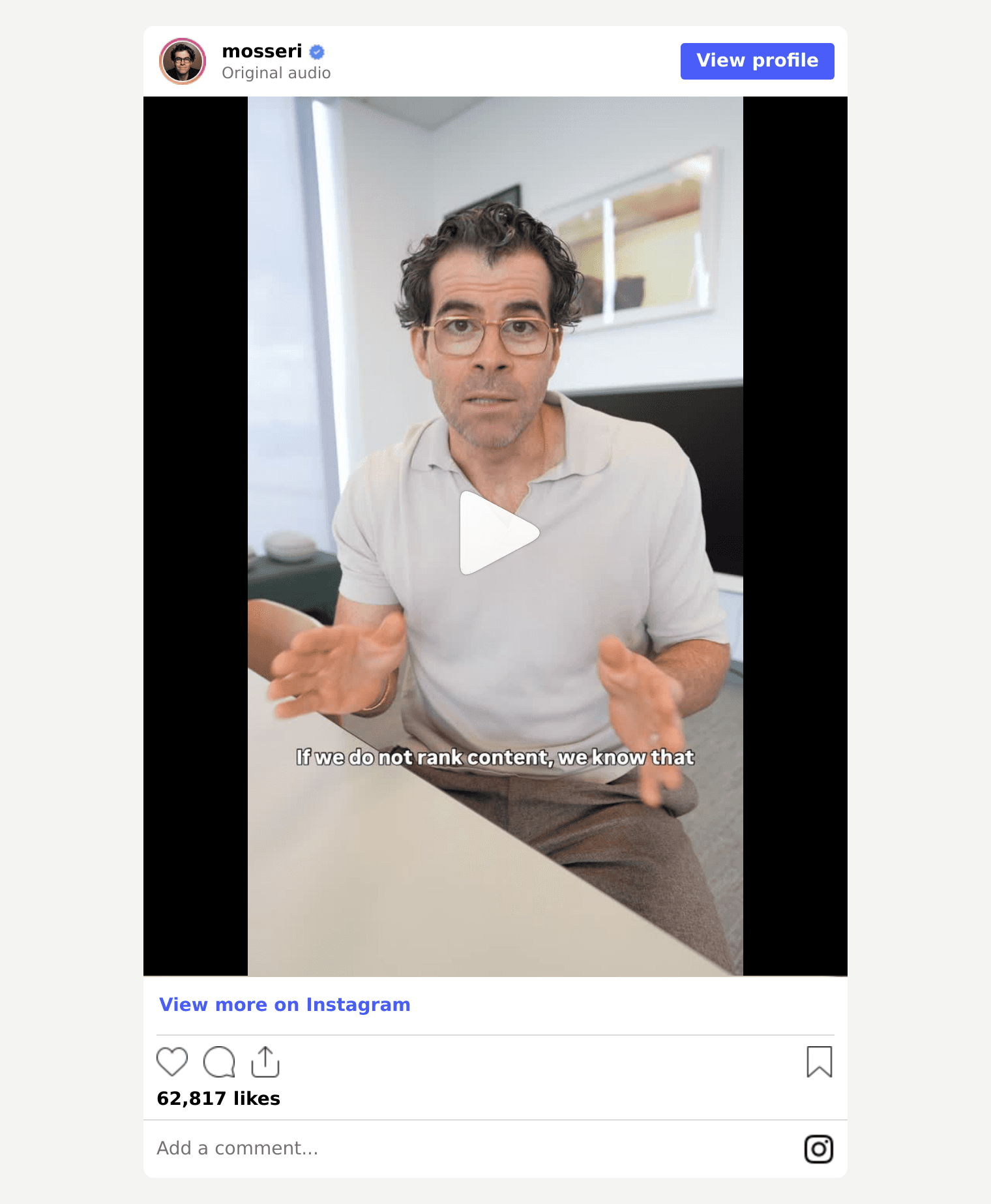
Part 1 of Mosseri's ranking series (September 3, 2026). Why ranking exists and why there are two kinds of algorithms. View post
Without ranking, he said, feeds get overrun by the accounts that post most often, and he named them: businesses and brands (0:30). Instagram would drift away from friends and creators toward a business and news publisher feed, which does not fit its identity (0:49).
There is a second cost. Without ranking, people see a lot less content on Instagram, and the average reach for the average creator goes down significantly, because the overall pie gets smaller (0:59).
I read that as a message aimed at brand accounts. Ranking exists to stop posting volume from turning into reach, and the side it protects is the creator. So I look for reach in originals that live on creator accounts, not in how often a brand account posts.
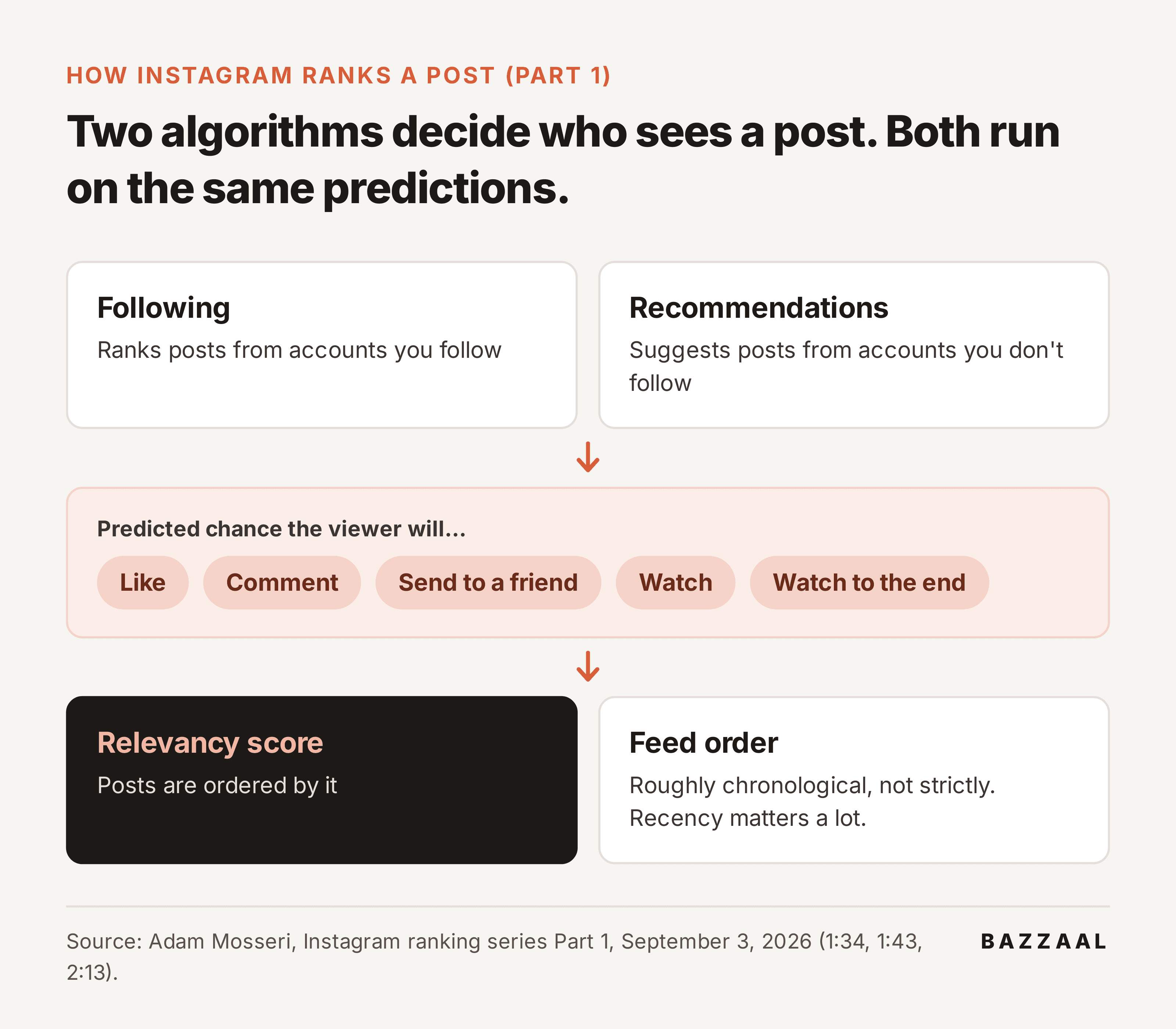
Part 1 also explains that there are two kinds of algorithms: one ranks content from accounts you follow, and one recommends content from accounts you do not (1:34). For a brand post to travel beyond its followers, it has to pass the second gate, and that gate runs on predictions of how people will react (1:43).
That does not mean order is gone. Recency matters a lot, he said, so posts appear roughly in chronological order, just not strictly (2:13). That is Mosseri's own answer to why your feed is not a timeline.
What exactly did Mosseri say about original creators?
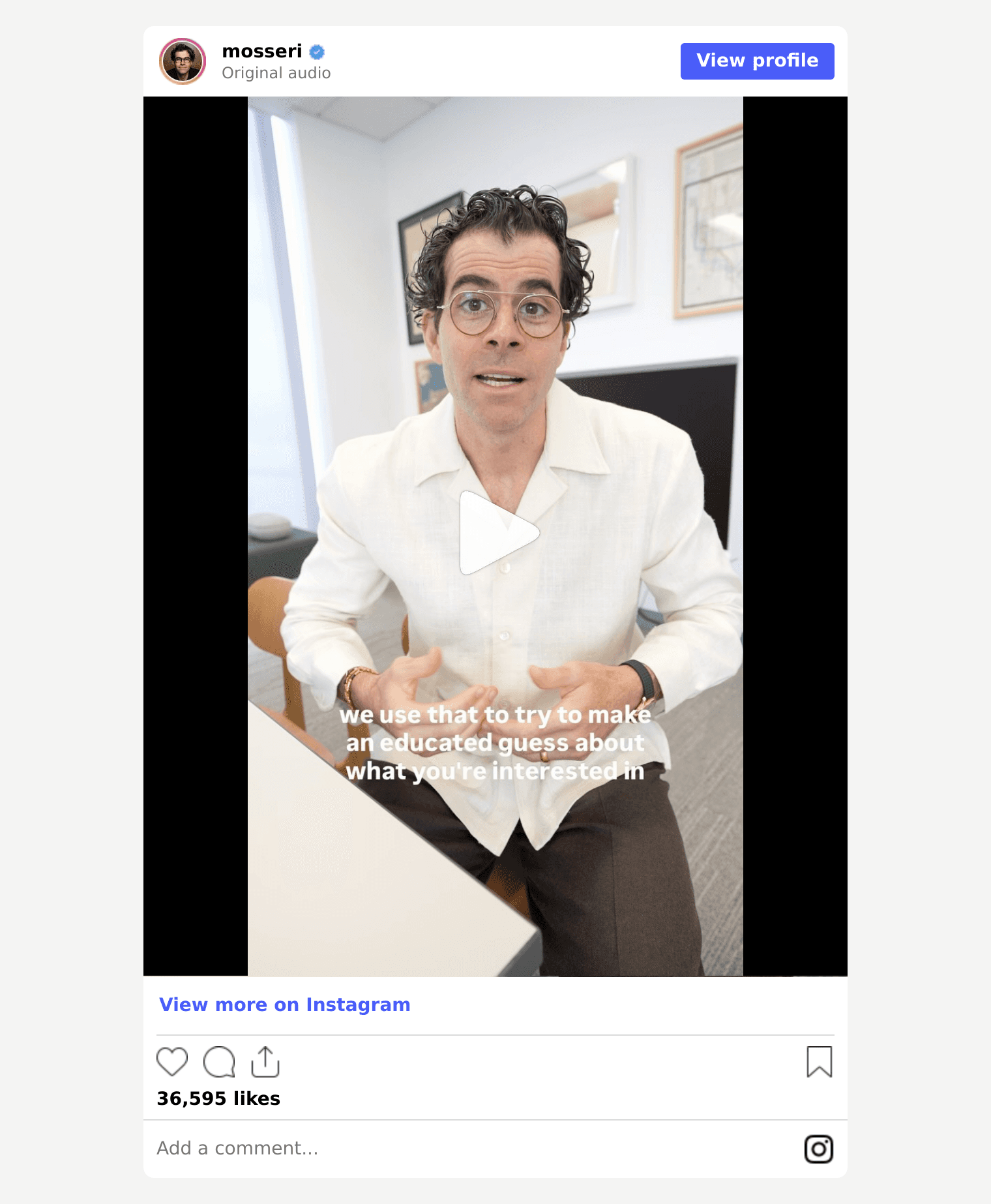
In Part 2 (September 9), Mosseri described four principles ranking values on top of engagement. The first is originality. Instagram wants to be a platform that gives more distribution to the original creator than to those who reposted (0:46).
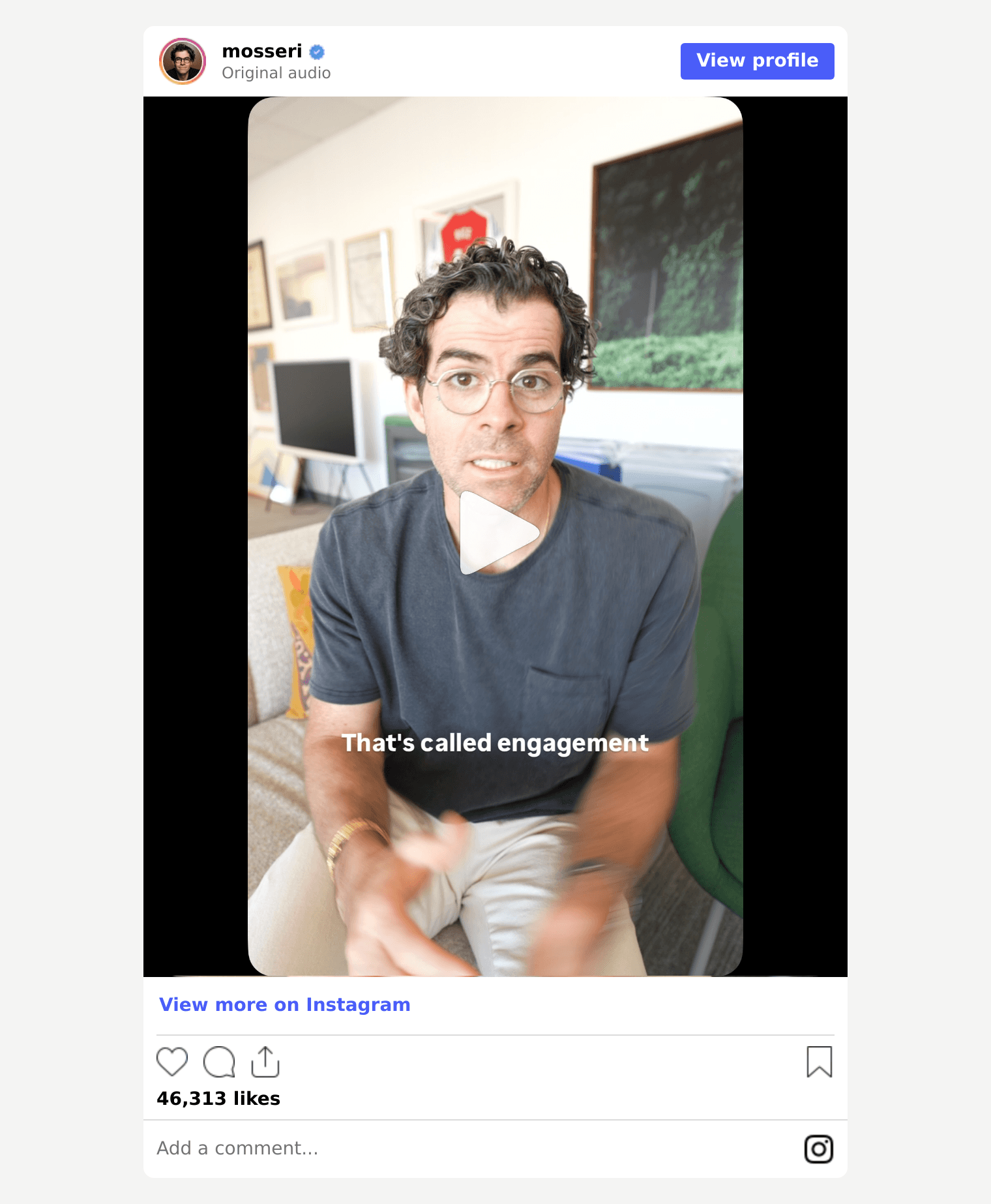
Part 2 (September 9, 2026). Originality comes up at 0:46. View post
He also explained how it decides. Instagram estimates how likely a post is to be original by looking at what the account has posted in the past, along with other signals. He added that the share of impressions going to original content has gone way up (1:05).
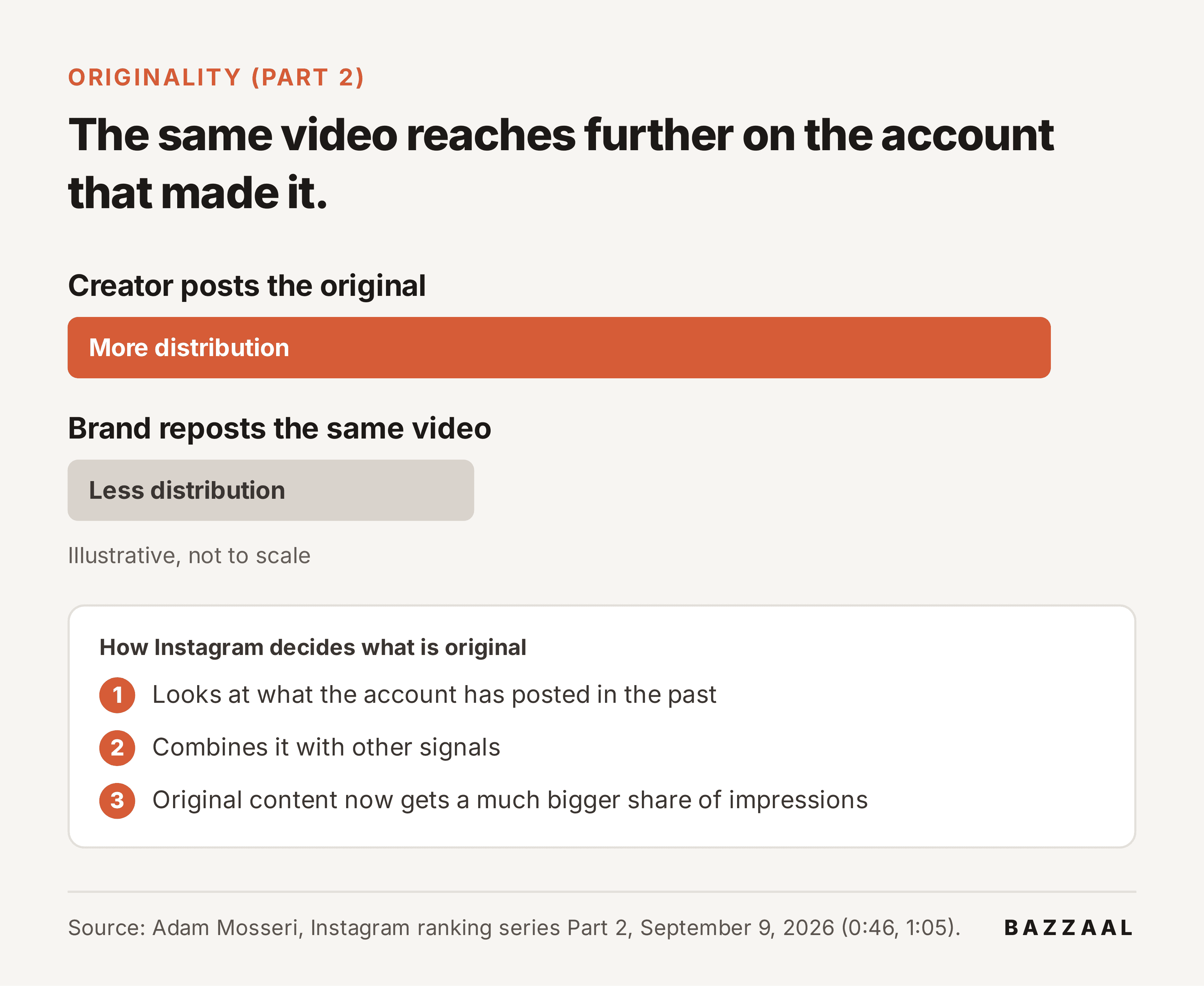
What happens when a brand reposts a creator's video?
If a brand posts a creator's video as is on its own account, that post starts from a weak position on originality. By Mosseri's account, reach for the same video flows more to the creator who posted it first. That is the assumption I plan US seeding around: the spread happens on the creator's account, so that is where the original should go live.
It also shapes the brief. Instagram judges originality partly from what an account has posted before, so a video that looks and sounds like the rest of the creator's feed has the best footing. Give direction through the guidelines, such as the product, the claims to avoid and the one thing viewers should remember, and leave the format, the pacing and the voice to the creator. A brief that dictates every shot produces something that reads like a brand ad dropped into a creator's grid.
When you still want a creator's video on the brand account or in ads, set the usage terms first, separately from any question of reach. BAZZAAL covers how to scope them in How much do creator usage rights cost?
What happens to brand content when users edit their own algorithm?
Part 3 (September 18) covers three tools people use to correct ranking: Favorites, Not Interested, and a screen he calls your algorithm. All three sit on the viewer's side, and each one shows how brand content gets filtered.
Part 3 (September 18, 2026). Favorites at 0:29, Not Interested at 0:44, your algorithm at 1:00. View post
Accounts added to Favorites get aggressively prioritized and appear at the top of Feed every time they post (0:29). The people a brand account can count on reaching are the loyal customers who went this far. First looks at new products or perks only followers get give them a reason to do it.
At the end of Part 1 he also listed the Following feed next to Favorites as a tool people can choose (2:27). It shows only the accounts you follow. For a brand, being followed and being favorited are the two routes that do not depend on a recommendation.
Not Interested tells Instagram to show less content like that in the future (0:44). This is the tool I am most careful about when I design seeding. Hand the same script to thirty creators and a viewer meets the same video thirty times, and somewhere along the way they can tap Not Interested. So the brief fixes the product and leaves the angle to each creator.
Your algorithm sits in the top right of the Reels and Explore tabs (1:00). It shows the topics Instagram thinks you are interested in and lets you add topics or block them outright (1:08). Content is sorted by topic and users pick their topics, so the product category has to be clear from the creator's video and caption. If you run a brand account, open that screen once and look.
Can a post from a small creator really reach a big audience?
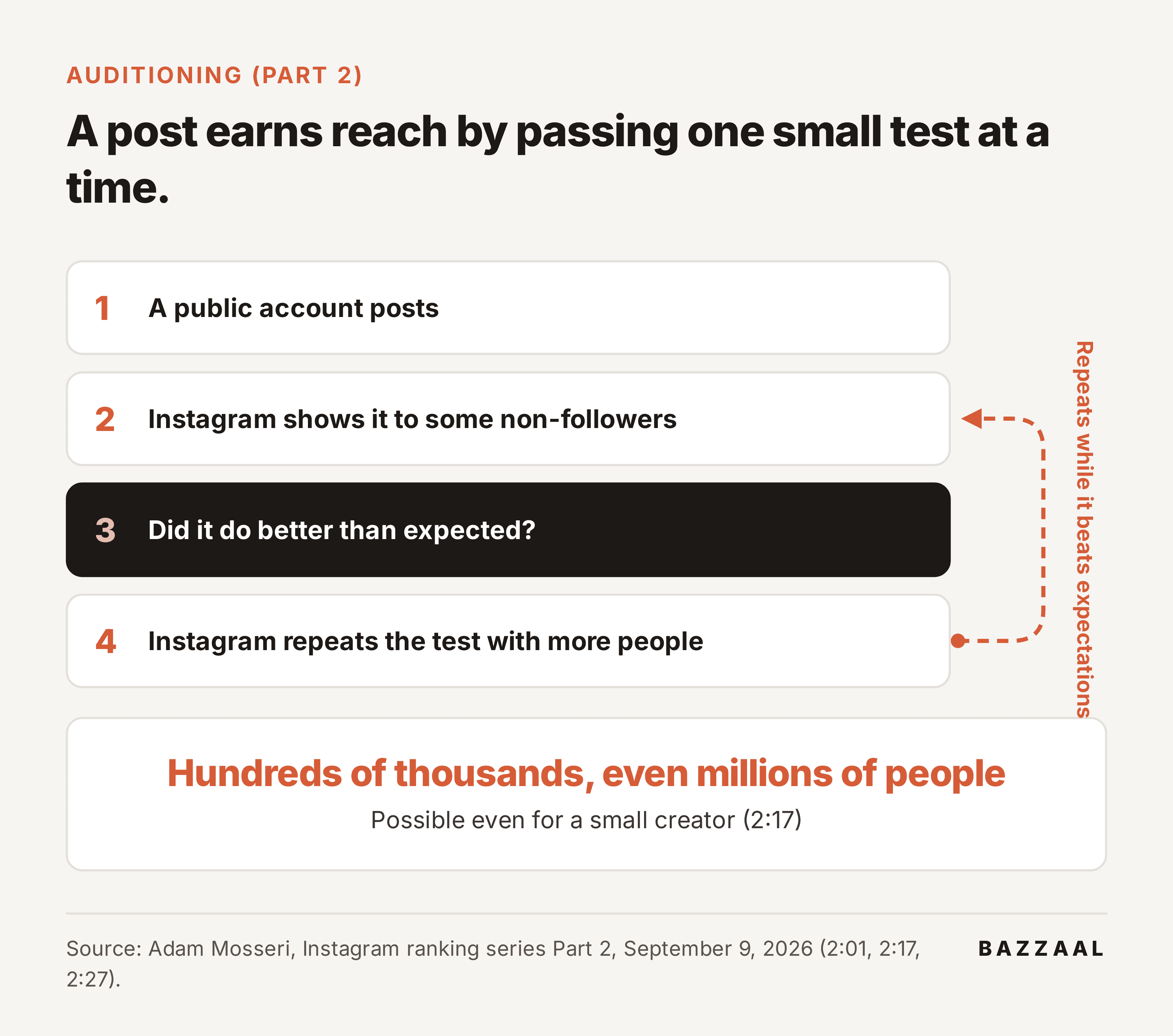
Yes. In Part 2, Mosseri called the process auditioning (2:01). Instagram shows a public account's post to some people who don't follow it. If it does better than expected, Instagram repeats the test. That is how a post from a small creator can reach hundreds of thousands or even millions of people (2:17).
Mosseri said Instagram measures this by how many posts get over a certain number of views in a given day, and that number has grown over the last few years (2:27). That is the case for spreading seeding across many creators instead of betting on one.
His baseball line in Part 4 (September 25) points the same way. Posting more gives you more at-bats and a better chance of a hit, but an aggressive schedule leads to burnout, so pick a frequency you can sustain (1:31). For seeding, I read that two ways. Sending product to twenty creators gives you twenty auditions. And a steady monthly rhythm is easier to keep going than one big push before a launch.
Part 4 also covers how to test new ideas. Mosseri recommended Trial Reels, which go only to non-followers and never show up for your followers (1:18). His reason: what resonates today might not in a month, because interests change.
He also named the target of those experiments: the overlap between what is true to your identity and goals and what finds an audience on Instagram (1:06). For a brand, I read that as testing a different angle with each creator while staying inside the brand's voice.
MEDIHEAL's Prime Day seeding ran on this structure. Creators received the products, made their own content, and posted it on their own accounts. BAZZAAL did not boost a single post. Of the four lead Instagram posts, the strongest reached 493,000 views.
Should campaign results be judged by views?
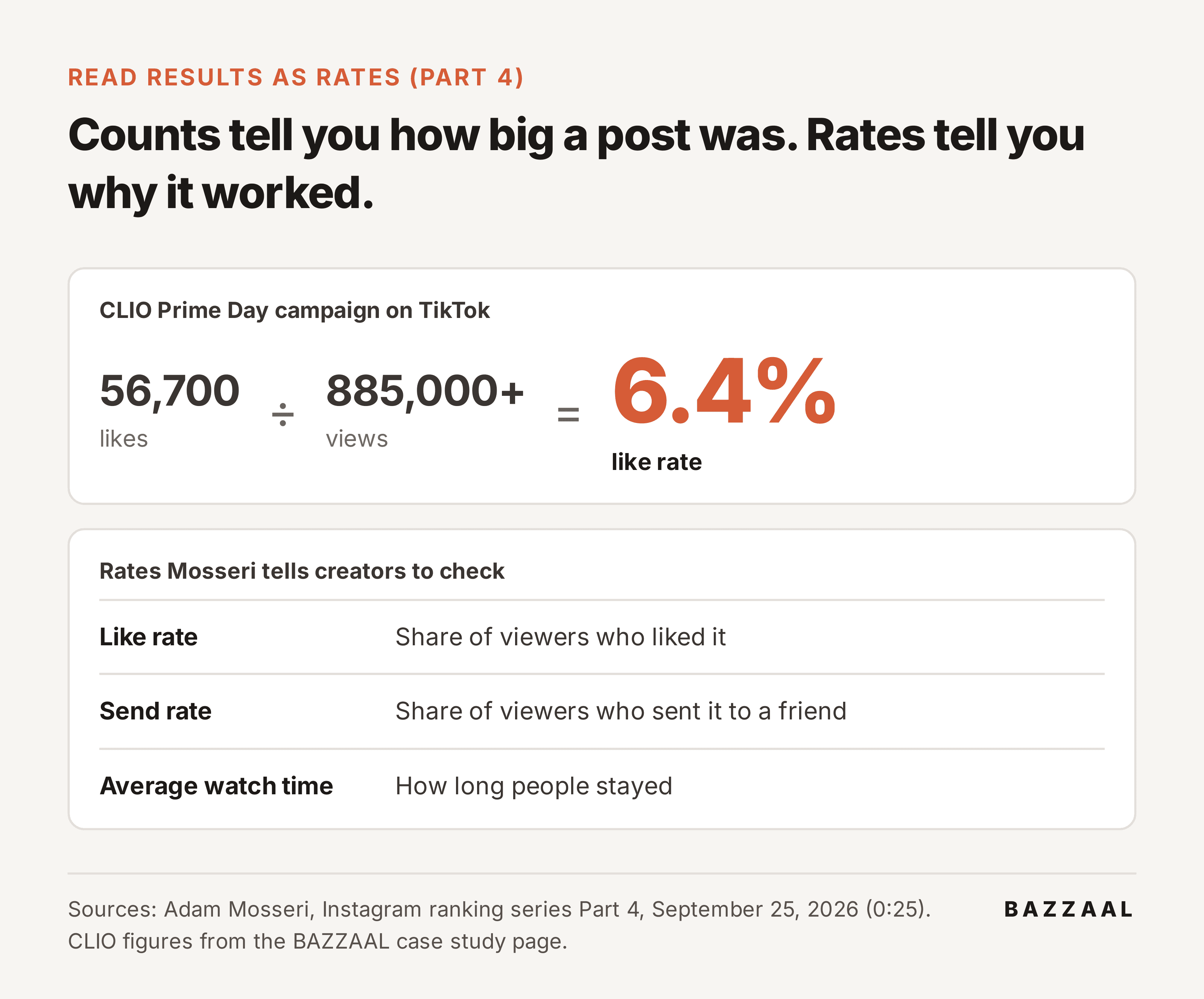
Mosseri's first piece of advice to creators in Part 4 was to look at rates (0:25). View counts and like counts on their own, he said, won't tell you why one post did better than another. Look at what percent of viewers liked a Reel, what percent sent it to a friend, and the average watch time.
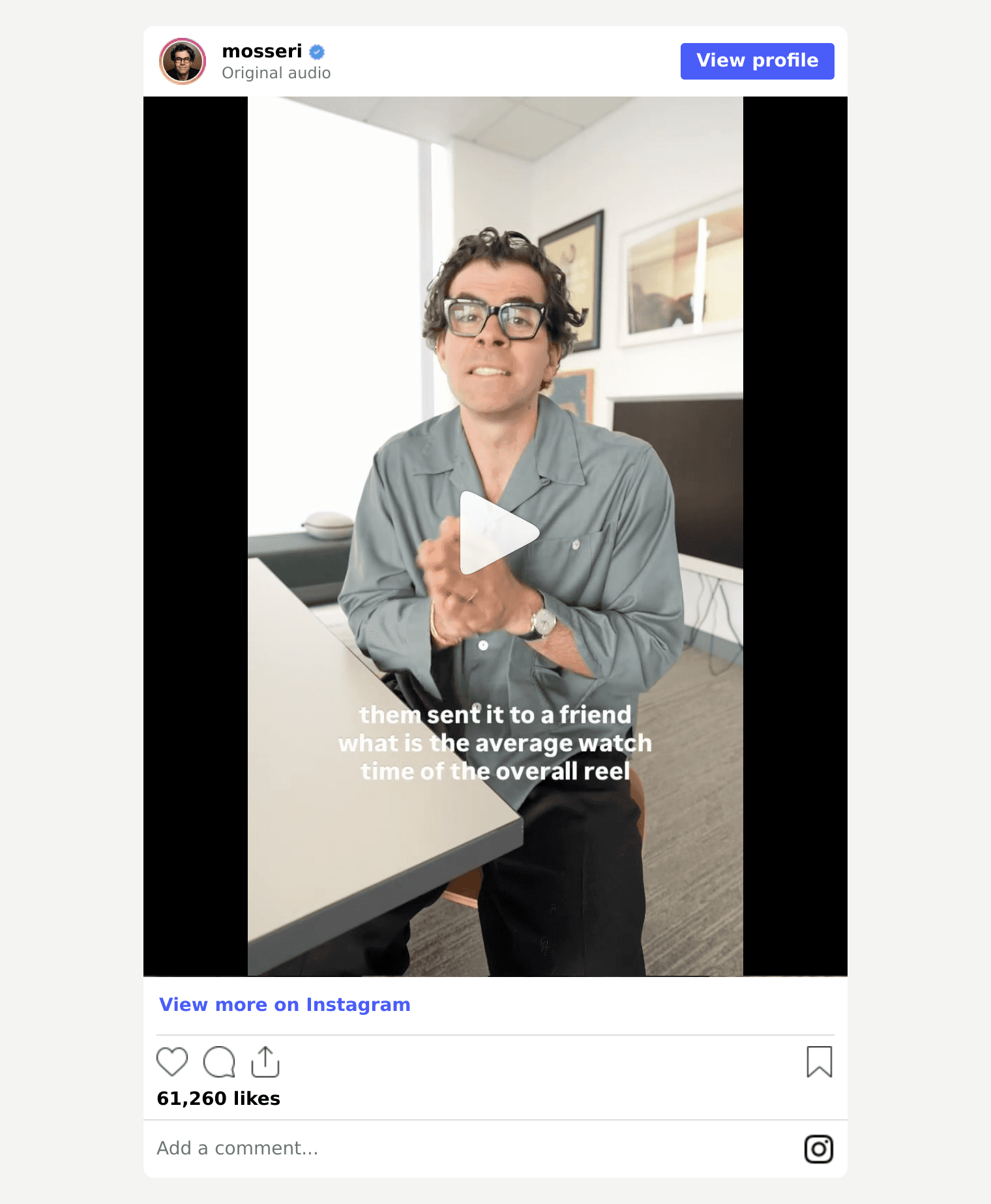
Part 4 (September 25, 2026). The advice to look at rates starts at 0:25. View post
That advice lines up with how Part 1 describes ranking. Instagram predicts how likely you are to like, comment, send to a friend, watch, and watch to the end. It turns those predictions into a relevancy score and orders posts by it (1:43). A probability is a rate by another name, so I think brand reports should be read in rates too.
CLIO's Prime Day campaign ran on TikTok, but the math is the same. More than 885,000 views and 56,700 likes works out to a like rate of about 6.4%. After each campaign, BAZZAAL converts results into rates and use them in the next round of casting.
How much does posting date matter now?
Mosseri admitted that something used to happen in the world and show up on Instagram three, four or five days later (Part 2, 1:16). Instagram now looks at what share of a day's impressions go to posts less than 24 hours old, and that number has gone way up (1:41).
You feel this most on fixed dates. For a launch day, Prime Day or Black Friday, I would cluster creator posts around the date. Spread over two weeks, fewer posts count as fresh on the day that matters most. It works alongside steady monthly seeding: the monthly rhythm keeps auditions coming, and the dated moments are where you concentrate posts so the freshness window works for you.
How do you earn comments and full watches?
Campaign recruiting posts on the BAZZAAL account @bazzaal_ carry a simple mechanic: comment a keyword and BAZZAAL DMs you the application link. The US creator casting call posted on September 30 used JOIN. It is built to create the comment signal Mosseri listed in Part 1. As of October 3, that post has 153 comments.
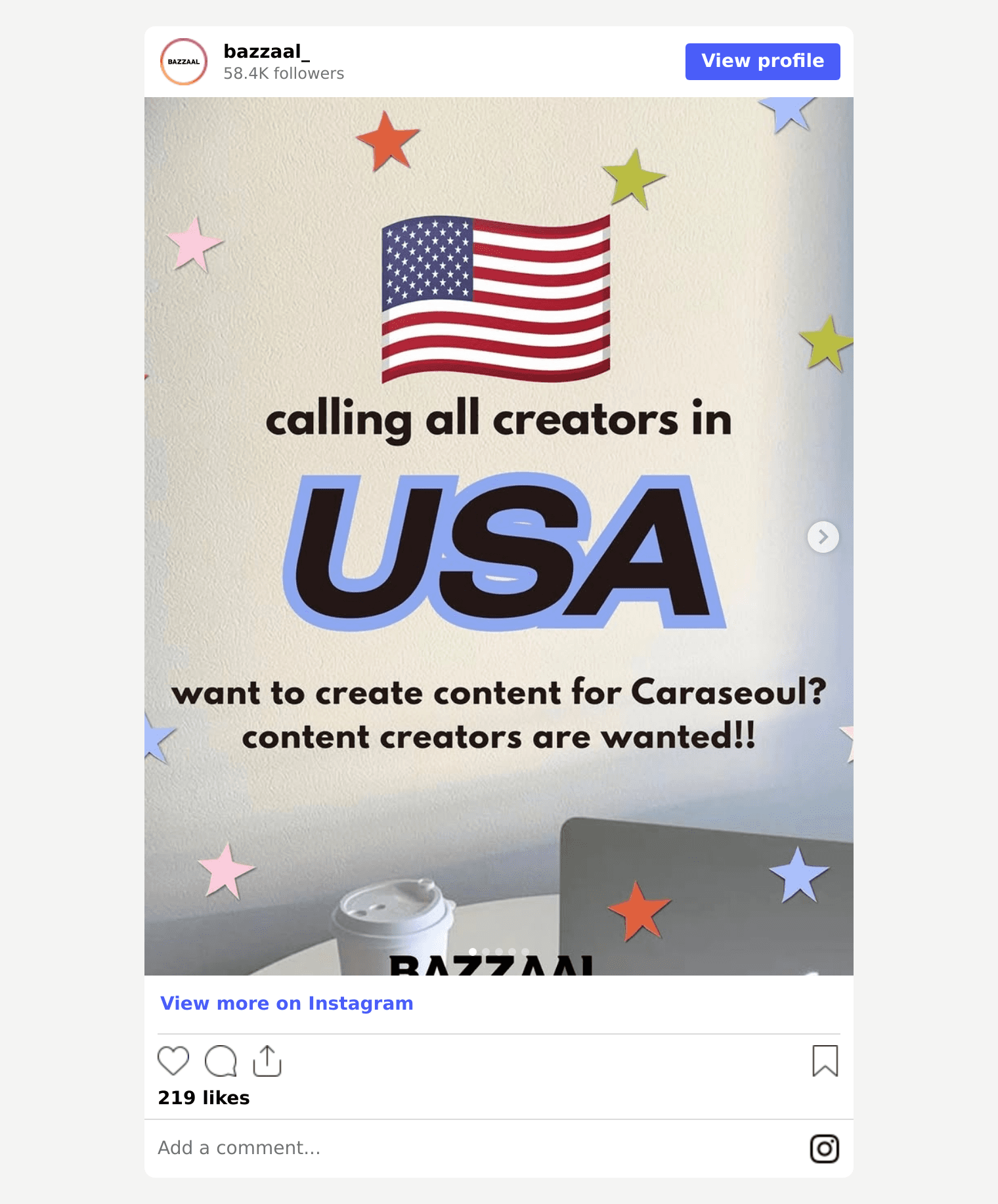
The US creator casting call on @bazzaal_ (September 30, 2026). The comment keyword is JOIN; 153 comments as of October 3. View post
Watching to the end is something you plan for. In the BAZZAAL Creator Bootcamp EP.1, creators are told to ask "what does the viewer get?" before they film a haul or a GRWM. Information, inspiration or entertainment, there has to be a reason to stay to the end. Brands look for creators who think this way. Earlier this month the same series added an episode on the do's and don'ts of content creation.
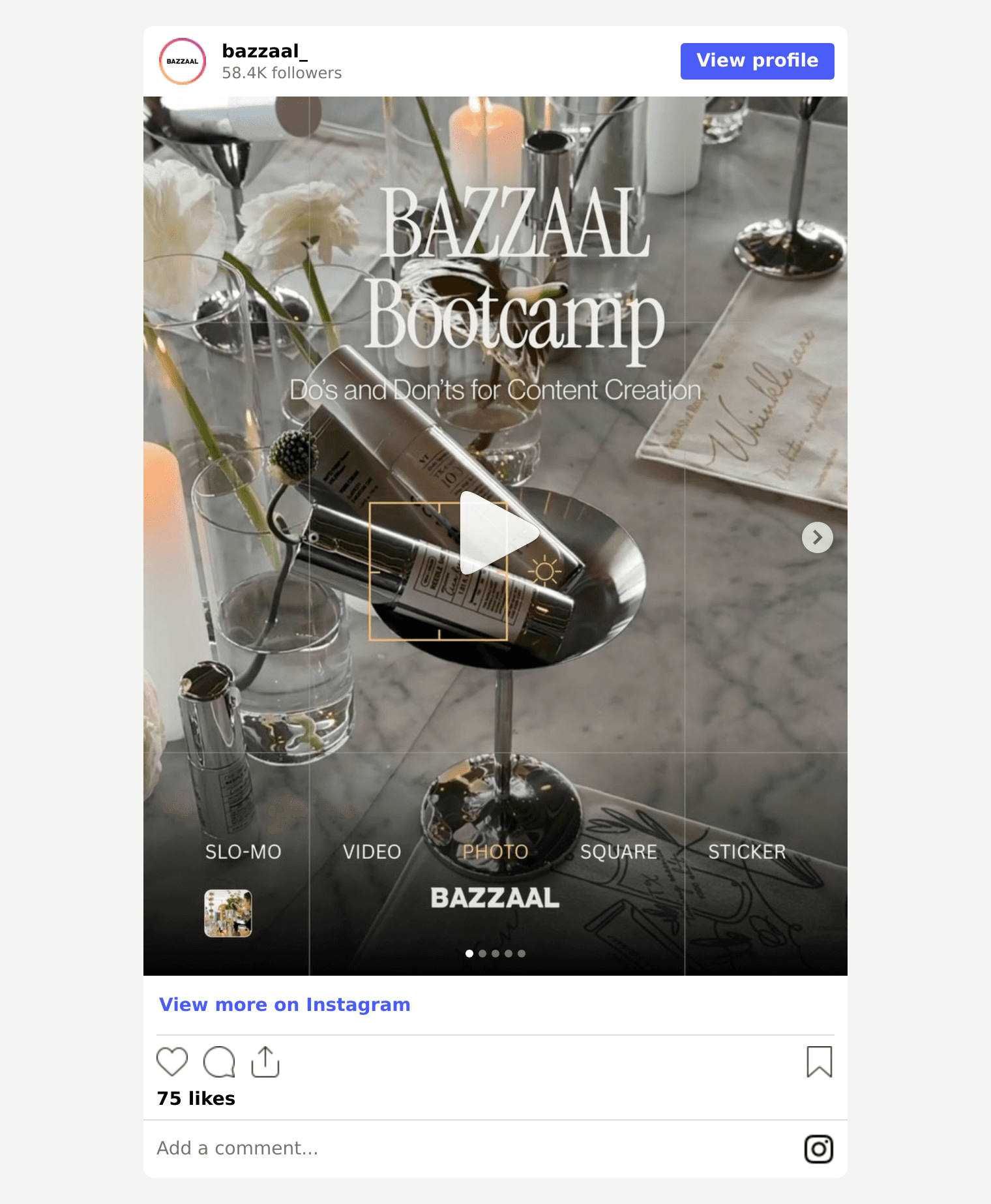
The Creator Bootcamp episode on the do's and don'ts of content creation, on @bazzaal_. The comment keyword is INTERESTED. View post
The brief can aim for the same signals. Ask, in one line, for something viewers would want to send a friend: an ingredient comparison, a before and after, a routine breakdown. That gives the post a shot at the send signal too.
A 12-point checklist to run now
I have sorted the last 30 days of posts by like rate, send rate and average watch time
I know what share of brand account posts are reposts
Seeding briefs fix the product and leave the angle different for each creator
The product category is clear from the video and the caption
Seeding is set up so creator originals go live on creator accounts first
Launch and sale posts are clustered around the date
The brief has one line on why someone would send this to a friend
The opening of each Reel shows what the viewer will get
New formats are tested with Trial Reels on non-followers first
A posting frequency we can sustain is on the calendar
Loyal customers have a reason to favorite the brand
There is a mechanic that invites comments
FAQ
Is there one Instagram algorithm?
Several. Mosseri said Feed, Stories, Reels and Explore each rank content differently (Part 1, 1:24), and content from accounts you follow is ranked separately from recommendations.
Which engagement does Instagram weigh most?
It predicts the chance of a like, comment, send to a friend, watch, and watch to the end, and scores posts on that. Mosseri did not say which counts most.
How often should a brand account post?
Mosseri did not give a number. More posts mean more chances, but he advised choosing a frequency you can sustain.
If you want to build US creator seeding around original content, talk to BAZZAAL.
Sources: Adam Mosseri, Instagram ranking series Part 1 (2026-09-03, instagram.com/p/Dc1CcoYgZD_), Part 2 (2026-09-09, instagram.com/p/DdENi2fP59I), Part 3 (2026-09-18, instagram.com/p/DdbYqrtPDzd), Part 4 (2026-09-25, instagram.com/p/DdrY25_gNvi). Timestamps refer to where each statement appears in the video. MEDIHEAL and CLIO figures are from BAZZAAL case study pages.
Related: How much do creator usage rights cost? · What should a creator contract include?
Written by
Yong Suk Choi
Chief Business Officer
Chief Business Officer at BAZZAAL. 15+ years of zero-to-one go-to-market execution across Korean and US markets, now leading growth for K-beauty brands entering the US from Los Angeles and Seoul.
Connect on LinkedIn
Planning your US launch?
BAZZAAL runs creator seeding, TikTok Shop, and paid campaigns for K-beauty brands entering the US — from Los Angeles, in Korean-company workflows.
Subscribe to STATESIDE
Weekly US K-beauty intelligence, from our team on the ground in LA.