What Does Ulta Look for in K-Beauty Brands?

By
Yong Suk Choi

Ulta keeps adding K-beauty brands, but it does not take just anyone. It looks first for brands that have already sold somewhere and bring something shoppers can only buy at Ulta. After that, the work splits by category: skincare spends the most time on FDA paperwork, and color reviews turn less on shade count than on oxidation and shade matching.
This post draws on Ulta's earnings call transcripts, its annual report and US press coverage, plus shade lists and reviews we counted ourselves on Ulta.com. The six months after landing are in how to plan your first six months after Sephora and Ulta, so this one stops at the first three months after signing.
In short
Ulta's K-beauty sales grew double digits in the second quarter, and about half came from exclusive brands and products. If your pitch can include an Ulta-only product, it helps.
Skincare stalls on regulation, above all sunscreen. For color, oxidation matters more than shade count. In the Ulta reviews we counted, K-beauty cushions drew oxidation complaints about four times as often as established-brand foundations.
Ulta does not publish how much of its promotions brands fund. Check your margin sheet and the first-three-months rules before you sign.
How much K-beauty is Ulta selling right now?
We read the last three earnings call transcripts. In March, Ulta said it added more than 100 new brands in 2025, with Medicube and TIRTIR among them. It also said 20% to 30% of growth comes from newness.
The August 27 call was more specific. K-beauty sales grew double digits, and nearly half came from exclusive brands or products.
Five new K-beauty brands joined: Dr. Melaxin, numbuzin, Dr.Reju-All, ClearDea and Centellian24.
On the same call the CEO said Ulta will not get caught up in K-beauty as fast fashion. In March, executives had also talked about SKU rationalization, with brands cycling in and out. The K-beauty label alone does not hold a shelf. You need proof that it sells, and something only Ulta has.
You can see what exclusive means on TIRTIR's Ulta page. On October 17, five of its 31 products carried an Only at Ulta tag, and the Red Cushion is one of them. In the second-quarter call, L'Oréal's Infallible Cushion Foundation was introduced as an Ulta exclusive. Put an exclusive product, shade or set into your pitch.
There is a signal for color too. Mass makeup fell low single digits in the second quarter, and Ulta blamed less newness from major brands. A gap for new color brands shows up right in the results.
How is an Ulta shopper different from a Sephora shopper?
BeautyMatter's February 2026 summary of Navigo's analysis shows two different demand structures. Sephora concentrates on a few brands, with The Ordinary taking 16.5% of skincare. Ulta is spread wide. Clinique leads skincare at 9%, La Roche-Posay follows at 8%, and the color leader Tarte holds 4.2%.
The analysis frames Sephora shoppers as driven by ingredients and trends, and Ulta shoppers as driven by skin concerns and routines. An ingredient story alone is not enough, and you need efficacy data with numbers. Visibility is spread across many brands, so budget for paid ads from the start.
Ulta is widening its own paths as well. It opened a brand store on TikTok Shop in March with 18 Ulta-exclusive brands. It has about 47 million active loyalty members, and the app drives more than 60% of online sales. It is already investing in turning creator-driven interest into in-app purchases.
How do brands get into Ulta?
There are three public routes. The first is a formal RangeMe submission to a category buyer. Ulta states on its official page that it has no obligation to review or answer a submission.
The second is UB Marketplace, an invite-only online mall where brands ship directly. It grew from more than 325 brands in the first quarter to 450 brands and more than 12,000 SKUs by the end of the second. At launch, shoppers complained that rewards and discount codes did not apply.
The third is a distributor. Landing International handled eight of the 13 K-beauty brands Ulta added in July 2025, and it listed more brands on the marketplace as K-Beauty World. Of the 17 added in March, only one is color.
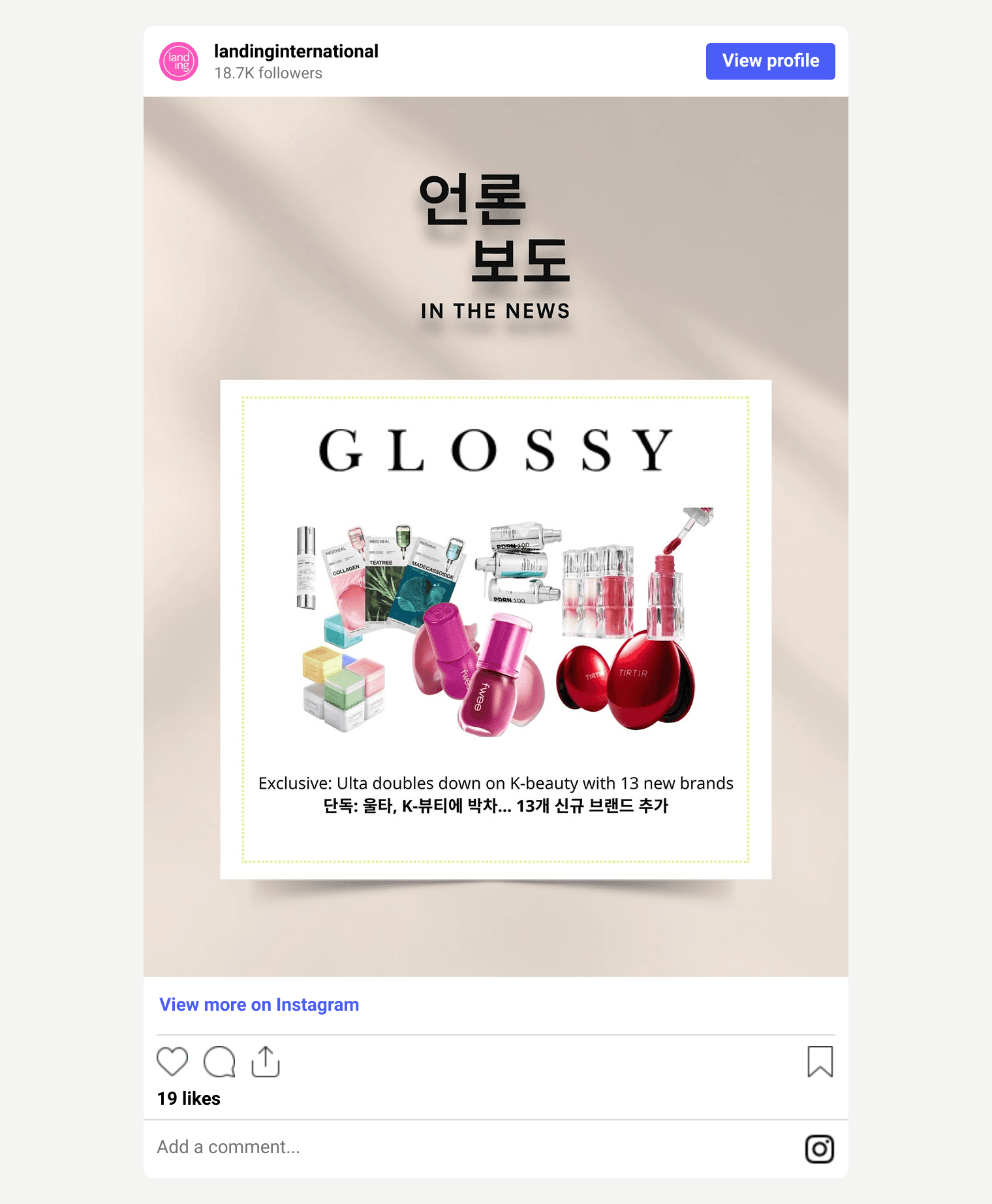
Landing International on Ulta adding 13 K-beauty brands. View on Instagram
What paths did the early brands take?
The color case is TIRTIR. The Red Cushion started in 2023 with three shades, and creator videos spread complaints that the deeper tones could not be matched. The brand went to nine shades in February 2024, 20 in May, 30 in June and 40 in August.

It filled the gap between 43N and 51N after criticism that the jump was too wide. It said a new shade takes about two months to produce, and added that other brands need at least four.
In July 2025 Ulta announced 13 K-beauty brands, and TIRTIR was one of five new color brands. It launched online and in about 400 stores on August 3. The brand says it was the first Korean brand in the Prestige Zone. According to Vogue, the Red Cushion makes up 70% of its sales.
TIRTIR announces its Ulta launch. View on Instagram
The skincare case is Medicube. Hailey Bieber's TikTok use of its device in July 2023 put it on the map, and it grew on Amazon first. It reached every Ulta store in August 2025, and its range went from 12 to 18 products.
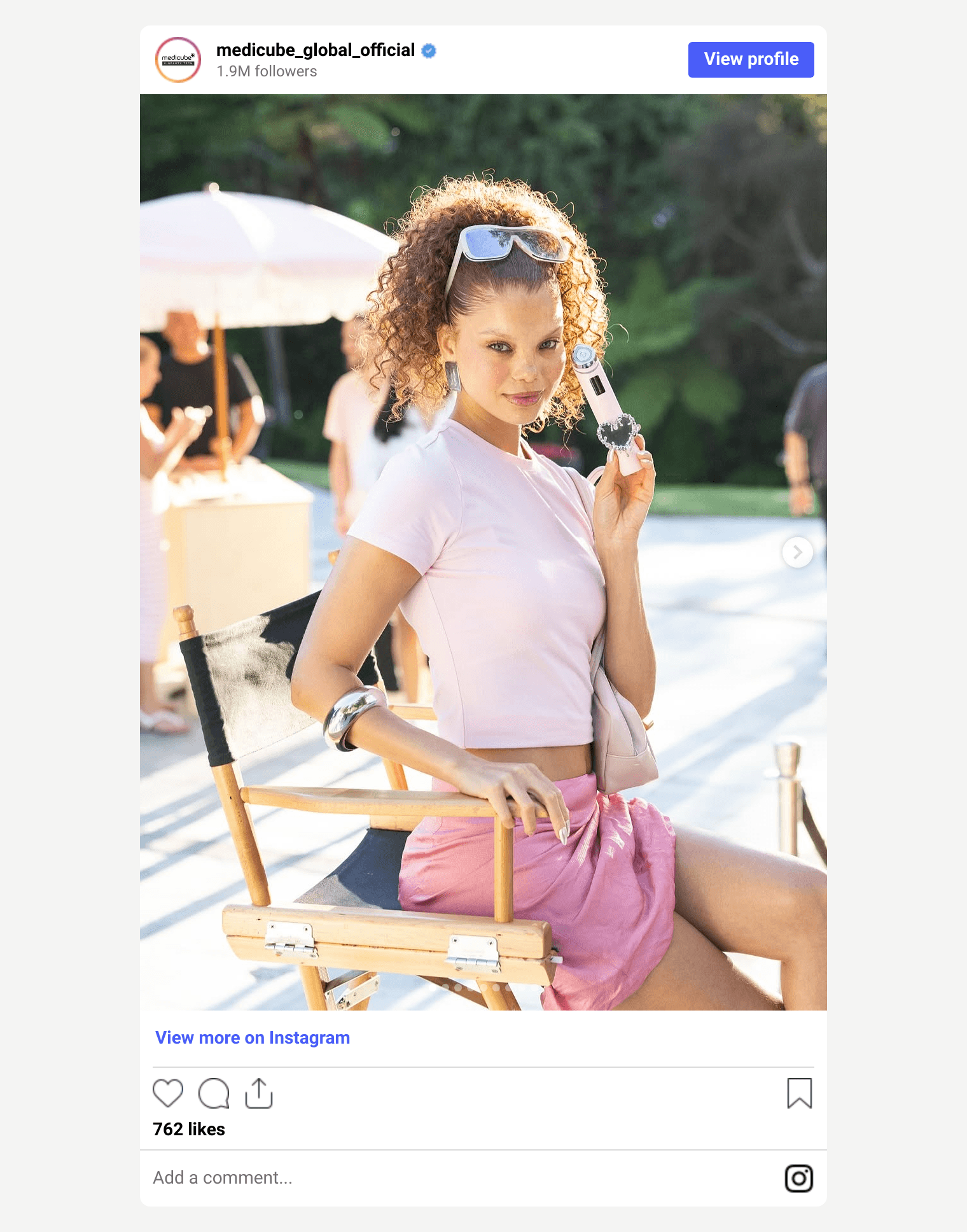
medicube announces its nationwide Ulta launch. View on Instagram
Its parent APR says Ulta store sales were up 312% by the end of last year. Chosun Biz reported it then spread to about 1,500 Target stores in April and about 3,000 Walmart stores. Both figures come from the company side.
TIRTIR and Medicube both had shoppers looking for them before they reached Ulta. Amazon sales, TikTok videos and creator reactions came before the listing.
For what to put in stores after the listing, and how to bring shoppers there, Unleashia is a useful case. It was one of the eight K-Beauty World brands that came to Ulta in July 2025, and 8 of the 10 Unleashia products on Ulta.com today are Ulta exclusives. According to Business Insider, Ulta's CEO named it with Medicube, TIRTIR and Fwee as new brands added that year on the December 2025 earnings call.
Stores and Ulta.com carry very different ranges. Online, the 10 products come in 72 shades in total. About 400 stores carry 15 of them. Unleashia posted its in-store list on Instagram on August 20, 2026. It names 4 of the 9 Glitterpedia palettes and 4 of the 12 gloss balm shades, plus 7 glitter stick, eyeshadow palette and brow items. During Ulta's K-beauty event that month, all 1,450 stores carried four items: three gloss balm shades and one Glitterpedia palette.
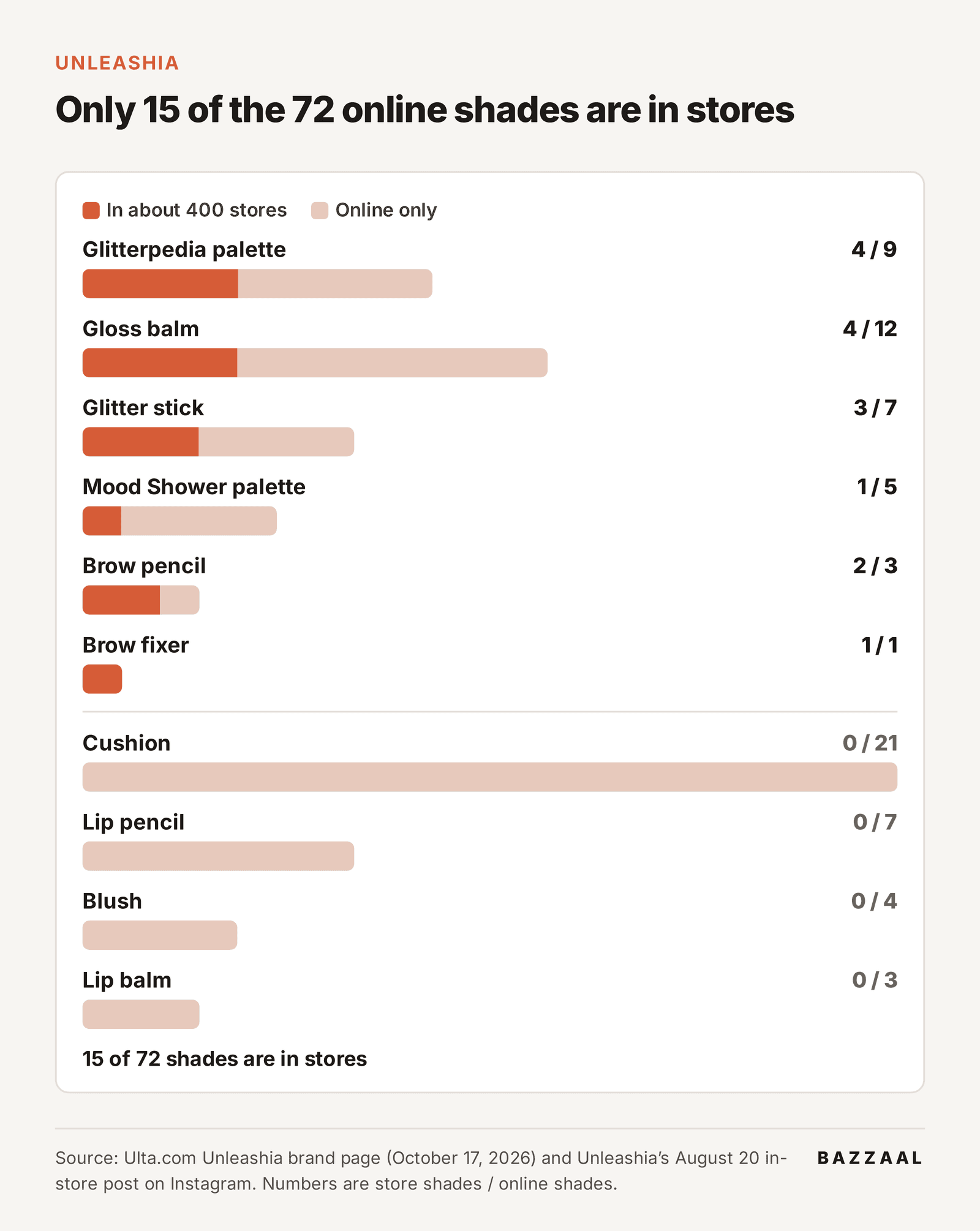
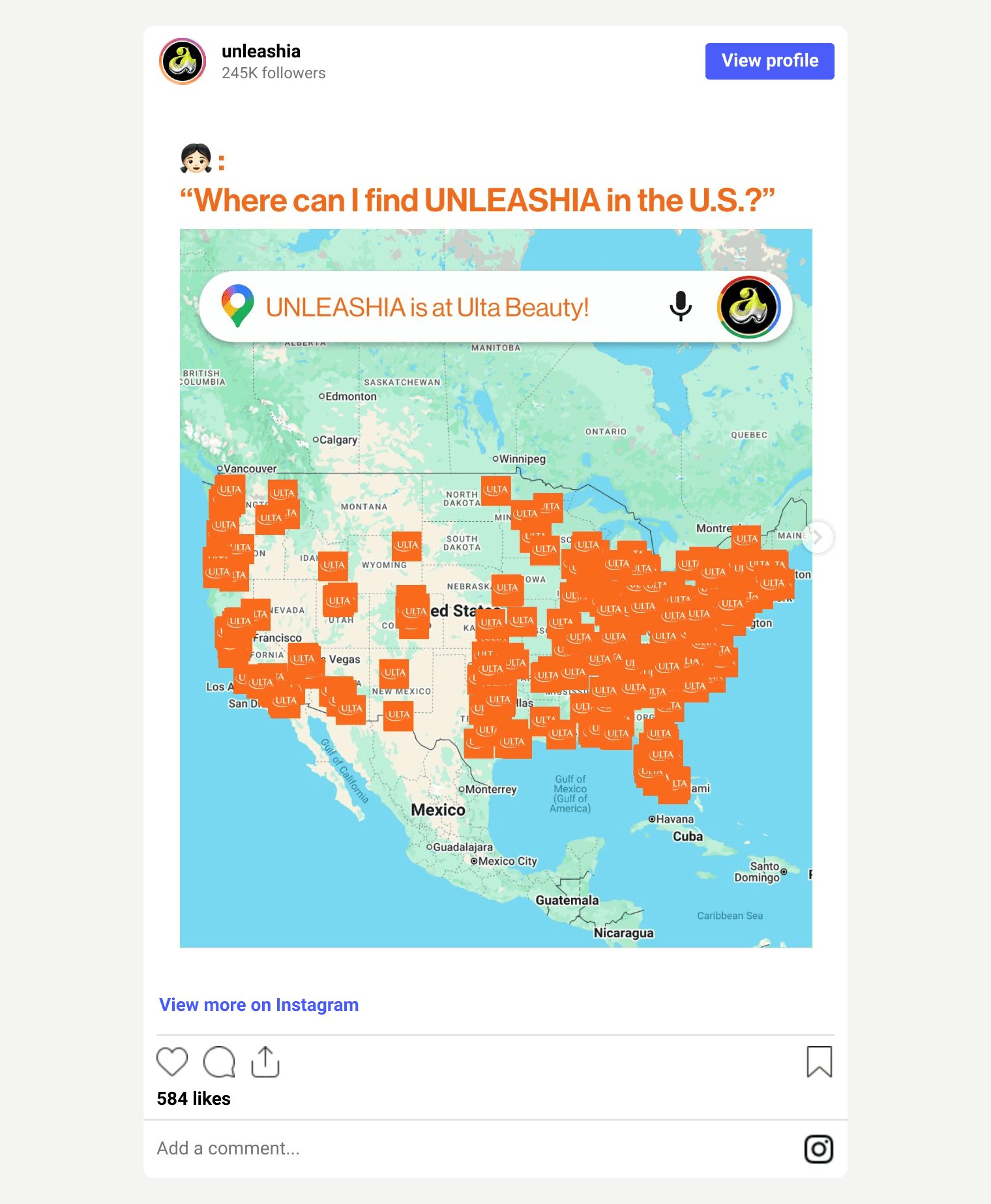
Unleashia lists the products in about 400 Ulta stores. View on Instagram
The 21-shade cushion is sold online only, along with the lip pencil, lip balm and blush. Every product in stores is an eye, lip or brow item that needs no skin-tone match. A cushion is hard to stock in just a few shades, because a shopper whose shade is missing cannot buy it on the spot. Comments on the August post ask for the cushion in stores, but a color brand's first in-store products are more realistic if they sell without a shade match.
Ulta spends on K-beauty marketing too, yet Unleashia worked to send its own Instagram followers to Ulta. Right after launch, from August 4 to 17, 2025, it picked four shoppers who posted their Unleashia Ulta hauls and gave each a $25 Ulta gift card and products. This year it pointed followers to its bestsellers on in-store displays in March, a 20% off code for the cushion at Ulta in July, and a store-finder map in August. Its Instagram bio reads "Find us at @ultabeauty."
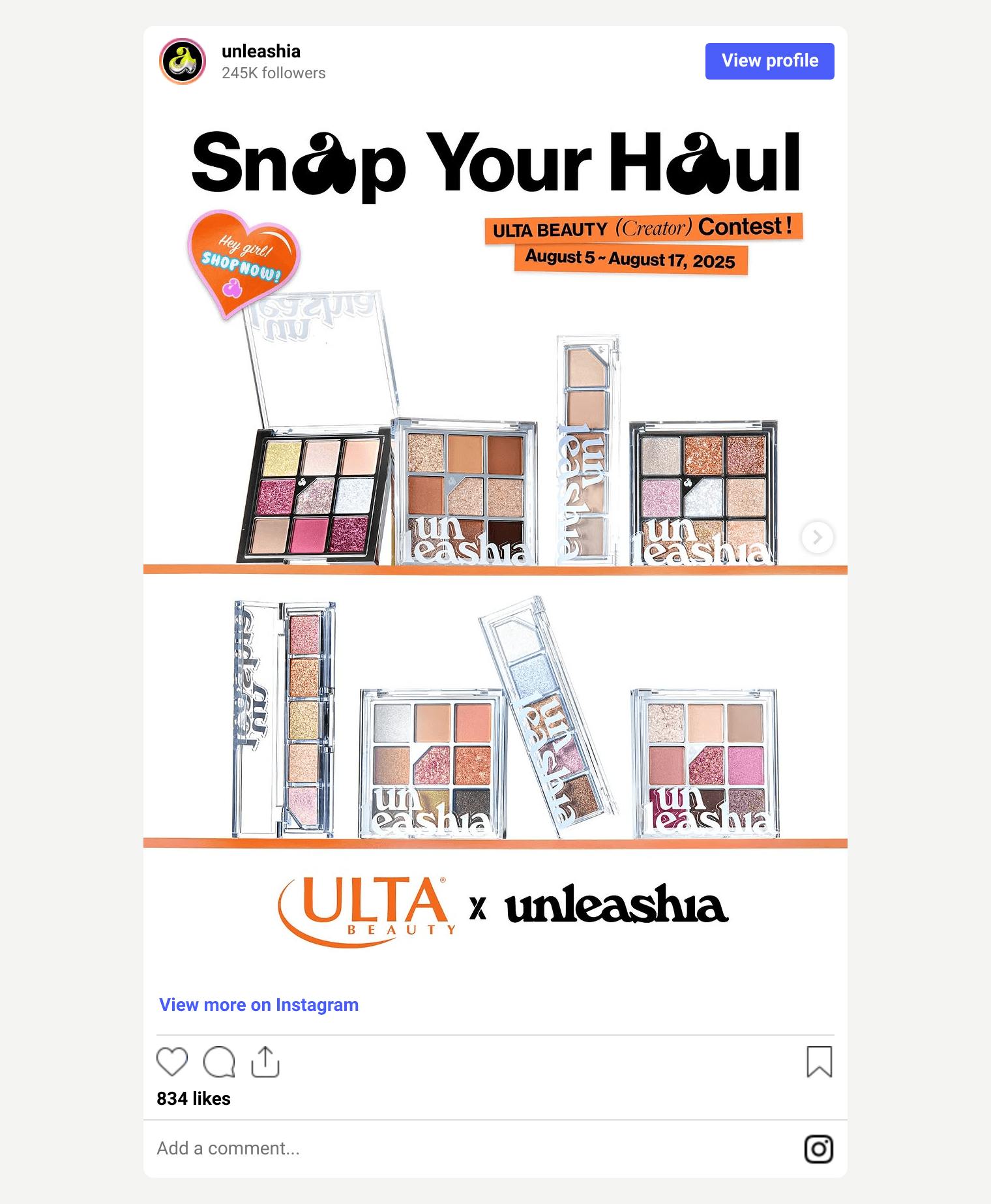
Unleashia’s #UnleashiaAtUlta launch event. View on Instagram
What blocks skincare brands first?
Sunscreen is the biggest hurdle. In the US it is classified as an over-the-counter drug. You need facility registration, product listing, a Drug Facts label and cGMP, and cosmetic registration alone will not do.
The rules moved once this year. On June 10, FDA added bemotrizinol as a sunscreen ingredient by final order, effective August 9, at up to 6%.
But the applicant, DSM, holds 18 months of exclusivity, so for now only DSM and its licensees can use it. A sunscreen sold in Korea still cannot ship as is.
Ordinary skincare brings paperwork too. FDA requires cosmetic facility registration to be renewed every two years, and products must be listed. The responsible person named on the label has to keep safety substantiation.
Clean and vegan claims need proof. A class action over Ulta's Made Without clean standard was filed in October 2025. It is only an allegation, not a ruling. Even so, if you print clean or vegan large on pack, collect your certificates first.
Last is efficacy data. One analysis says clinical trust drives conversion at Ulta. Keep clinical results, dermatologist tests and before-and-after photos in English, and use the same material in the buyer pitch and on the product page.
How many shades does a color brand need?
We found no published minimum shade count for new color brands at Ulta. So we read the shade lists on Ulta.com product pages and counted them ourselves. The date is October 17, 2026, and we compared four K-beauty cushions with 84 foundations from 32 established brands such as MAC, Maybelline, Fenty Beauty and Rare Beauty.
Product | Shades | Cool | Neutral | Warm |
|---|---|---|---|---|
TIRTIR Mask Fit Red Cushion | 40 | 11 | 21 | 8 |
TIRTIR Mask Fit AI Filter Cushion | 30 | 8 | 17 | 5 |
TIRTIR Tinted Skin Glow Cushion | 30 | 8 | 16 | 6 |
Unleashia Satin Wear Cushion | 21 | 2 | 15 | 4 |
Four K-beauty cushions, total | 121 | 29 (24%) | 69 (57%) | 23 (19%) |
84 foundations from established brands | median 27, 22 with 40 or more | 26% | 37% | 37% |
The undertone shares for established brands use only the 838 shades whose names carry a C, N or W code. Products without codes, such as MAC and Maybelline, are left out, and the comparison set is 32 brands we picked. This is not a census.
The result is that shade count is not where K-beauty cushions fall short. The TIRTIR Red Cushion has 40 shades, down to 55N. The median of 30 across the four cushions is above the established-brand median of 27. Fenty has 50, Rare Beauty 48, and the largest, MAC Studio Fix Powder Plus, 70.
L'Oréal's Infallible Cushion Foundation, an Ulta exclusive launched in the second quarter, has 20 shades. If a mass-market brand ships a cushion in 20, shade count alone cannot explain a K-beauty gap.
The bar is higher in prestige color. Rare Beauty reached all Ulta stores on February 1 with a 48-shade foundation. Ulta called that launch record-breaking on its fourth-quarter call, and said Rare Beauty drove prestige color growth in the first quarter.
Undertone is what stands out. Warm shades are 19% of the K-beauty cushions against 37% in the established-brand set, about half. Among cushions, warm is actually the smaller share.
We could not test the idea that tone-up creams skew warm. None of the 60 products in Ulta's K-Beauty makeup category were tone-up creams.
The CEO of Landing International told Glossy that you cannot get a 100% American makeup look from Korean products because coverage and pigmentation differ. Filling the shade list does not make the experience the same.
What do reviewers complain about?
So we counted complaint keywords in 72,275 foundation reviews on Ulta.com: 428 for the four K-beauty cushions and 71,847 for 82 established-brand foundation products. The TIRTIR Red Cushion supplies 342 of the 428 K-beauty reviews, so the sample leans heavily on one product.
Share of reviews mentioning | K-beauty cushions | established-brand foundations |
|---|---|---|
Wanting more shades | 0.5% (2 reviews) | 0.5% |
Oxidation | 9.1% (39) | 2.2% |
Orange or gray cast | 7.0% (30) | 2.5% |
Online shade-match tool | 1.4% (6) | 0.35% |
Overall dissatisfaction is similar. Reviews of one or two stars are 11.0% for the K-beauty cushions and 11.8% for the established-brand foundations. What differs is the kind of complaint, not the score.
Almost nobody says their shade is missing. Requests for more shades run 0.5% in both groups. Oxidation comes up about four times as often for K-beauty cushions, and an orange cast nearly three times as often. The complaint sits less in how many colors there are than in the chosen color changing hours later.
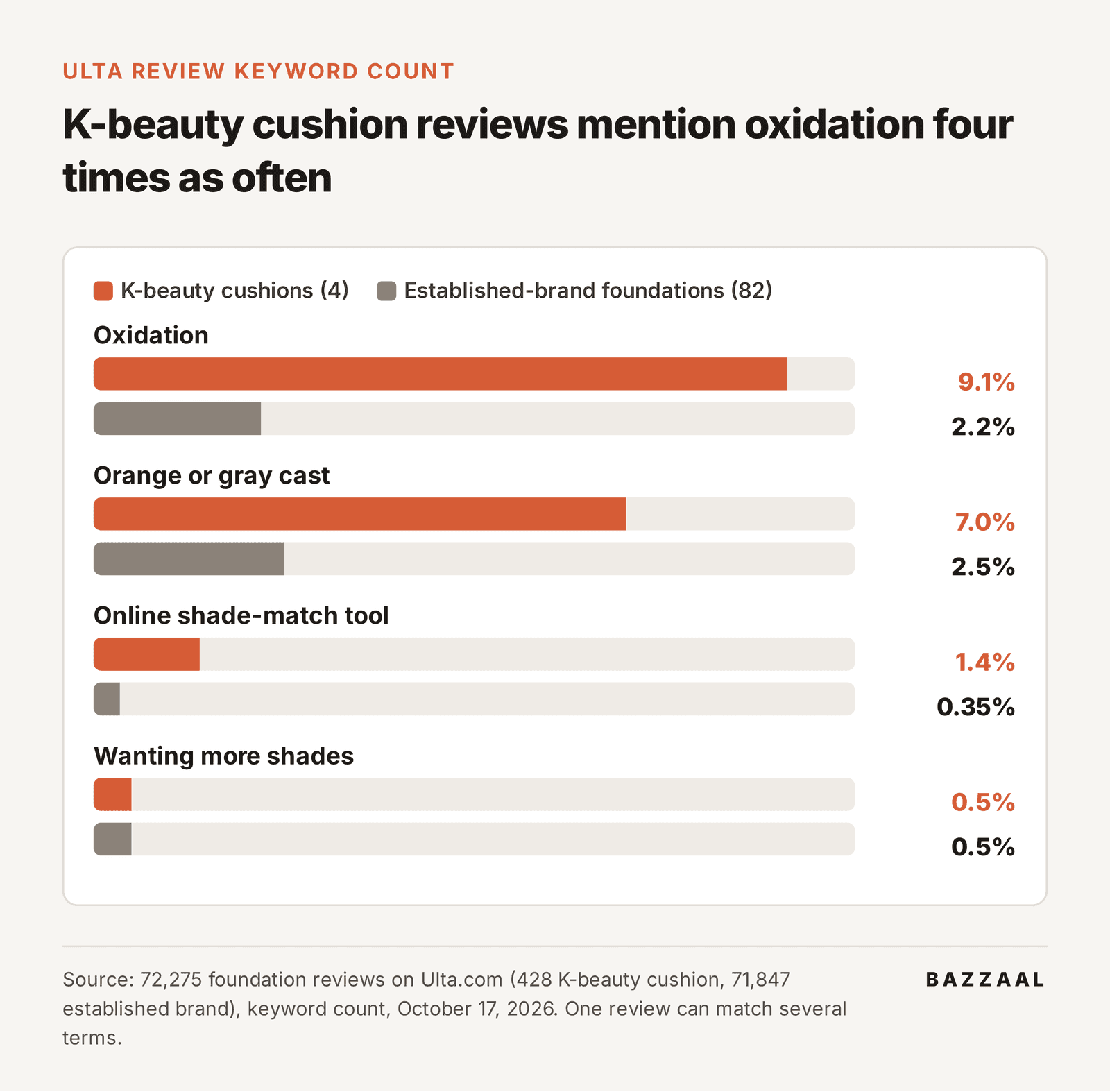
The reviewers' own words explain the numbers. One said the cushion oxidized so badly that adding a much lighter shade still left her orange. Another used the brand site's shade-match tool, got a different shade for each product, and found none matched olive skin. For brands that shoppers cannot test in store, online matching is the weak spot.
These counts come from word patterns, so one review can fall under several rows. Read them for direction. The K-beauty sample is small, so the 95% interval for oxidation at 9.1% runs from 6.7% to 12.2%. Even its low end is more than three times the established-brand 2.2%.
In practice, add oxidation testing, undertone guidance and testers and swatches in store to your entry prep, alongside the shade-expansion plan.
Who pays for promotions?
Put plainly, no public source says. The annual report states that vendor allowances for co-op advertising, markdowns and volume discounts are reflected in inventory cost. That shows vendors bear part of the cost, and no document gives a per-event share.
There are clues to where money goes. On the first-quarter call, Ulta said it held more than 40,000 in-store events with brands in one quarter. Promotion there is bundled with events and ads, not only price cuts.
The climate is shifting a little. In March, guidance included no elevated promotion. In August, executives said the market ticked up and Ulta was slightly more promotional than the year before. They left room in guidance to stay promotional if needed.
Industry write-ups assume you sell at about half of retail, with a brand share of 25% to 30% of retail after costs. Ulta has not published that number. On a $20 product, you supply at $10 and keep $5 to $6, and manufacturing and US freight must fit inside it.
So build the margin sheet with three columns: a month with no promotion, a big event month, and a month with ad spend. All three must be profitable before you sign. Do not reuse your Korean wholesale price with exchange rate and tariffs added. Build a US price list.
Plan stock separately for big event months. Two Glitterpedia reviews on Ulta.com say an order placed on the first day of a sale was canceled for lack of stock, and both gave one star. Whoever caused the shortfall, the low rating stays on the brand's product page.
What hits in the three months after you sign?
What follows leans on industry write-ups of Ulta's supplier portal guide. We could not open the portal itself, so get the current rules at the contract stage.
The first thing to land is EDI. Summaries say you must be EDI-capable within 30 days of the supply agreement. You send an order acknowledgement within two business days of a purchase order, then a ship notice and an invoice at shipment. Setup runs from about $450 one-time to monthly fees, depending on the service.
Next come chargebacks. Ulta reportedly notifies you of a violation first and deducts after 60 days. Typical categories are ship notice accuracy, on-time delivery, fill rate, labeling and packaging, and invoice mismatch. The scorecard refreshes every Monday.
Missing or wrong GS1-128 carton labels are the most common violation, so check the spec before goods leave your Korean factory.
Ulta's supplier standards, revised in March 2024, say subcontracting needs Ulta's written consent. If one Korean manufacturer makes for several brands, ask about subcontracting scope early. Minimum product liability insurance varies by source and we could not confirm it. Ask your contact in writing.
If you have no warehouse, an Ulta new-brand lead once recommended a US 3PL. That was a 2022 RangeMe interview, so it may be out of date.
How should the timeline look?
This is the order public sources suggest. Use it for direction, and settle dates with your buyer.
Before entry, build sales history and reviews on Amazon and TikTok Shop.
One account puts the wait from RangeMe submission to an answer at 12 to 16 weeks. It is a 2022 interview and may differ now.
The same interview says sunscreen sets change once a year in spring, and missing the window can push you to next year.
Right after signing, the 30-day EDI rule applies, so finish integration prep before you sign.
Skincare adds time for FDA paperwork, and color adds time for shade expansion. TIRTIR's case suggests budgeting two to four months for each new shade.
What should you prepare before entry?
Area | Skincare | Color |
|---|---|---|
First hurdle | Regulatory paperwork. Sunscreen follows the drug process | Oxidation, shade matching and undertone mix |
Numbers behind it | Bemotrizinol allowed, 18 months of exclusivity | Cushion median 30 shades, oxidation in 9.1% of reviews |
Case | Medicube. Started on Amazon, then every Ulta store | TIRTIR. Three shades to 40, then about 400 stores in August. Unleashia. Only eye, lip and brow items with no shade match in stores, cushion online |
Prepare ahead | US formula, Drug Facts label, efficacy data | Oxidation tests, undertone guidance, testers and swatches |
Both need product barcodes and EDI.
What does BAZZAAL see in LA?
BAZZAAL runs creator seeding for K-beauty brands in LA. The counts here show that shade complaints surface first in videos and reviews, ahead of the shelf. TIRTIR's shade story also started in creator videos.
If you send product to creators with a wide range of skin tones in LA before you reach the shelf, you hear the oxidation and undertone reactions before entry. Turn those into a fix list, and you will not hear the same story later in your review feed.
Frequently asked questions
Where does an Ulta listing start?
The official route is a RangeMe profile submission. Ulta says it has no obligation to review, so many brands build Amazon or TikTok Shop sales history first.
Can a Korean sunscreen be listed as is?
Not as is. In the US sunscreen is an over-the-counter drug, so it must follow the permitted ingredient list, a Drug Facts label, and facility and product registration.
How many shades should a color product have?
There is no published minimum. Across the 84 foundations from established brands we counted, the median is 27 and 22 have 40 or more. The TIRTIR Red Cushion has 40 and Fenty has 50. Check the two ends of the range, the gaps between shades and the undertone mix before the count.
Which products should a color brand put in stores first?
Ulta publishes no standard. In Unleashia's case, stores carry only items like glitter palettes and gloss balms that need no shade match, and the cushion is sold online only. To bring a cushion into stores, prepare an oxidation test, testers and shade guidance first.
Can a tone-up cream get listed?
None of the 60 products in Ulta's K-Beauty makeup category in our check were tone-up creams. With no listing case confirmed, ask the buyer first where the category would sit.
Do I have to join promotions once listed?
Public sources do not say. Participation duty and cost share are questions for your buyer before the contract.
Is UB Marketplace a safer first step?
Some see it as a lower-cost route than stores. At launch, shoppers complained that rewards and discount codes did not apply. Marketplace brands are now included in events like 21 Days of Beauty, but do not count on strong conversion.
Sources. Our own counts: shade lists and public reviews on Ulta.com product pages, collected October 17, 2026. Ulta Beauty: fiscal 2025 Q4 and fiscal 2026 Q1 and Q2 earnings call transcripts, annual report on Form 10-K, product submission guidance, supplier standards (March 2024). K-Beauty World press release (PR Newswire, July 14, 2025), Business Insider (December 2025), Unleashia's official Instagram posts (August 5, 2025; March 8, July 29 and August 20, 2026). Press: Glossy (July 11, 2025), Korea Times (February 12, 2026), Chosun Biz, Yonhap Infomax, Electronic Times, Teen Vogue and Vogue on TIRTIR, BeautyMatter (February 3, 2026), Beauty Independent. Regulation: FDA final order OTC000039, FDA cosmetic facility registration guidance.
Limits. We could not open the fiscal 2025 Q3 call, so the CEO's mention of Unleashia comes from Business Insider's report. Consultancy and industry guides are secondary sources, and we could not check Ulta's supplier portal. The review and shade counts are samples built from brands we chose.
Related: How to plan your first six months after Sephora and Ulta · Olive Young's 19 Sephora brands: the bar was Korean sales
Written by
Yong Suk Choi
Chief Business Officer
Chief Business Officer at BAZZAAL. 15+ years of zero-to-one go-to-market execution across Korean and US markets, now leading growth for K-beauty brands entering the US from Los Angeles and Seoul.
Connect on LinkedIn
Planning your US launch?
BAZZAAL runs creator seeding, TikTok Shop, and paid campaigns for K-beauty brands entering the US — from Los Angeles, in Korean-company workflows.
Subscribe to STATESIDE
Weekly US K-beauty intelligence, from our team on the ground in LA.


