How Can a K-Beauty Brand Reach US College Sororities?

By
Yong Suk Choi

Sorority recruitment, known as rush, runs every August at large US universities and fills TikTok with outfit and get-ready videos. In August 2026, the Alpha Delta Pi chapter at the University of Texas at Austin thanked Innisfree US for "teeing up" with its golf-themed rush party, and Glow Recipe and CeraVe ran sorority campaigns the same summer.
All three worked through chapters: Innisfree turned up at one chapter's rush party, CeraVe rebuilt one chapter's backyard, and Glow Recipe picked chapters from applications. A smaller brand doesn't need to start there. It can leave chapter sponsorships for later and begin with a handful of students who already post on RushTok on a single campus. The basics are getting product into students' hands by late July, putting a disclosure request in the package, and asking separately for usage rights if you want to run their videos as ads.
In short
At Alabama, rush runs about ten days on campus, and rushees on RushTok post their look every day. By 2023, #RushTok had 2 billion views and #BamaRush 3.9 billion.
Tarte gifted products to 30,000 rushees in 2022 with no payment and no posting requirement. Sales through the student discount program Unidays spiked 1,300%, Glossy reported.
In 2026, Poppi partnered with more than 20 chapters, Glow Recipe took chapter applications and CeraVe rebuilt a sorority backyard around sunscreen. A smaller brand needs none of that to start: one campus, a few students who already post on RushTok, and product in their hands by late July.
What is a sorority, and how big is Greek life?
A sorority is a women's social and service organization at a US college. The men's version is a fraternity, and together they make up Greek life. Each campus branch is called a chapter, and some chapters run houses where members live and hold events.
The scale shows most clearly at the University of Alabama, which is credited with the largest Greek-life participation in the US. In spring 2026 it counted 7,975 sorority members and 4,670 fraternity members, according to The Tuscaloosa News. For 2026 recruitment, Alabama Panhellenic, the campus council that runs sorority recruitment, says 2,506 women registered. On Bid Day, August 16, 2,371 of them ran to their new chapter houses.

Bid Day 2026, posted by Alabama Panhellenic. View on Instagram
Nationally, 6% of American women told YouGov in 2023 that they had been members of a college sorority. The Tuscaloosa News estimates Greek participation at about 750,000 students at more than 600 colleges in the US and Canada. It points to RushTok as a big driver of the recent growth. If RushTok is pulling students into Greek life, it is also where a brand can show up in rush long before it gets inside a chapter house.
What happens during rush week?
Inside the chapter house, rush is how sororities choose new members. The Tuscaloosa News traces the word to the late 19th century, when chapter members would rush to train stations to greet and recruit incoming freshmen. Today, prospective new members, or PNMs, visit chapter houses, talk with members and are matched through mutual selection. On Bid Day they open their bid envelopes and run to their new houses.
Rush itself lasts about ten days on campus, but the process starts months earlier. At Alabama in 2026, online registration ran from May 1 to July 15, early move-in for PNMs began August 6, and bids came out August 16.
That calendar sets a brand's deadlines. The videos pile up in the ten or so days between early move-in and Bid Day, so product has to be in students' hands by the end of July.

What is RushTok?
RushTok is where those ten or so days play out: the TikTok genre that documents rush, with the outfit-of-the-day video as its signature format. Business Insider reported in 2023 that #RushTok had 2 billion views, while #BamaRush, the separate tag for Alabama's rush alone, had nearly twice as many at 3.9 billion. The Tuscaloosa News dates the #BamaRush explosion to the summer of 2021, after the pandemic shutdowns. The climb was fast. When Glossy first covered the trend in August 2021, #BamaRush had 235 million views, and a year later it had 1.8 billion.
The PNMs make the content themselves. Ava LeBlanc, an Auburn University freshman in 2023, drew more than 1.1 million views with her first rush video, and her reaction to joining Alpha Gamma Delta passed 770,000. "Everybody knows about rush. It's a southern thing that everybody does," she told Business Insider. By September 2023 she had 444,000 TikTok followers, and she said she had received several offers to work with beauty brands since the videos took off. "The thing I love about RushTok is everybody gets so invested in you and your journey," she said. Because rush is over so quickly, Business Insider notes, many creators use RushTok as a stepping stone to a broader audience.
Why do so many people watch it?
LeBlanc's viewers get invested for a reason. Writer Anne Helen Petersen, quoted in The Tuscaloosa News, says #BamaRush plays out like a reality TV show that people tune in to for two weeks in August. "It's like watching a different subculture," she wrote. Rushees post every day, so viewers follow PNMs such as LeBlanc the way they would a series. Outfits, makeup and what's in their bags all end up on camera.
For a beauty brand, that day-by-day format is the opening. PNMs who post on RushTok film their look and their getting-ready routine. Whatever products they use end up in those videos, and the same product can show up several days in a row.
Does the content stop after Bid Day?
For some creators, it keeps going. Amayah Shaienne documented her 2022 rush at Alabama and kept posting after she joined Zeta Tau Alpha, Business Insider reported. The next year she shared what was in a bag her sorority gave her, advice for PNMs, her outfits and behind-the-scenes footage of Bama Rush.
The campus calendar keeps going too. At Alabama, Weeks of Welcome began two days after Bid Day and cover the first eight weeks of the fall semester, with events running through October 10, 2026. Those are eight more weeks of events to film, so a product sent before rush can keep turning up well after Bid Day.
Why are beauty brands going back to campus?
Rush is the loudest moment on campus, but brands are returning through several doors, from rush gifting to campus stores and ambassador programs. The first reason is what young shoppers already use and spend. In WWD, Jeff Lindquist, a partner in Boston Consulting Group's New York office, said that "over 75 percent of folks around that just-before-college age are already using skin care and fragrance on a daily basis." They are also "spending 50 percent more than prior generations," he said. BCG estimates that teens spend about $5 billion a year on beauty.
Lindquist calls college the moment to lock in young adults who lean toward prestige and masstige and are just starting to build their own beauty routines. That is when trial can turn into long-term loyalty, he said, and distribution and customer acquisition are efficient "because it's all done on campus." He also sees campus micro influencers and student athletes as an effective way to reach Gen Z. When they share a product, he said, it "feels more like the advice of a friend," and students are "more willing to accept that" than something that feels like a paid ad.
If Lindquist explains why students matter, Kim Johnson, a director at Next Gen, United Talent Agency's marketing division, explains the timing. She says brands ran fewer in-person campus activations from 2020 through about 2023 and focused on social and content instead. Now they are coming back. Campuses are "these little communities, some feel like little cities," she said, and a presence there is "something that you really can't replicate even through social or through content." She also warned that students are hard to reach. "They're really busy," she said, so brands have to "show up really thoughtfully and really intentionally" to get their attention. With a small budget, that argues for timing a few boxes to one campus's rush calendar instead of spreading them thin.
How have brands joined rush season?
The brands coming back have joined rush in four ways: gifting rushees, partnering with chapters, bringing retail to campus and running student ambassador programs. Gifting is where a smaller brand should start, and Tarte's 2022 campaign is the clearest model. It reached rushees through 90-plus sororities, a scale a smaller brand can skip, but its calendar is worth copying.

According to Glossy, Tarte had sent DMs to 90 sororities by July 19 that year, asking whether they would like Tarte product and a discount code for their friends or "sisters." Boxes were shipped to more than 90 sororities, and by July 25 packages had arrived at the doors of 30,000 rushees at schools including Alabama, Florida State, Ole Miss, Arkansas, Georgia, Texas, Tennessee and Auburn. Each box held two products, the recently launched Tartelette Tubing Mascara and the TikTok-favorite Maracuja Juicy Lip Balm, a tinted balm. Tarte also picked 100 students with strong engagement on #RushTok posts and sent them "Survival Kits" that added Shape Tape concealer.
No money changed hands, and nobody was required to post. Most recipients posted anyway, as did most of the sororities. Tarte's Gen Z interns, some of them sorority members, had helped shape the messaging. Glossy reported that sales through Unidays, a student discount program that gives students 15% off and free shipping, spiked 1,300%, and Tarte's TikTok following grew by 3,500 to 843,000.
The second route skips the individual rushee. Poppi, the soda brand, works with chapters directly. In 2026 it partnered with more than 20 chapters, sent them 28,000 pieces of custom merch, and left branded coolers and fridges in the houses after Work Week, the preparation week before recruitment, Forbes reported. Sophia Sesto, Poppi's vice president of culture, said chapters have no posting expectations. Poppi says its 2025 rush program generated 10,000 posts and a reach of 40 million. More than 20 chapters is a later-stage budget, but dropping the posting requirement, as Poppi did, costs nothing at any size.
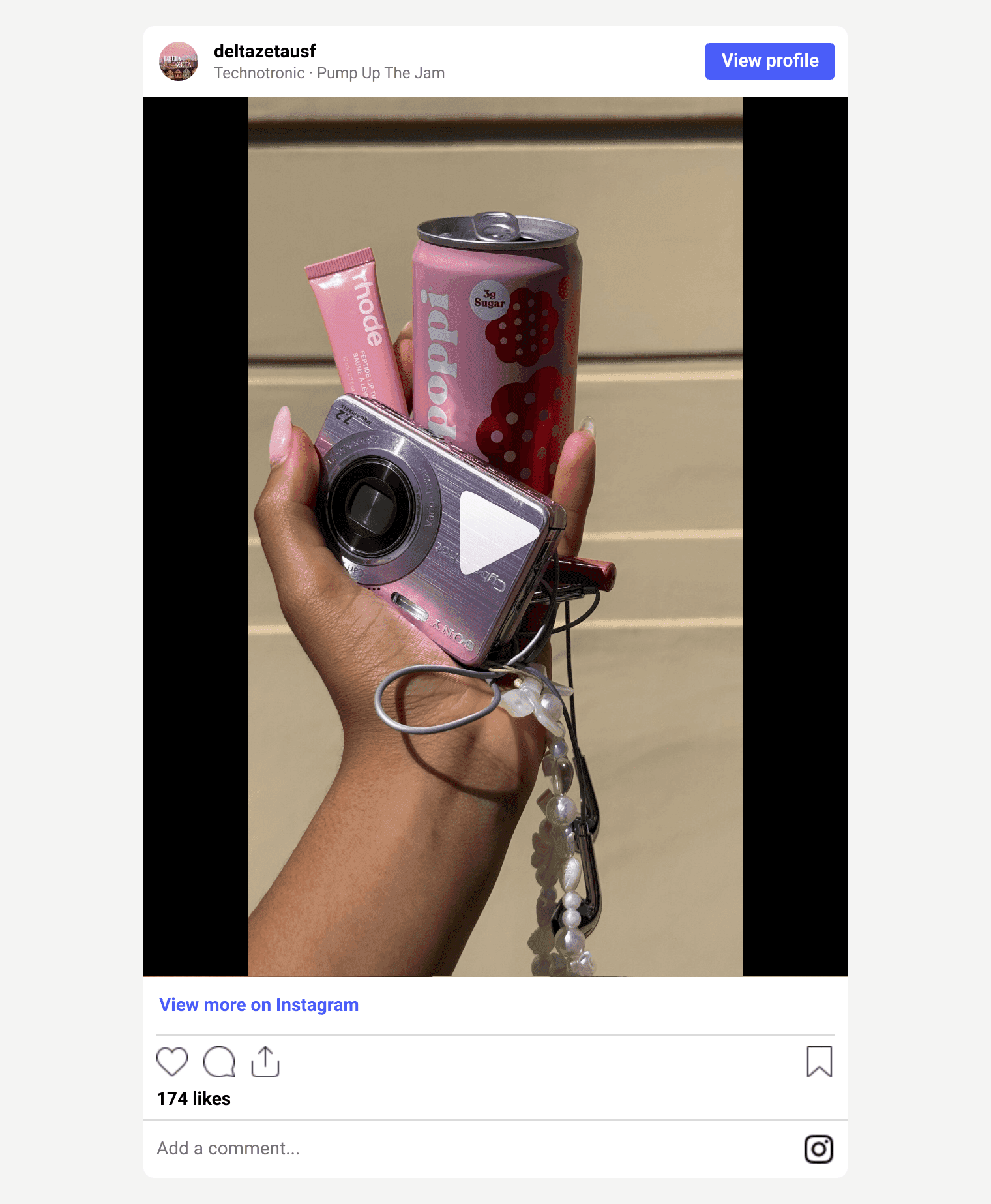
A Poppi post from Delta Zeta at UCF. View on Instagram
The third route puts the store itself on campus. That requires retail distribution, which a first seeding plan doesn't need. In August 2025, Bath & Body Works announced plans to sell body and lip care, candles and other products in more than 600 campus stores, WWD reported. That same month, Kohl's, which runs Sephora shops inside its department stores, opened a Sephora at Kohl's "Beauty Corner" at the University of Tennessee, the University of Georgia and the University of Florida during sorority recruitment week. The corners offered makeup and hair touch-ups, plus product giveaways.
Kohl's built the corners around rush on purpose. "Rush Week sparks a dynamic social conversation each year, and we saw an opportunity to meet Gen Z where they're already engaging," said Christie Raymond, Kohl's chief marketing officer. The Beauty Corner came back for a second year in August 2026 at Auburn, Georgia and Florida, BeautyMatter reported, this time with a postcard station that let students send friends and family a note with a 15%-off coupon. For a brand without campus retail, the lesson is the timing: Kohl's put product in front of students the same week they were filming rush videos.
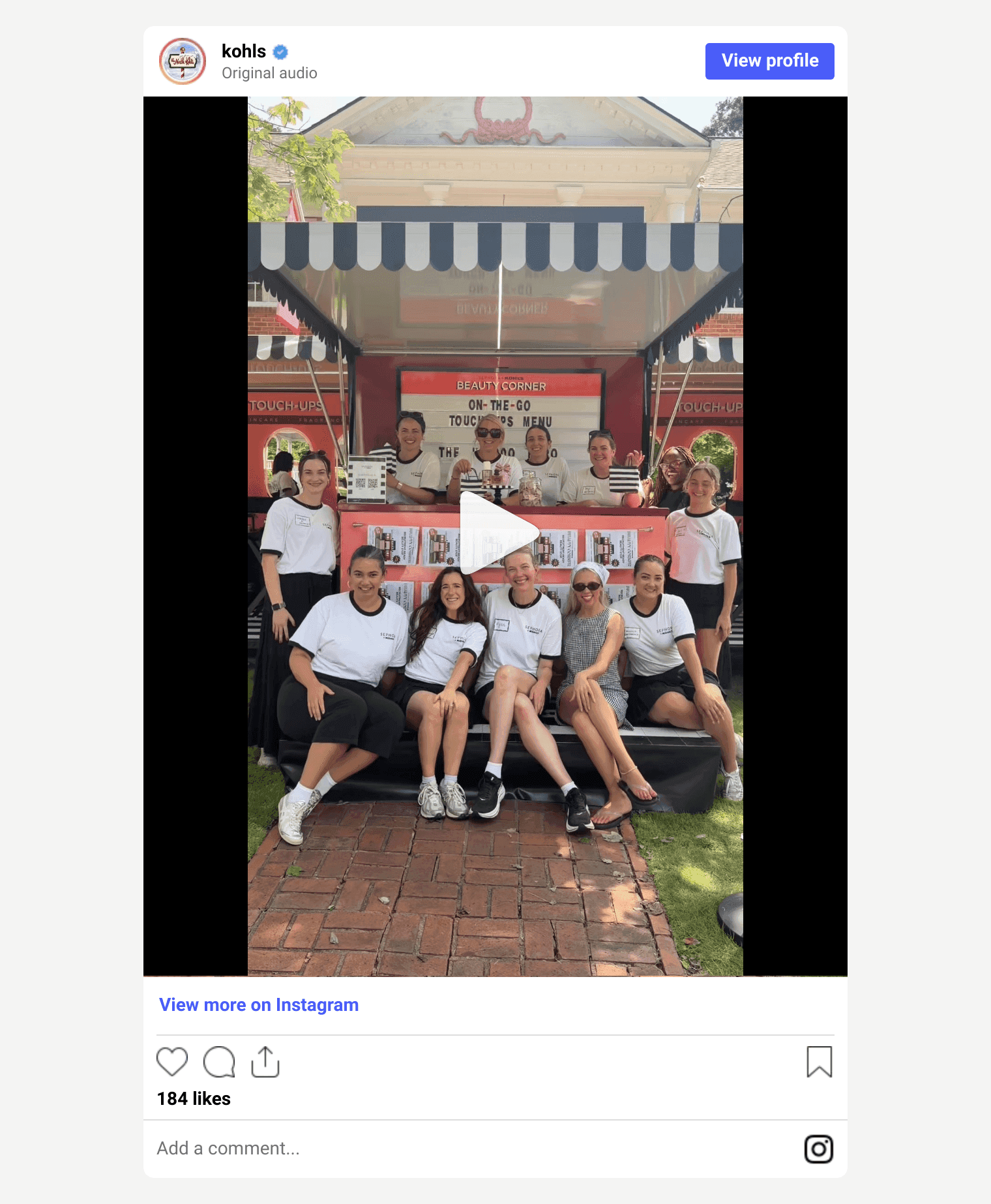
Kohl's brings the Sephora at Kohl's Beauty Corner to campus. View on Instagram
The fourth route turns students into a standing sales network. Bubble Skincare runs a student ambassador program. It had 15,000 college ambassadors when WWD reported on it in late 2025. They earn commission through their own promo codes, and 10 college reps each semester take on more structured roles such as hosting events. By May 2026, BeautyMatter put the network at 18,500, including 300 ambassadors at Alabama, and said Bubble's gifting suites and campus events during Alabama rush generated 3 million organic impressions. "If Bubble has a strong presence on a campus, we're going to build the trust with the students," said Marianne Robinson, Bubble's senior director of community and influencer. The students who post from a first seeding round are the natural first names for that kind of ambassador list later.
How did Innisfree show up at rush in 2026?
The chapter post from the top of this piece went up on August 13, 2026, when Texas Alpha Delta Pi shared a golf-themed rush party video on Instagram and TikTok. The caption reads, "It's a PAR-TEE at 2620 Rio Grande!! Thanks @innisfreeusa for teeing up with us!!!" The post also tagged Intern Queen, a marketing agency that runs paid student ambassador programs and whose website lists a paid Innisfree campaign for student creators. That campaign page says student creators are selected by location, follower count and fit with the brand's content.
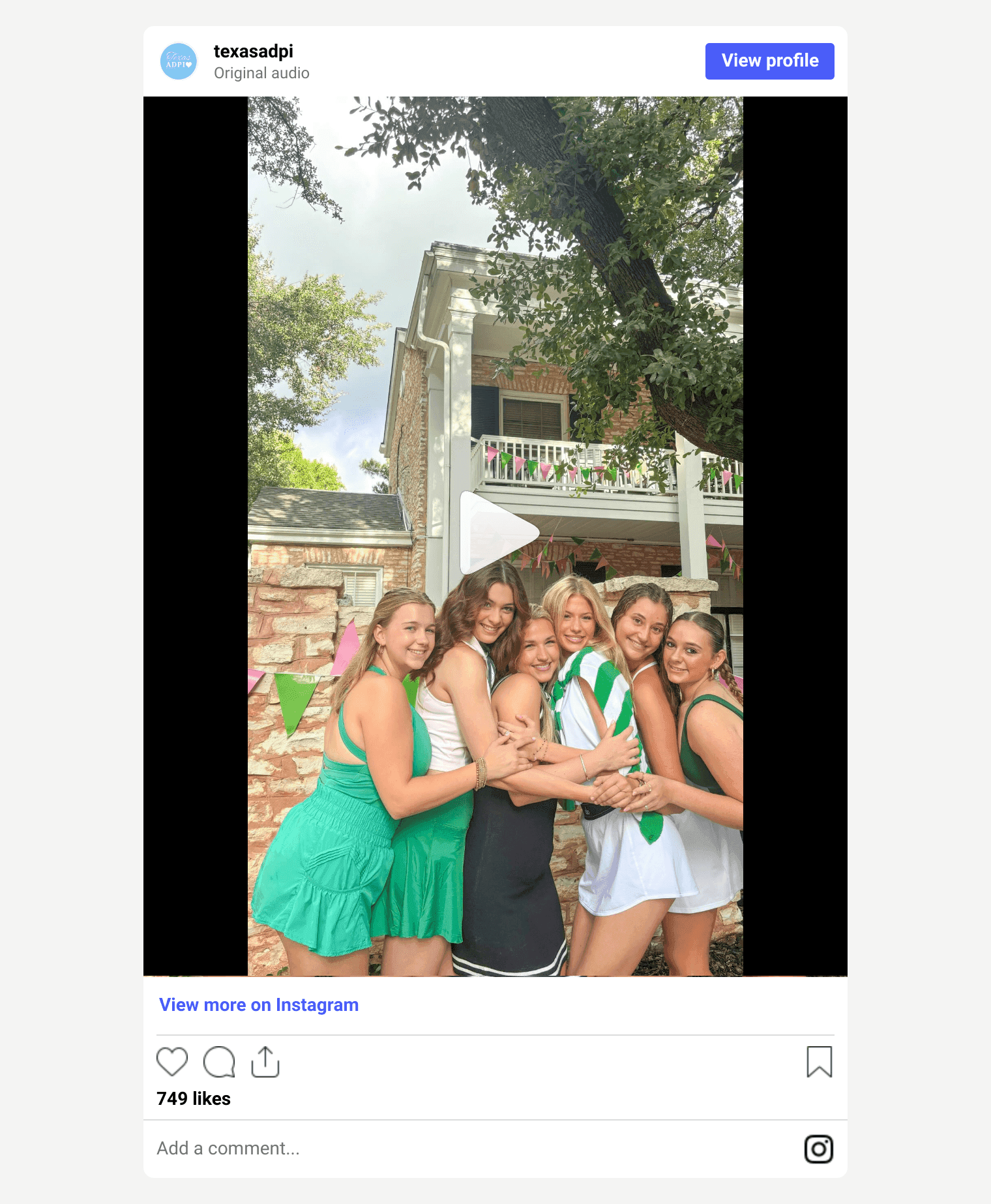
Texas Alpha Delta Pi’s PAR-TEE rush party, August 13, 2026. View on Instagram
Two weeks later, on August 27, Innisfree US posted its own rush reel tagging the chapter. "Rush week is all about showing up as your most authentic self," the caption began, adding that "feeling your best and finding your sisters starts with feeling confident in your own skin."

innisfree USA’s rush reel, August 27, 2026. View on Instagram
The quoted lines are about the rushees, not the product. A month before rush, Innisfree had run the same playbook off campus: let people carry the video and keep the product in the background. In July it named comedian and "Saturday Night Live" star Tommy Brennan its "official SPF Matchmaker" and sent him onto the streets of New York to ask people about their commitment issues. The videos promoted Green Tea Sunscreen Serum SPF 47, but Glossy reports that the sunscreen's benefits played second fiddle to Brennan's playful questions, and that this was largely the idea.
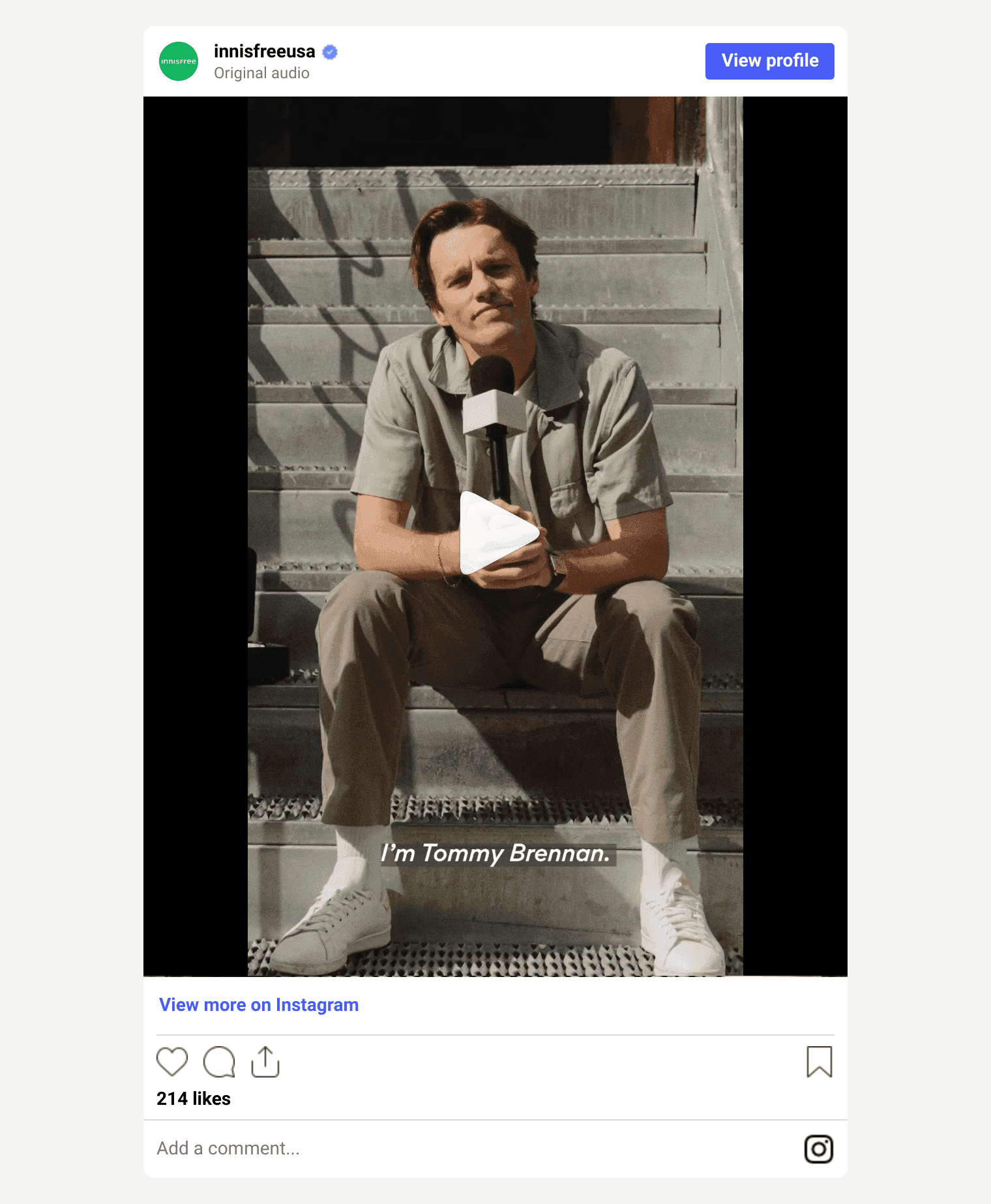
innisfree USA street-interview video with Tommy Brennan, July 2026. View on Instagram
"With Gen Z, in particular, traditional product-focused advertising is really not enough anymore," Jamie Lee, head of brand marketing at Innisfree US, told Glossy. "Entertainment is 100% the way to capture an audience." A rush party and a street interview look nothing alike, but both put people ahead of the product pitch. A seeded rushee's get-ready video does the same job: the student is the show, and the product rides along.
What did other beauty brands try in rush 2026?
Innisfree was not the only beauty brand on Greek Row that summer. Glow Recipe opened applications to sorority chapters on Instagram on July 18, 2026. Selected chapters would get a glass skin duo worth $36 for each member and would "post & feature Glow Recipe throughout recruitment content." They also had a chance at more than $10,000 in products and merch. Applications closed July 25, three weeks before Alabama's Bid Day.
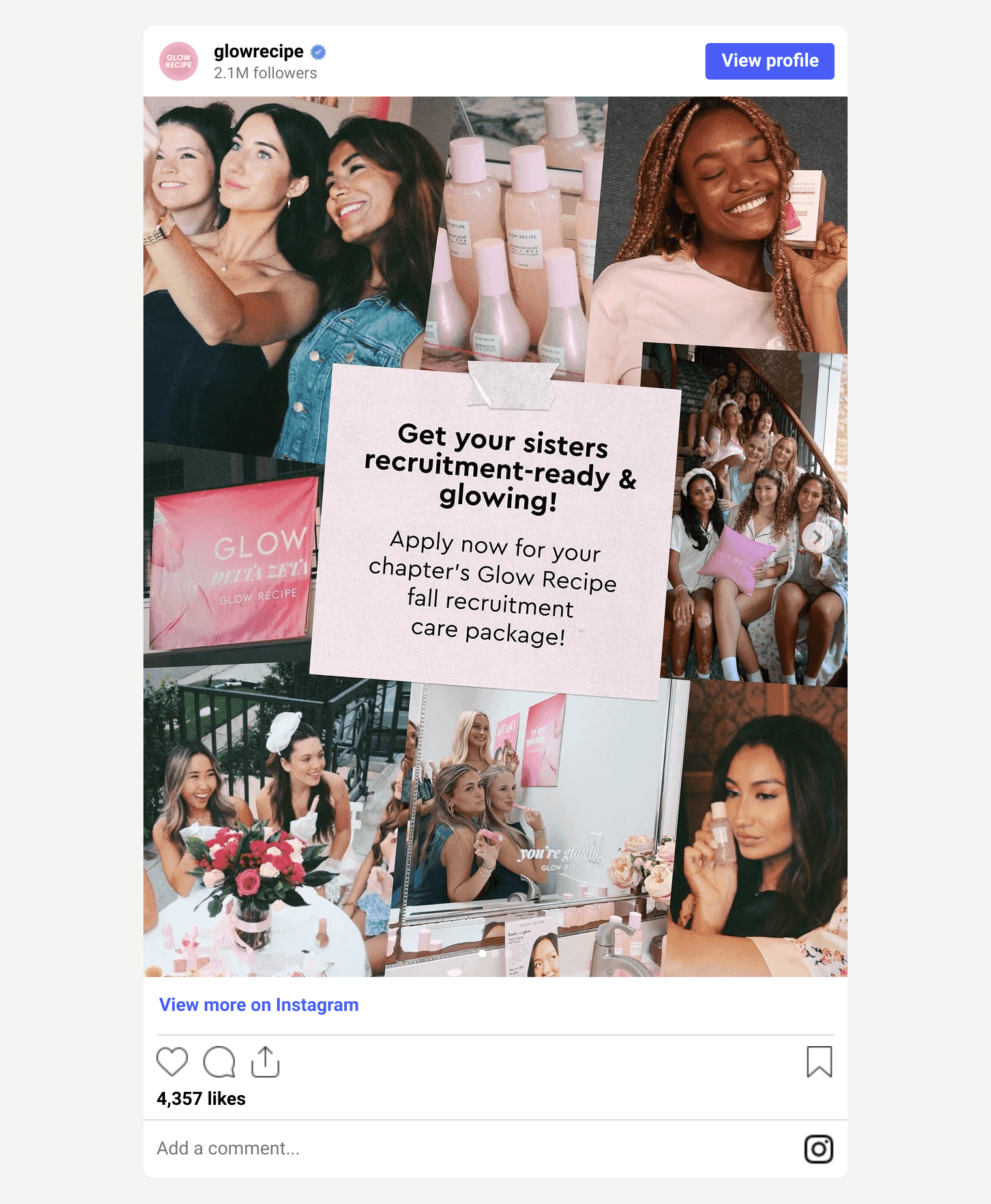
Glow Recipe’s call for chapter applications, July 18, 2026. View on Instagram
Where Glow Recipe recruited chapters, CeraVe built for one. It took a sunscreen launch to Florida State that back-to-school season and rebuilt the Tri Delta house backyard into a sun-safe social space with a pergola, shade landscaping, UV meters and SPF-dispensing stations, BeautyMatter reported. Bachelorette alum and licensed contractor Tyler Cameron and dermatologist Dr. Chloe Goldman filmed the project as a four-part social series featuring CeraVe's new Invisible Mineral Sunscreen SPF 50. CeraVe tied its sunscreen to house life spent outdoors. A brand can borrow the idea without building anything: use the card in the box to suggest a scene, such as reapplying sunscreen in the yard or at an outdoor event.
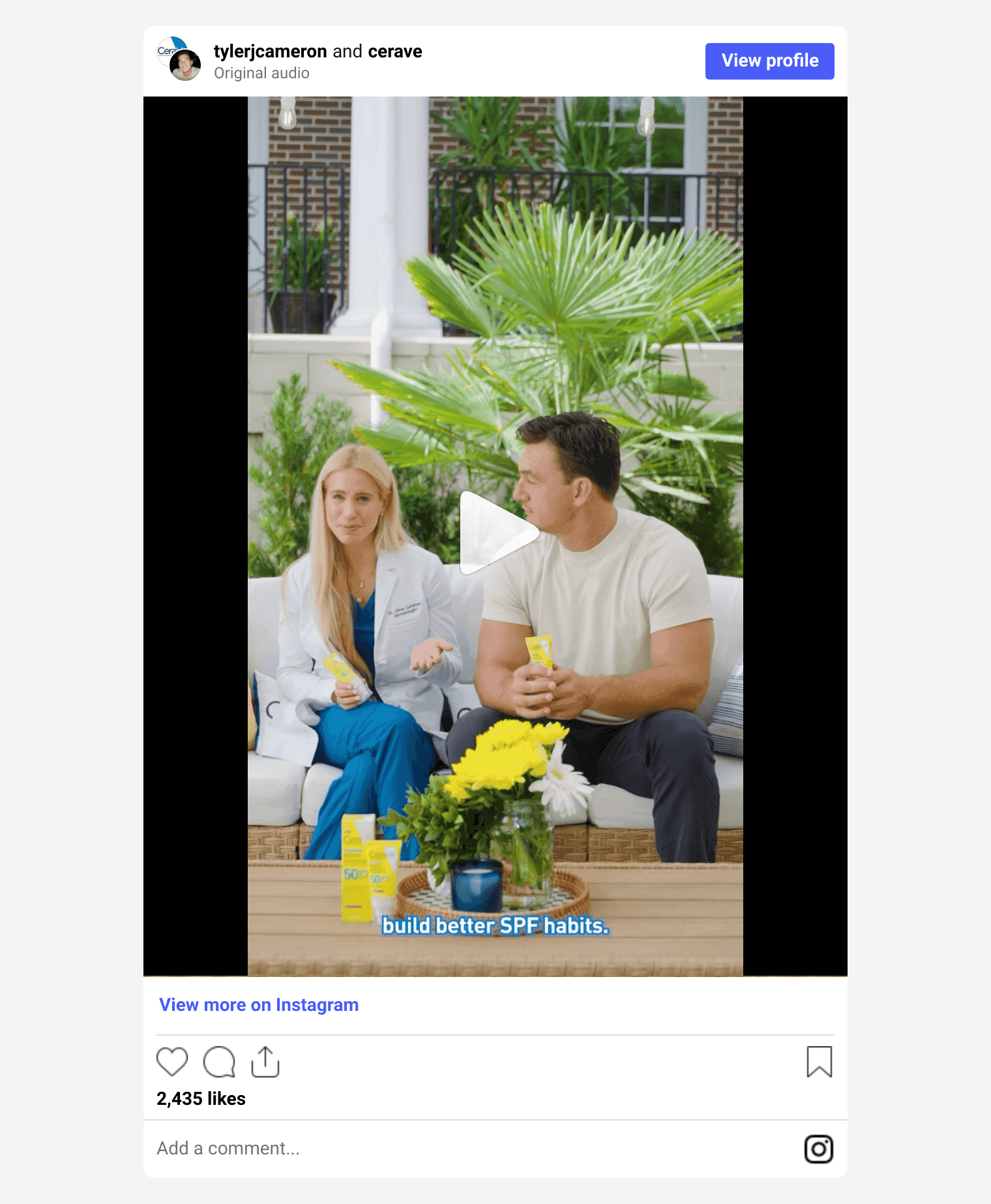
CeraVe’s sorority backyard series with Tyler Cameron. View on Instagram
CeraVe chose Florida State, which raises the question every brand faces first: which campus? Bali Body, an Australian tanning and suncare brand, told Forbes how it decides. It looks at its own sales at Ulta Beauty and Walmart, finds its strongest stores, and then looks at the campuses and sorority communities around them. Chapter size and social engagement come next. Bali Body works through agency partners and directly with chapters, sends product in bulk, and sets no posting requirement.
That hands-off setup fits how founder Laura Osterloo reads her audience. "Gen Z is incredibly good at recognizing marketing that feels forced," she said. "Simply putting a logo on something or paying for a post isn't necessarily enough anymore." Step 1 below borrows that store-first filter for picking a first campus.
Not every brand built a program around rush. Loving Tan, a self-tan brand, showed up through a single rush reel in August 2026. It pitched "10 minutes to a flawless glow during busy sorority recruitment" and tagged Texas State Alpha Xi Delta, calling the chapter's barre-themed recruitment "the cutest thing we've seen all week."
The reel sold one benefit, speed, to people with no time to spare. A note in a seeding box has room for exactly that kind of one-line pitch.
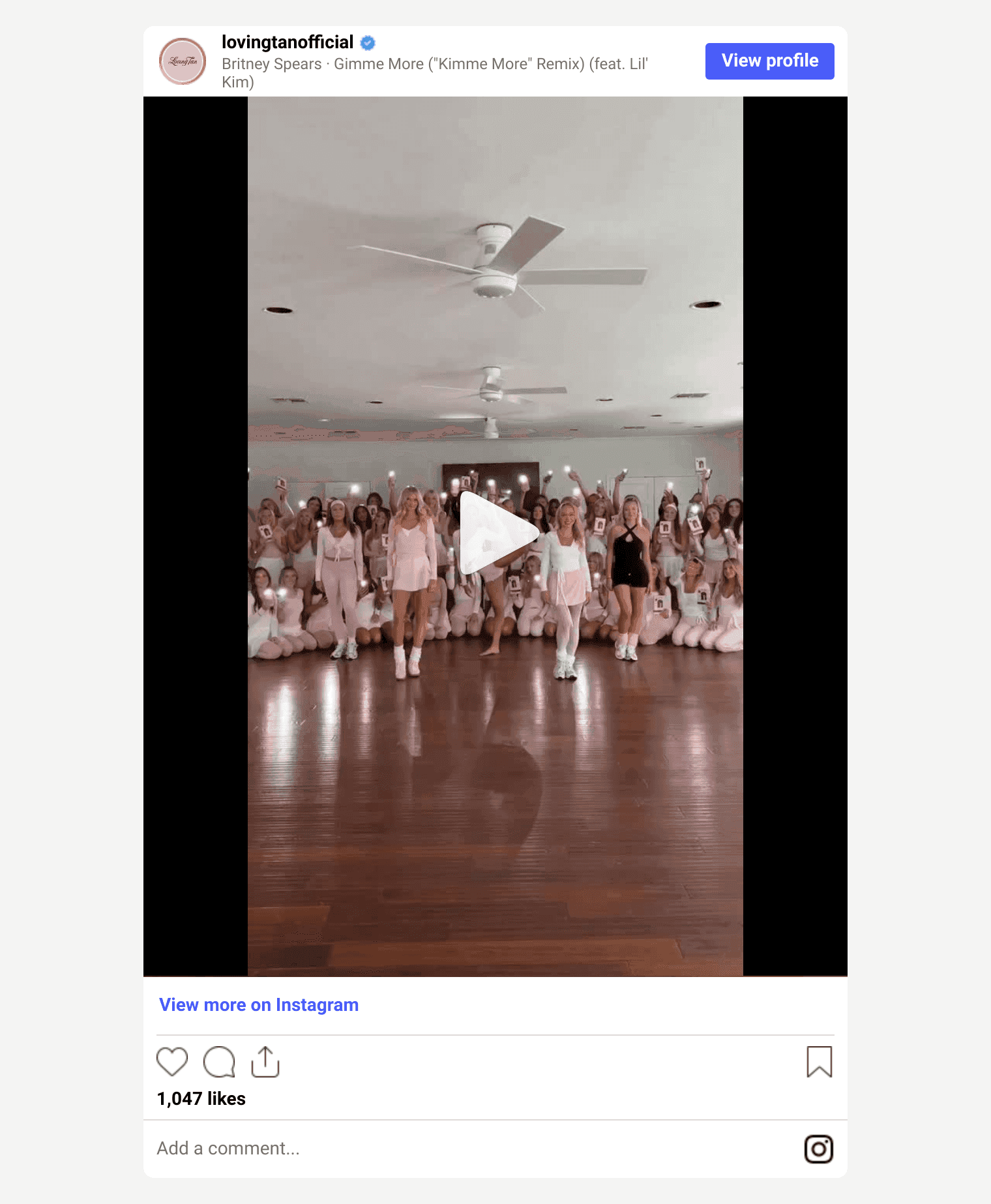
Loving Tan’s rush reel, August 2026. View on Instagram
Lash brand FlutterHabit went the other way and built a standing program around chapters, BeautyMatter reported. The Flutter Campus Club works with sorority chapters and student groups, including Alpha Delta Pi at the College of Charleston and Kappa Delta at Texas Christian University. It sends products and resources so members can host their own events and make their own content. Members earn through commission and referral codes, and there is no follower minimum. For a first seeding list, copy the no-minimum rule.

Flutter Habit’s campus club program. View on Instagram
Where should a smaller brand start?
Most of what these brands did scales down, and you don't need a Tarte or Innisfree budget to borrow it. Start in this order.
Step 1: Pick one campus. The schools Tarte shipped to in 2022, including Alabama, Ole Miss, Georgia and Texas, make a useful shortlist. Alabama leads that list: #BamaRush alone had nearly twice the views of #RushTok by 2023. If your products already sell at Ulta Beauty or Walmart, borrow Bali Body's filter, starting with a campus near your strongest stores and then weighing chapter size and social engagement.
Step 2: Seed individual students before chapters. Sponsoring a chapter the way Poppi and CeraVe did costs more and comes with school and chapter rules to check. Sending product to a few students who already post on RushTok is a smaller first step, and those students are exactly the campus micro influencers Lindquist described. Pick rushees who will film their rush looks, members who post during recruitment, or both. Screen them by location, follower count and fit, the same three filters the Innisfree campaign on Intern Queen's site uses. Treat follower count as a read on reach, not a cutoff; FlutterHabit's Campus Club sets no follower minimum. For list size, see BAZZAAL's post on how many creators a US seeding campaign needs.
Later, once a first round of student posts gives you something to show a chapter, start with the member who handles partnerships. At Alpha Chi Omega at San Diego State, that is Naomi Green, the chapter's vice president of public relations and marketing. She told Forbes the chapter had 15 brand partnerships and counting in 2026, and that she turns down brands that don't fit her members. Her test is "would I genuinely use this product if I weren't being paid or receiving anything in return?"
Step 3: Finish planning by spring and land product in July. BeautyMatter describes spring as the window when brands build ambassador networks and lock in fall activations. Tarte had messaged sororities by July 19, 2022, and had product delivered by July 25. Videos peak during rush in August, so July is the delivery month.
Step 4: Ask for usage rights separately. To run a creator's video as an ad, request usage rights from the creator as a separate step. BAZZAAL's post on what usage rights cost covers how to ask and what it costs.
How do skincare and color brands approach this differently?
Once the campus and the students are set, what goes in the box depends on whether you sell color or skincare. The cases in this post split the same way. Tarte's 2022 box was color, a mascara and a tinted lip balm. Glow Recipe's 2026 offer was a two-product skincare duo, and CeraVe built its campus project around one mineral sunscreen.
For color brands that sell base makeup, the risk is a video that shows the wrong shade or a base that oxidizes on camera. In BAZZAAL's Ulta analysis, K-beauty cushions drew oxidation complaints in reviews about four times as often as established-brand foundations. Put a shade-matching card in the box and ask creators to show the product on skin in daylight.
For skincare, a small set built around one result, like Glow Recipe's glass skin duo, lets one video show the whole routine. Either way, pack the box so a creator can film the unboxing and the first use in a single take.
What rules apply when you send product?
Whatever goes in the box should carry one more thing. The FTC treats free product as a material connection that should be disclosed clearly in the post. Even with no posting requirement, as in Tarte's case, put a disclosure request in the note that goes in the box.
Sending to individuals is the simple case. Chapter sponsorships and event partnerships may fall under school, chapter and Panhellenic rules, and those differ by campus. Contact the school's fraternity and sorority life office before you commit.
Some Panhellenic associations also take sponsors directly. Before 2026 recruitment, Alabama Panhellenic introduced its feature sponsors on Instagram, and several were local beauty businesses, from a med spa to salons and a beauty lounge. Panhellenic sponsorship is not reserved for national brands. Unlike seeding individual students, though, it has to clear school rules first.
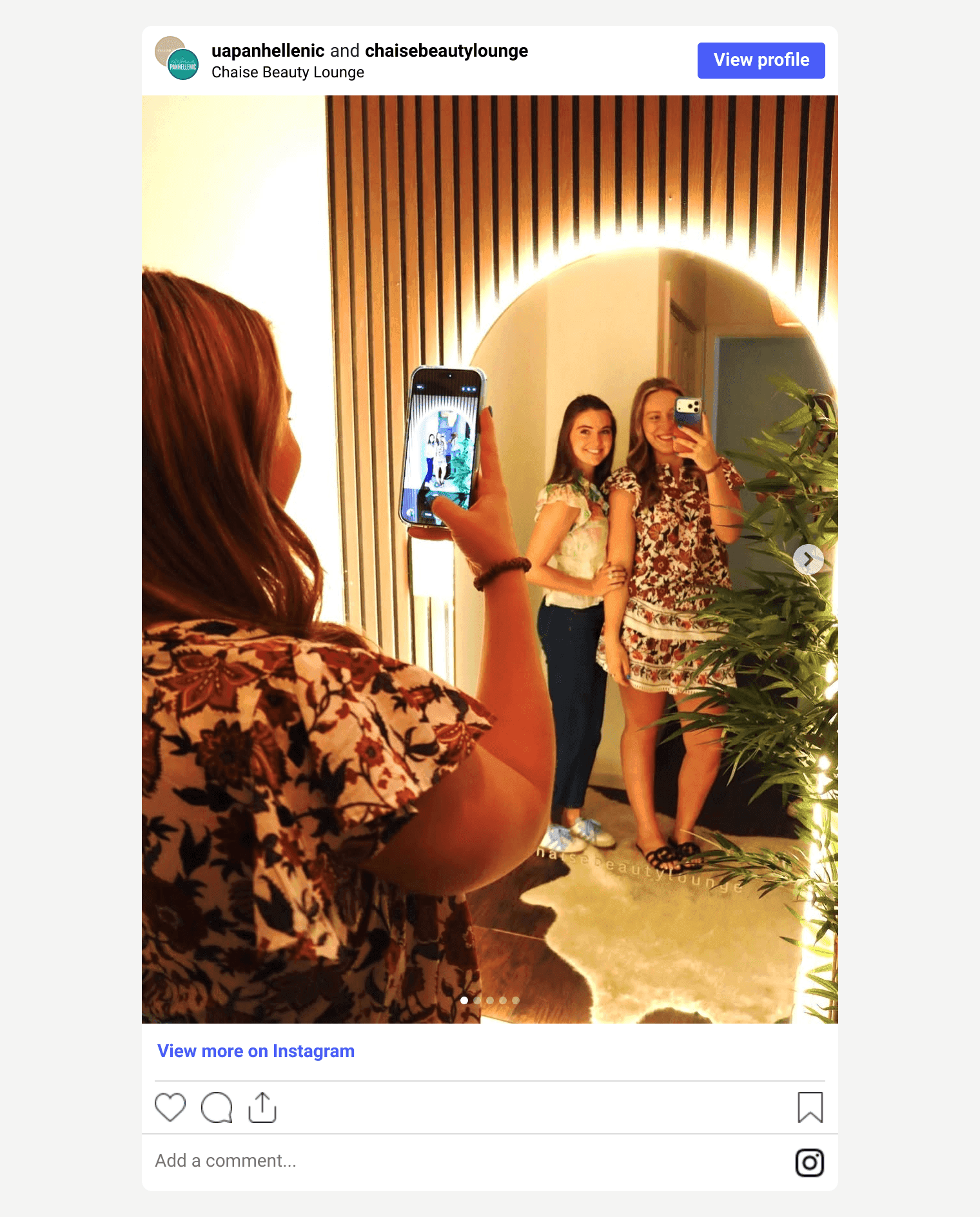
Alabama Panhellenic introduces a local beauty sponsor. View on Instagram
FAQ
Can we send product to a sorority as a group?
It depends on school, chapter and Panhellenic rules, which differ by campus. Check with the school's fraternity and sorority life office first.
When should we reach out to RushTok creators?
Early enough that product arrives by the end of July. At Alabama in 2026, early move-in for PNMs began August 6.
Can a K-beauty brand do this?
Yes. In 2026 a UT Austin sorority thanked Innisfree US for "teeing up" with its rush party, and Intern Queen's website lists a paid Innisfree campaign for student creators.
Should we require posts?
Not necessarily. Tarte in 2022 and Poppi and Bali Body in 2026 set no posting requirement. Glow Recipe asked selected chapters to feature its products in recruitment content. Disclosure applies either way.
When should you start planning for next year's rush?
This winter. Choose the school now, build the creator list in spring, and land product with students by the end of July.
For the seeding itself, BAZZAAL runs US campaigns from LA with a network of 100,000+ creators. Creators apply, BAZZAAL screens them, the brand approves the list, and product ships only to those who confirm they want it. The seeding is gifted, and most participants are nano creators. If campus seeding is on your list, BAZZAAL can help you choose the school.
Related reading: How Many Creators for a US Seeding Campaign? · What Does It Cost to Pay a Creator for Usage Rights?
Sources. The Tuscaloosa News, The truth about the viral #BamaRush phenomenon, 2026-08-17; Alabama Panhellenic Association, Instagram posts (@uapanhellenic), 2026-07-18 to 2026-08-18; YouGov, Americans are divided on the impact of college fraternities and sororities, 2023-08-30; Business Insider, Sorority Influencers Are Building Careers Off the Back of Rush Season, 2023-09; Glossy, To get in on #RushTok, Tarte sent products to 30,000 sorority hopefuls, 2022-08-23; WWD, Why Beauty and Wellness Brands Are Going Back to School, 2025-11; Texas Alpha Delta Pi, Instagram and TikTok post "It's a PAR-TEE at 2620 Rio Grande," 2026-08-13 (instagram.com/reel/Db_-2uZpYyo); FTC, Influencers, are your #materialconnection disclosures #clearandconspicuous; Glow Recipe, Instagram post, 2026-07-18 (instagram.com/p/Da8fkhpkVD9); Forbes, Brands Are Capitalizing On Sorority Recruitment To Connect With Gen Z (And Beyond), 2026-09-08; BeautyMatter, Rush Week Is the New Runway: Why Beauty Brands Are Betting Big on Sororities, 2026-05-17; BeautyMatter, Back-to-School Beauty: The Brands on Campus, 2026-09-10; Intern Queen, innisfree campaign page (internqueen.com/campaign/innisfree); innisfree USA, Instagram posts (@innisfreeusa), 2026-07-14 and 2026-08-27; Glossy, Your favorite beauty brands are now also entertainment brands, 2026-08-05; Loving Tan, Instagram reel, 2026-08-17 (instagram.com/reel/DcJ5nLsT9L4).
Cover photo: Olivia Walsh, "Ole Miss ADPi Bid Day 2023," Wikimedia Commons, CC BY-SA 4.0 (cropped). Original · License
Written by
Yong Suk Choi
Chief Business Officer
Chief Business Officer at BAZZAAL. 15+ years of zero-to-one go-to-market execution across Korean and US markets, now leading growth for K-beauty brands entering the US from Los Angeles and Seoul.
Connect on LinkedIn
Planning your US launch?
BAZZAAL runs creator seeding, TikTok Shop, and paid campaigns for K-beauty brands entering the US — from Los Angeles, in Korean-company workflows.
Subscribe to STATESIDE
Weekly US K-beauty intelligence, from our team on the ground in LA.


