AI Can Clone Anything Now. Which Relationships Should K-Beauty Brands Invest In?

By
Yong Suk Choi

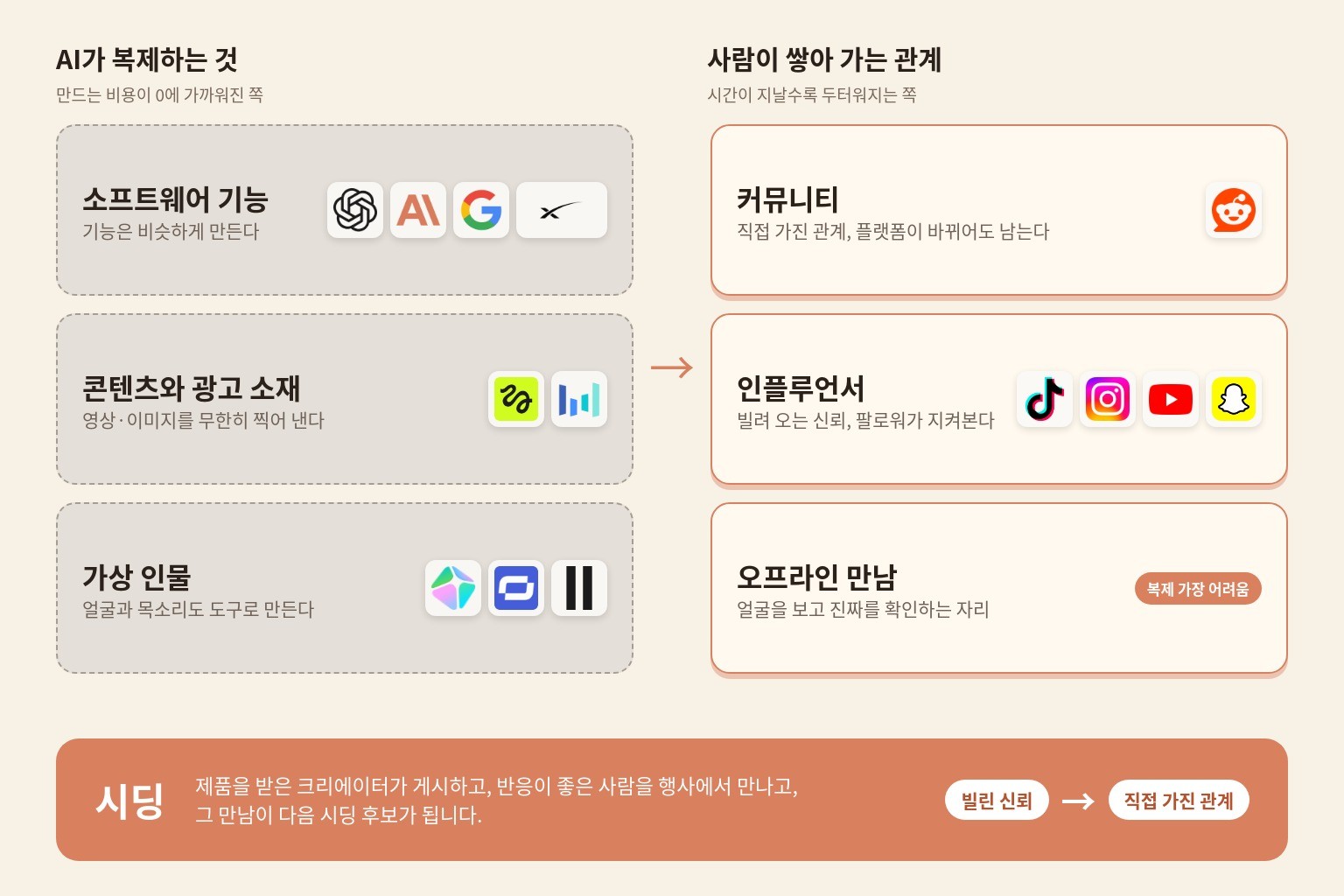
When AI can make software and content almost for free, the asset that lasts is the people who trust you and keep coming back. For K-beauty brands, that means creators who try the product and talk about it, a community that loves the brand, and face-to-face meetups. The catch is that AI can now imitate those relationships too. So building relationships matters less than being able to tell which ones are real.
BAZZAAL has worked mainly on creator seeding campaigns for K-beauty brands in LA, and now plans to widen its services as the market shifts. This article explains the thinking behind that move. It starts with how AI is reshaping industries, walks through how to tell real relationships from fake ones, and ends with why BAZZAAL is moving toward consulting that includes execution.
Why are subscriptions fading while advertising comes back?
A few years ago, ad revenue was the unpopular choice in startups. SaaS, with its monthly subscription income, was the ideal model, and many companies built their business around that formula. Now the formula is running in reverse.
Daangn (Karrot) is a good example. For years it was undervalued because advertising was its only revenue source, despite its huge user base.
Then Daangn posted consolidated 2025 revenue of KRW 270.7 billion, up 43% from the year before. At the parent company Daangn Market alone, operating profit rose 78% to KRW 67.1 billion. Advertising drove the growth, with advertisers up 37% and ads served up 29%.
Netflix, the symbol of the subscription economy, is now turning toward ads. As of May 2026, the ad tier has more than 250 million monthly viewers. Part of that comes from a change in how households sharing an account are counted, but it is still far from the 94 million a year earlier.
Ad revenue passed $1.5 billion in 2025, 2.5 times the previous year, and is expected to double again to about $3 billion in 2026. It is still around 6% of total revenue, but advertising is Netflix's fastest-growing income stream.
OpenAI, which earned money from ChatGPT subscriptions, has entered advertising too. In March 2026 it hired a former Meta executive who had handled global advertisers and agencies as its head of advertising. On August 31 it said the ChatGPT ads it launched in the US in February passed an annualized $1 billion in revenue in under 200 days.
Platforms where people gather are sweeping up ad revenue, while the subscription software industry has even picked up a name for its decline, SaaSpocalypse. Money is flowing to where people gather, not to features. That is why beauty brands put budget into creators and communities.
Why is a software subscription no longer a shield?
Because AI has sharply cut the cost of building software. Making a large program like Photoshop or Premiere used to take thousands of developers several years. Users had no alternative, so they had to pay the monthly fee.
In October 2026, PetaPixel reported that one developer used Claude to build equivalents of seven Adobe apps, including Photoshop, Lightroom and Premiere, and released them as free open source. The project is called ArtCraft. It is still early, not ready for real work, and tangled in copyright disputes. But AI improves every few months, so the day it becomes usable comes sooner.
Stock prices already reflect this. B2B SaaS that charged per employee account was hit first. When companies cut staff with AI, the number of accounts they need falls with it.
Salesforce shares fell 40.9% in the first half of 2026. Workday was 39% below its start-of-year level as of February 24, and Adobe fell more than 70% from its February 2024 high to its June 2026 low.
Figma is more dramatic. It listed in 2025 at $33 and once traded above $140, but fell to $16.60 in April 2026, about 88% below its peak.
Its results were actually good. First-quarter 2026 revenue was $333 million, up 46% from a year earlier. The market worried about what comes next: if AI can replace the design tool itself, can Figma still charge for it?
Companies that sold information and features were shaken more. Chegg sold homework help and study material by subscription. It booked $766.9 million in revenue in 2022, the year ChatGPT appeared, and $376.9 million in 2025, roughly half. Its shares fell more than 99% from the February 2021 peak. Once ChatGPT gave similar answers for free, a subscription that sold answers had little room left.
Are there companies AI has re-rated upward?
Yes, and SK hynix is the clearest. It was long seen as a memory maker whose earnings swung with the cycle. In the early 2000s it nearly sold to Micron under a heavy debt load, and in 2023 it still posted an operating loss of KRW 7.73 trillion.
Through that downturn, SK hynix kept building HBM, the high-performance memory used in AI servers. Its HBM shipment share reached 62% in the second quarter of 2025, ranking first. Operating profit in 2025 was KRW 47.2 trillion, double the previous year, and on May 27, 2026 its market capitalization topped $1 trillion for the first time.
What changed SK hynix was holding something AI cannot make for itself. However good AI gets, someone still has to build the memory that runs it in a factory. The principle that money flows to what is hard to copy applies to relationships between people as well.
Why has taking other people's work become so casual?
The mood is more troubling than the technology. As copying gets easier, guilt about borrowing other people's work fades with it.
In March 2026, an indie game developer posted a prototype of Tetris where the whole board rotates. Within days AI-made copies appeared, and one of their makers told 404 Media he built his in a day with a few prompts.
On Roblox this has become almost a formula. The co-op climbing game PEAK took off on Steam. Then a copy called CLIFF appeared on Roblox and passed 6 million visits in two weeks, about the scale of PEAK's estimated sales.
Short-form video is no different. Re-shooting a popular video almost shot for shot is now common.
The same happens with writing on social media. When a carefully written post spreads, plenty of accounts repost it whole with only [repost] on top, add a line or two of their own underneath, and collect the views.
As tools improve, taking others' work gets easier and the sense that it is wrong dulls. That numbness is spreading across whole industries.
Do agencies and outsourced service firms face the same pressure?
They do. The pressure does not stop at SaaS. Outsourced development shops, ad agencies, marketing firms, and design and content studios, all of which sell people's time, face the same question.
WPP, one of the world's largest ad groups, saw its shares fall about 60% in 2025. In the first half of 2026 its net revenue fell 5.6% and average headcount dropped from 106,000 to 97,000. Omnicom plans to cut about 4,000 jobs as it completes the IPG acquisition, with a target of $1 billion in annual labor savings by 2028.
Platforms want ad production itself, too. In June 2025 the Wall Street Journal reported that Meta plans tools to hand the entire ad-making process to AI by the end of 2026. An advertiser enters a product photo and a budget, and AI decides images, video, copy and targeting.
Mid-sized outsourced firms will struggle first. Even the survivors are likely to make running with a minimum headcount, using AI, the standard.
This change is not unfamiliar to BAZZAAL, which has mainly run K-beauty creator campaigns. AI is quickly taking over much of campaign operations, such as writing briefs, listing creators and compiling performance reports. So rather than wait and watch, BAZZAAL plans to widen its services ahead of where the market is heading.
What do services that still hold up have in common?
A service that only offers features is dropped as soon as a better alternative appears. AI models are a good example. When a new model among GPT, Claude and Gemini does the job better, users switch without hesitation. Services where users are tied to one another are different.
The clearest case is PC game platforms. The Epic Games Store gave away 662 million free games in 2025 and passed 317 million users. Yet Steam broke its concurrent-user record several times in 2026 and topped 42.3 million in March.
Microsoft's EU disclosure puts its PC game store at about 3 million average monthly users. A clean interface and free perks did not shake Steam, because years of accumulated game libraries, friend lists and community do not move to another store.
Korean online communities work the same way. DC Inside, FM Korea and TheQoo do not hold users with flashy new features. Building a more polished alternative with AI is easy. Carrying over the posts, speech habits and familiar nicknames built up there is impossible.
Overseas, Reddit plays that role. Its weekly active users reached 514.6 million in the second quarter of 2026, up 24% from a year earlier, and revenue was $805 million, up 61%. Subreddits such as r/AsianBeauty and r/KoreanBeauty are led by users, not by brands.
Beauty is no exception. In a 2026 Reddit survey of 1,000 US adult consumers, 7 in 10 beauty shoppers said they feel more confident about a purchase after reading about it on Reddit. It is Reddit's own survey and should be read that way. Still, for a category that sells on reviews and recommendations, it shows that conversations built among users already feed purchase decisions.
KakaoTalk is the most obvious case. A major overhaul on September 23, 2025 turned the friends tab into a feed and drew heavy backlash, and in December Kakao restored the friends list as the first screen. Yet monthly users in October, just after the change, were 47.97 million, only 0.4% below August.
Why users stay despite complaints is simple. Family, friends and coworkers are all in there, and if you move to another messenger alone, you have no one to talk to.
Creators do not rely on content alone either. Chimchakman, with 3.29 million subscribers, runs a viewer community alongside the channel, and Syuka World, with 3.73 million, has its own community service called Wepoll.
BoGyeom TV is more dramatic. According to Newsis, the channel had 3.22 million subscribers in September 2023, and passed 10 million a year after he showed his face and resumed activity. The channel built direct touchpoints with fans through events that took viewers' stories and gave out gifts.
AI can copy a video format and script exactly, but it cannot copy the way viewers talk to each other or the memories built with fans. In an age when technology and labor become free, the ability to gather people who are on your side is the strongest shield.
If relationships can be made by AI, what should you trust?
One more thing has changed. Relationships can now be manufactured too.
Adam Mosseri, head of Instagram, wrote in a Threads post on December 31, 2025 that authenticity is becoming infinitely reproducible. The real face and the hard-to-imitate voice that once made a creator special can now be produced by anyone with the right tools.

Adam Mosseri’s Threads post, December 31, 2025. View on Threads
He expects people to doubt what they see first and to ask who posted it and why, rather than what was said. BAZZAAL covers how Mosseri explained Instagram's ranking in a separate post, How the Instagram Algorithm Works in 2026: Mosseri's 4 Videos.
The numbers point the same way. Security firm Imperva counted more than 53% of global web traffic in 2025 as bot-generated rather than human. In Influencer Marketing Hub's 2026 survey, 56.5% of the influencer fraud and quality problems marketers hit came from fake or bot followers.
Even real creators' faces are not exempt. In January 2026, TikTok star Khaby Lame signed a deal worth $975 million that includes the right to build an AI avatar of his face and voice. Whether the person on screen is really that person has become information that now needs checking separately.
Consumers are already reacting. In a survey by creator marketing agency Billion Dollar Boy, the share of consumers who welcomed AI-made creator content fell from 60% in 2023 to 26% in 2025.
In the same survey, 79% of marketers raised their AI creator content budget over the past year. The people making it and the people watching it are moving in opposite directions. How far US consumers accept AI ads is covered separately in Do Consumers Trust AI Ads? 2026 Data Says Trust Is Moving to Real Creators.
The formula that whoever builds more relationships wins has not changed. From here on, though, the winner is whoever can show that the relationship is real.
What do Korean, US and EU rules require?
Regulation is starting to ask the same question. The timeline of rules that arrived in under a year shows the direction.
December 22, 2025: The US FTC sent its first warning letters to 10 companies under its rule banning fake reviews and endorsements.
January 22, 2026: Korea's AI Basic Act took effect, requiring labels on generative AI output.
June 1, 2026: Korea's Fair Trade Commission revised its endorsement and testimonial review guidelines to require labels on ads featuring AI virtual people.
June 9, 2026: A New York State law took effect requiring disclosure in ads that feature AI-generated virtual models.
August 2, 2026: The transparency obligations in Article 50 of the EU AI Act began to apply.
Korean marketers should look first at the Fair Trade Commission guideline. For a blog or cafe post, a phrase such as "includes virtual person" must go in the title or opening. For video, mark "virtual person" close to the screen for as long as the virtual person appears.
Even with the label, reviewing as if you had actually used the product can make an ad deceptive. For categories like beauty, which sell on reviews and recommendations, this is the part to check first.
Expressions differ by country, but the rules ask one thing: did the ad lead consumers to believe it was a real person's experience.
Where are real relationships told apart?
Mosseri offers two answers. One is that marking what is real is more practical than hunting down every fake. Having the camera leave a digital signature on a photo at the moment it is taken is one example. The other is that platforms should show much more context about the accounts sharing a piece of content, alongside the content itself.
What a brand looks at when choosing creators is also account context. BAZZAAL uses follower count only as a lower bound, and above that compares engagement, reaction to recent content, face exposure and shooting quality. To judge whether a creator is real, it checks whether face and voice are consistent across posts, whether the comments are genuine, and whether the creator has covered the category steadily. The full criteria are in How to Choose Creators for a US Seeding Campaign.
BAZZAAL's seeding is unpaid: it sends product only, and most participants are nano creators. Creators apply first, BAZZAAL screens them, and the brand approves the candidate list directly. Product goes only to creators who have confirmed they want to receive it.
Whether a creator's interest was genuine shows in whether the post actually goes up. BAZZAAL counted its past campaigns and uses a conservative posting rate of about 70%. It is a planning baseline, not a guaranteed number.
The operating principles are three. The casting team screens separately before and after casting. Accounts with past problems go on a blacklist that is managed continuously, and performance reviews happen twice a month.
None of this is a new method. The difference comes from repetition. Running the same process campaign after campaign gives a feel for the step where fakes get filtered out and for which accounts take the product and disappear. A team that watches creator reactions in LA in real time and understands both Korean brands and the US market sharpens that feel.
How do community, influencers and offline meetups connect?
Relationship assets are not one lump. Influencers are borrowed trust. They reach people quickly but depend on algorithms and platforms.
A community is a relationship you own. It builds slowly, but it stays when platforms change. Offline meetups are where the other two get verified, and of the three they are the hardest for AI to imitate.
In event company Freeman's 2024 attendee survey, 80% of respondents named in-person events as the most trusted source of information, up from 75% in 2023. In the same survey, social media influencers ranked on the low-trust side. Online recommendations alone do not carry trust all the way, and a place to confirm it face to face is needed separately.
The beauty industry is already moving. In August 2026 Olive Young held its first US festa with KCON LA, drawing 100,000 people over three days with 55 brands taking part. In March, Sephora brought its experiential beauty festival SEPHORiA back to LA for the first time since 2019. It also builds a Sephora Squad of creators every year, regardless of follower count.
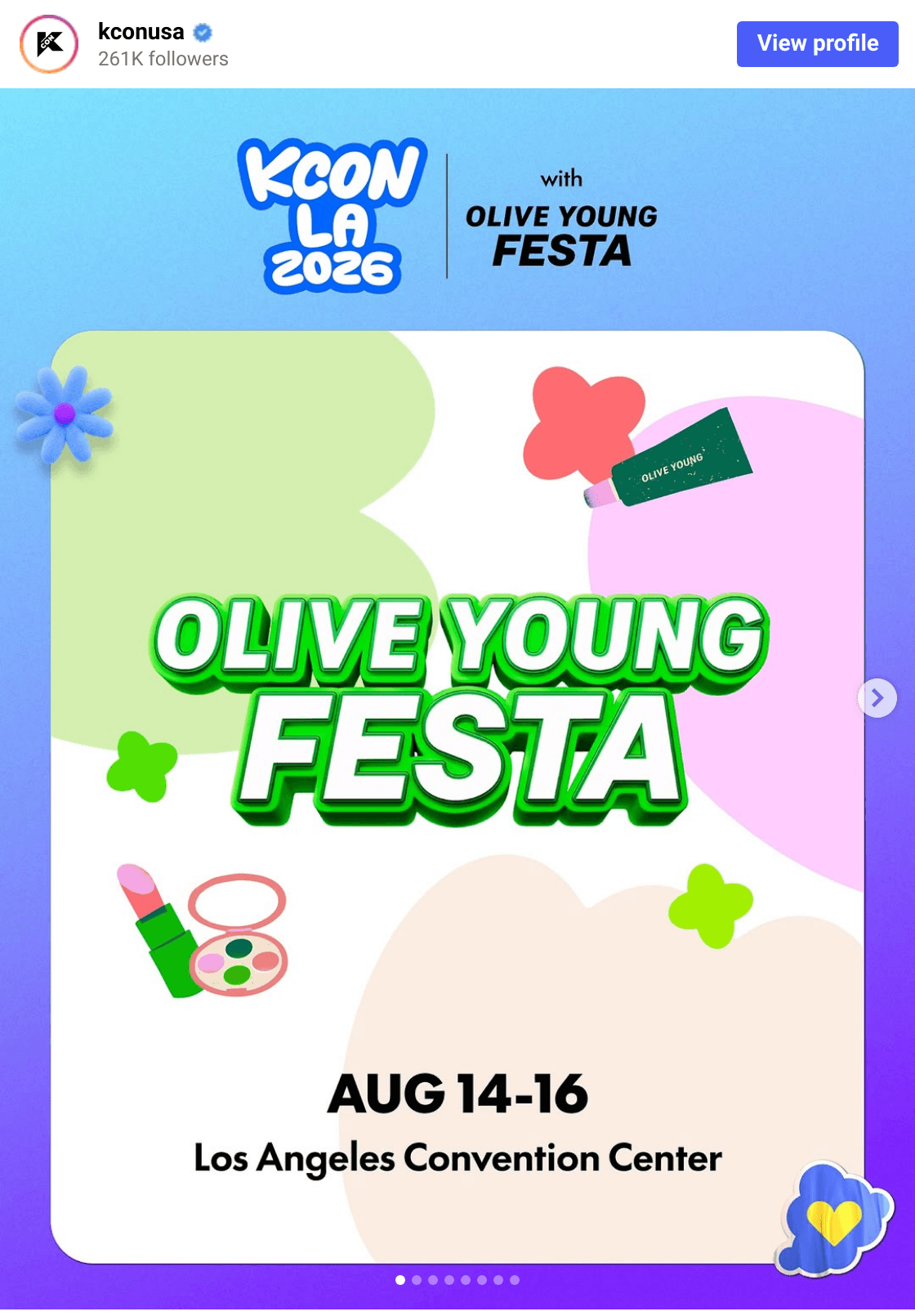
KCON USA announces OLIVE YOUNG FESTA at KCON LA 2026. View on Instagram
Seeding is the starting point that links these three. A creator who receives product posts, you meet the ones who responded well at an event, and the people you get to know there become candidates for the next seeding. It is a path from borrowed trust to relationships you own.
So what kind of service does BAZZAAL want to build?
Brands are moving to run creator marketing themselves. In Influencer Marketing Hub's 2026 survey, 66.33% of companies said they run influencer marketing entirely in-house, and only 10.71% leave it entirely to agencies.
The pressure on agencies and brands going in-house are the same trend. AI and in-house teams can supply the labor. Judgment remains: which creator is real, how to turn one seeding into the next relationship, and how to bring someone met at an event into the next campaign.
BAZZAAL plans to widen its services using the know-how it has built running seeding and other campaigns directly. It is consulting that carries a proposed direction through to execution. The criteria for picking out real creators and the process it has used to run campaigns are the base.
Frequently asked questions
Are you saying not to use AI?
No. BAZZAAL uses AI for work behind the camera, such as briefs, translation and editing. The aim is to put real people in the places consumers take as real experience: faces, skin and voices.
Does seeding still matter in the AI era?
Yes. AI can make product photos and review sentences, but it cannot make the experience of someone who actually used the product. Seeding puts the product in a real user's hands and checks whether the reaction turns into a post.
Where should a small brand start with community?
Start by inviting back the creators who responded to seeding. It does not need to be a big event at first. Meeting a handful of creators who posted in person is the first step.
Sources: Daangn, 2025 annual results (March 27, 2026). Netflix, Q4 2025 and Q2 2026 shareholder letters, 2026 Upfront (May 2026). MediaPost and Digiday, ChatGPT ads $1 billion annualized revenue (August 31, 2026). MediaPost, OpenAI hires head of ads (March 23, 2026). PetaPixel, ArtCraft (October 7, 2026). The Motley Fool and S&P Global Market Intelligence, Salesforce first-half share price (July 10, 2026). CNBC, Workday Q4 results (February 24, 2026) and Adobe shares (August 5, 2026). Chegg, 2022 annual report (SEC 10-K) and Q4 2025 results. 404 Media, "AI Made Cloning Games Easier Than Ever" (March 2026). Windows Central, Roblox copy (August 8, 2025). Bloomberg, ad group shares (December 14, 2025). WPP, 2026 half-year results. Axios, Omnicom job cuts (December 2, 2025). MM+M, Omnicom cost-cutting target. Investing.com, Meta ad automation plan (citing WSJ, June 2025). Epic Games Store, 2025 Year in Review. PCGamesN, Steam concurrent-user record (March 2026). Microsoft, EU Digital Services Act average monthly users (six months to June 30, 2026). Yonhap News, KakaoTalk users after the overhaul (November 18, 2025). JTBC, KakaoTalk friends tab restored (December 16, 2025). YouTube channel pages (as of October 17, 2026). TIKR and Investing.com, Figma shares (April to July 2026). TradingKey, Figma Q1 2026 results. Reuters, SK hynix $1 trillion market cap (May 27, 2026). SK hynix Newsroom, 2023 and 2025 business results. Yonhap News, Counterpoint Research HBM share (September 24, 2025). FX Empire, SK hynix failed sale history. Adam Mosseri, Threads post (December 31, 2025). Newsis, BoGyeom TV passes 10 million subscribers (October 30, 2024). Imperva, 2026 Bad Bot Report. Influencer Marketing Hub, Influencer Marketing Benchmark Report 2026. Fortune, Khaby Lame deal (January 29, 2026). Billion Dollar Boy, Muse survey (October 8, 2025). Arnold & Porter, FTC warning letters (January 2026). Korea Fair Trade Commission, revised endorsement and testimonial review guidelines press release (June 1, 2026). Framework Act on the Development of Artificial Intelligence and Establishment of Trust, Article 31. Cooley, New York synthetic performer disclosure law. European Commission, code of practice on AI-generated content transparency. Freeman, 2024 Attendee Intent and Behavior. CJ Olive Young Newsroom, OLIVE YOUNG FESTA LA 2026. BeautyMatter, SEPHORiA 2026. Sephora Squad official site. Reddit, Reddit Reports Second Quarter 2026 Results. Reddit, The People’s Beauty Index (Reddit Path to Purchase 2026 Survey). Adam Mosseri, Threads post (December 31, 2025). KCON USA, OLIVE YOUNG FESTA official Instagram post.
Creator selection criteria, the seeding sequence and the posting rate reflect BAZZAAL's internal operating standards and counts.
Related: How the Instagram Algorithm Works in 2026: Mosseri's 4 Videos · Do Consumers Trust AI Ads? 2026 Data Says Trust Is Moving to Real Creators · How Many Creators for a US Seeding Campaign? · How to Choose Creators for a US Seeding Campaign
Written by
Yong Suk Choi
Chief Business Officer
Chief Business Officer at BAZZAAL. 15+ years of zero-to-one go-to-market execution across Korean and US markets, now leading growth for K-beauty brands entering the US from Los Angeles and Seoul.
Connect on LinkedIn
Planning your US launch?
BAZZAAL runs creator seeding, TikTok Shop, and paid campaigns for K-beauty brands entering the US — from Los Angeles, in Korean-company workflows.
Subscribe to STATESIDE
Weekly US K-beauty intelligence, from our team on the ground in LA.


