How Big Is K-Beauty on TikTok Shop? The US Data, Explained

By
Yong Suk Choi

If you lead marketing for a K-beauty brand, your competitors are posting numbers on TikTok Shop that would have sounded invented two years ago. The question is no longer whether K-beauty works in the US. The data has settled that. The question is whether your brand captures the demand — or watches someone else do it.
This post tracks the key numbers behind K-beauty's TikTok Shop run and what they mean for a US launch. Figures reflect the most recent full quarter and are updated as new data lands.
How big is K-beauty on TikTok Shop right now?
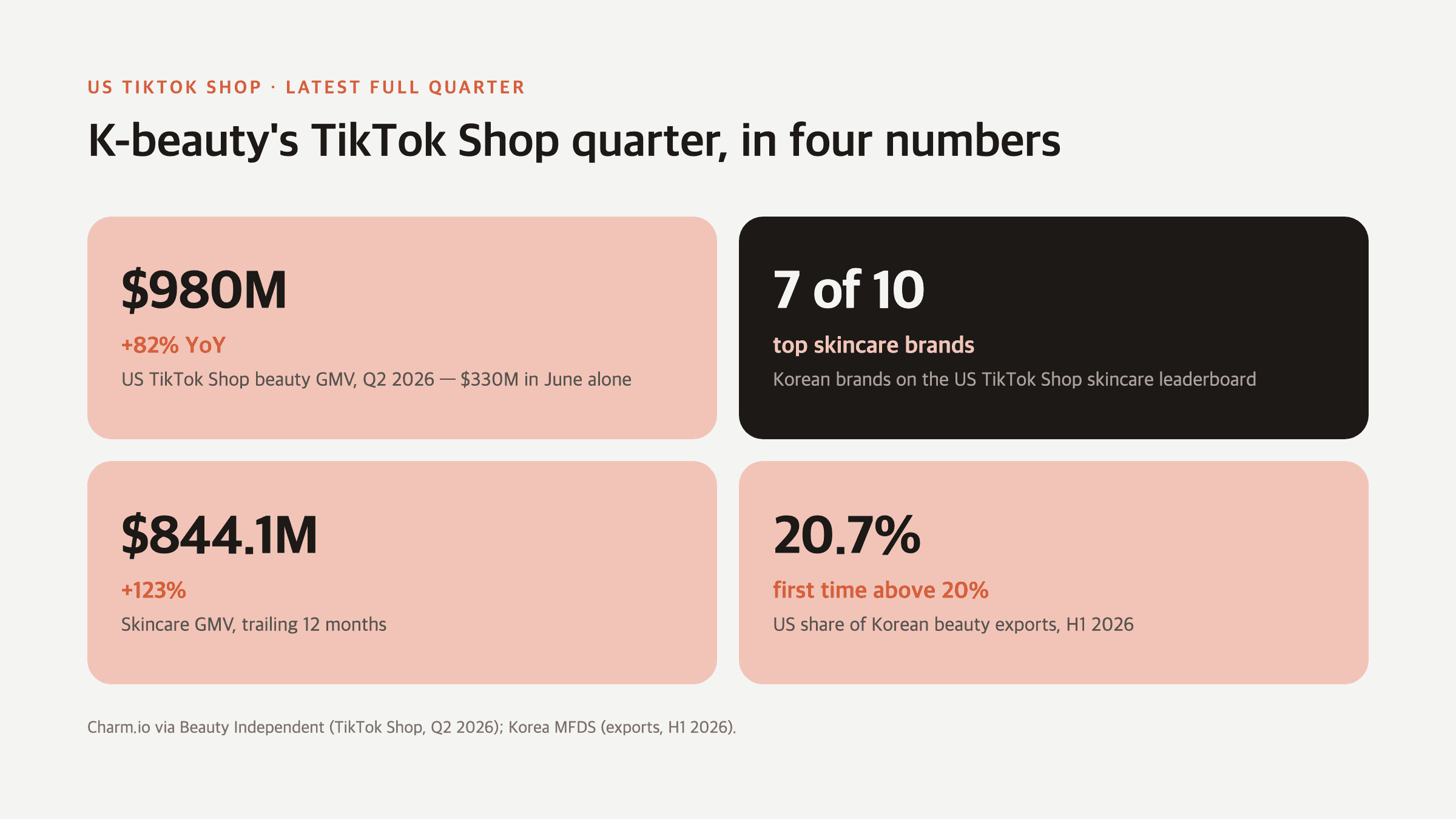
TikTok Shop figures: Charm.io, reported by Beauty Independent. US K-beauty sales and 28.7% household penetration: NIQ, cited by CNBC in July 2026. Export figures: Korea MFDS, H1 2026.
medicube led the category with $62.8 million in Q2 sales; Dr.Melaxin followed at $38.8 million. During Amazon Prime Day, medicube was the most-searched beauty term, per Market Defense's search report.
Seven of the top ten are Korean
This is not a platform quirk. Zoom out and every dataset points the same direction: US TikTok Shop beauty is growing fast, and Korean brands hold most of the skincare leaderboard. When a single origin country takes seven of ten top spots in the largest social commerce market, that is not a trend — it is a structural position.
Why K-beauty wins on TikTok Shop
K-beauty's US growth is not being bought with ad budgets. It runs on a creator-led loop: shoppers discover a product in creator content, then buy it inside the same feed through affiliate links. The brands at the top of the leaderboard got there on the volume and consistency of creator content — hundreds of creators posting every week — not on a handful of polished campaigns. We unpack that operating model in How K-Beauty Wins in the US: Creator Systems, Not Viral Luck.
What the data means for your US launch
1. Category proof is done. The window is now. You no longer need to convince American consumers — or retail buyers — that K-beauty is real. That work is finished. What is not finished is the race for feed space and shelf space, and both fill fast.
2. Affiliate infrastructure beats ad budget. The winners run always-on creator affiliate programs, not one-off campaign bursts. Commission structure, creator recruiting, and content velocity are the levers that compound.
3. A crowded leaderboard makes creator fit the differentiator. When seven of the top ten brands share your origin story, the story alone stops differentiating. Which creators carry your product — and how natively they tell it — decides who breaks out.
4. TikTok Shop data is your retail pitch. Sales velocity on TikTok Shop has become the evidence US retail buyers ask for. The brands landing Amazon, Ulta, and CVS conversations are walking in with social commerce numbers.
If you are ready to move, the setup mechanics — shop registration, affiliate commissions, creator recruiting — are covered step by step in How to Sell K-Beauty on TikTok Shop in the US.
Frequently asked questions
Is TikTok Shop worth it for K-beauty brands entering the US?
The category data says yes: beauty GMV grew 82% year over year, and skincare — K-beauty's core — grew 123% over the trailing twelve months. The caveat is that the leaderboard is already crowded with Korean brands, so entering late without a creator program means competing against compounding affiliate machines.
Which K-beauty brands sell most on TikTok Shop?
In the most recent full quarter, medicube led US TikTok Shop skincare at $62.8M, followed by Dr.Melaxin at $38.8M. Seven of the top ten skincare brands were Korean.
Do I need creators to sell on TikTok Shop?
In practice, yes. The dominant purchase path is creator content with affiliate links — not brand ads. Brands that treat TikTok Shop as a listing exercise rather than a creator operation rarely reach the leaderboard.
Where BAZZAAL sits in this
We watch this market from Los Angeles, in real time. What works on US feeds changes weekly, and we build it into campaigns at that speed — something a Seoul-based agency structurally cannot do. At the same time, we are built to work with Korean brands: Korean-language briefs in, US-native execution out, reporting in the format your HQ expects. BAZZAAL started in Seoul in 2019 and has operated in LA since 2022, with a network of 100,000+ US creators.
The numbers above are market data. Ours look like this: 313 creators posted in a single SKIN1004 seeding campaign; a CLIO campaign cleared 820,000 views. That is what creator-led growth looks like when it is run from inside the market.
Planning a US launch — or fixing one that stalled? Contact Sales at info@bazzaal.com, or explore our case studies.
Images in this post are AI-generated.
Related: the H1 2026 US numbers · the system behind US growth · running Amazon and TikTok Shop together
Written by
Yong Suk Choi
Chief Business Officer
Chief Business Officer at BAZZAAL. 15+ years of zero-to-one go-to-market execution across Korean and US markets, now leading growth for K-beauty brands entering the US from Los Angeles and Seoul.
Connect on LinkedIn
Planning your US launch?
BAZZAAL runs creator seeding, TikTok Shop, and paid campaigns for K-beauty brands entering the US — from Los Angeles, in Korean-company workflows.
Subscribe to STATESIDE
Weekly US K-beauty intelligence, from our team on the ground in LA.


